

 iscover
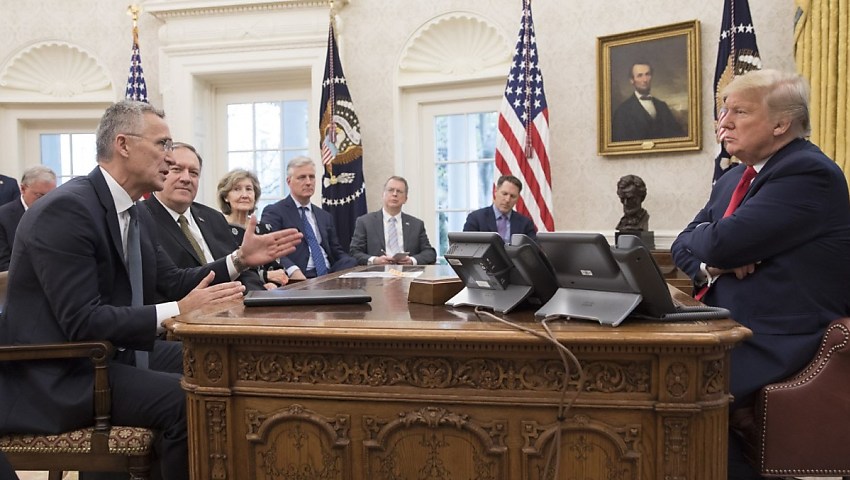
The long-awaited Trump administration’s 2025 National Security Strategy has finally been handed down, with major implications for Australia and other partner nations, with one message abundantly clear: do more.
From the moment it became clear that Donald Trump would return to the White House at the 2024 presidential election, the hysteria dominated much of the strategic conversation in capitals across the Western world.
Much of this had been driven by belief that the mercurial and often controversial president was a firm ally of the “revisionist” powers like Putin’s Russia, Xi’s China and the Ayatollah’s Iran, among others, and hangover from the first Trump administration (2016–20).
However, this positioning was largely devoid of reality of the shifting dynamics then occurring within the global order and that had begun to accelerate since the mid-2010s.
In particular, the emergence of Beijing and the slipping of the mask that had, until then, hidden its ambition and designs towards the Indo-Pacific, coupled with the emergence of multiple competing centres of economic, political and strategic power across the globe serving to, in aggregate, counter the United States.
This reality, in essence, called time on the “unipolar” moment that had existed since the end of the Cold War and the collapse of the Soviet Union and would only be exacerbated by the international chaos that ensued throughout the Biden administration (2020–24), particularly the return of conventional conflict between nation states in Europe and, to a lesser extent, the Middle East between Israel and Iran.
Only serving to further complicate the decisions made by policymakers is the ongoing domestic challenges that face nations across western Europe, Canada, Australia and other Western nations as they grapple with the perfect combination of domestic and international challenges
In response to this myriad of challenges, the returned Trump administration has launched it’s 2025 National Security Strategy, seeking to reorientate its own national security posture, with a greater emphasis on forcing allies to do more for their own security, rather than merely depending on the security guarantees of United States.

At the core of this is a reprioritisation by the United States to emphasise the western hemisphere and US homeland security over costly, foreign interventions and “neo-conservative” regime change operations that characterised American foreign and security policy from the 1990s until the mid-2010s, in the pursuit of President Trump’s trademark “America First” posture.
Indeed, in his opening letter, President Trump said, “In everything we do, we are putting America First. What follows is a National Security Strategy to describe and build upon the extraordinary strides we have made. This document is a roadmap to ensure that America remains the greatest and most successful nation in human history, and home of freedom on Earth.”
But what does this look like in practice?
Setting the foundation
At the core of the Trump administration’s 2025 National Security Strategy (NSS) is a realistic and clear-eyed assessment of the shifting realities of the global security environment and the challenges that continue to unfold and develop across the world.
In particular, the growing recognition that even American power has its limits, specifically in the era of multipolarity and great power is one of the driving forces behind the shifting priorities outlined in the 2025 NSS, especially the emphasis on strategy being defined as a “concrete, realistic plan that explains the essential connection between ends and means: it begins from an accurate assessment of what is desired and what tools are available, or can realistically be created, to achieve the desired outcomes”.
To this end, the United States emphasised the need for this strategy to remain clear-eyed and “evaluate, sort and prioritise” in order to more effectively and efficiently focus American strategy, attention and power with a distinct and articulated emphasis on the “protection of core national interests”.
This shifting reality and priority has taken both American and allied policymakers, including Australian policymakers (many of whom continue to delude themselves into believing to be infinite), some time to grapple with, while others continue to thrash against the “physics of reality” in the modern, contested, multipolar world.
The 2025 National Security Strategy emphasised this, stating, “After the end of the Cold War, American foreign policy elites convinced themselves that permanent American domination of the entire world was in the best interests of our country. Yet the affairs of other countries are our concern only if their activities directly threaten our interests.”
Unpacking this further and effectively stressing the limitations of American power, the strategy added the faulty premise upon which previous incarnations of the strategy have been built upon and sought to enforce, stating, “They overestimated America’s ability to fund, simultaneously, a massive welfare regulatory-administrative state alongside a massive military, diplomatic, intelligence and foreign aid complex...
“They placed hugely misguided and destructive bets on globalism and so-called “free trade” that hollowed out the very middle class and industrial base on which American economic and military pre-eminence depend. They allowed allies and partners to offload the cost of their defence onto the American people, and sometimes to suck us into conflicts and controversies central to their interests but peripheral or irrelevant to our own.”
This undoubtedly presents and places significant strain on US allies across the world as they begin to grapple with the reality of an America that is less willing to engage in foreign conflicts as the “World’s Policeman”, which has served as the basis for much of the world’s post-war economic, political and strategic stability, prosperity and security and, ironically enough, earned America significant global hostility.
A new Monroe Doctrine
At the core of the reprioritisation of the central line of questioning posed by the Trump administration illuminates the broader direction of travel for the US government, beginning with three core questions:
- What should the United States want?
- What are our available means to get it?
- How can we connect ends and means into a viable National Security Strategy?
At the high level, these questions herald the US pivot towards greater emphasis on defending the American homeland and, by extension, America’s own sphere of influence in the Americas, underpinned by seeking to protect the nation, its people, territorial integrity, its economy and its way of life “from military attack and hostile foreign influence, whether espionage, predatory trade practices, drug and human trafficking, destructive propaganda and influence operations, cultural subversion or any other threat to our nation”.
While not as “isolationist” as many pundits and strategic analysts had first feared, the “retreat” towards the western hemisphere undoubtedly places increased pressure on American allies used to having the economic, political and strategic might of the United States just over their shoulder should they become embroiled in a regional or broader globally significant conflagration.
This by no means indicates a decline in American military power but rather a reprioritisation and refocusing of American military power, something that the National Security Strategy articulated, saying, “We want to recruit, train, equip, and field the world’s most powerful, lethal, and technologically advanced military to protect our interests, deter wars, and – if necessary – win them quickly and decisively, with the lowest possible casualties to our forces. And we want a military in which every single service member is proud of their country and confident in their mission.
“We want the world’s most robust, credible and modern nuclear deterrent, plus next-generation missile defences – including a Golden Dome for the American homeland – to protect the American people, American assets overseas and American allies.”
Articulating the return or neo-Monroe Doctrine, the National Security Strategy detailed the emphasis of the Trump administration on the western hemisphere, stating in response to the question of “What should the United States want?”
“We want to ensure that the western hemisphere remains reasonably stable and well-governed enough to prevent and discourage mass migration to the United States; we want a hemisphere whose governments cooperate with us against narco-terrorists, cartels and other transnational criminal organisations; we want a hemisphere that remains free of hostile foreign incursion or ownership of key assets, and that supports critical supply chains; and we want to ensure our continued access to key strategic locations. In other words, we will assert and enforce a ‘Trump Corollary’ to the Monroe Doctrine,” the strategy said.
However, this doesn’t mean the US is abandoning the broader global environs or the Indo-Pacific, in particular; it is a recognition that you can’t build a castle on a foundation of sand, rather, that the United States wants to “halt and reverse the ongoing damage that foreign actors inflict on the American economy while keeping the Indo-Pacific free and open, preserving freedom of navigation in all crucial sea lanes and maintaining secure and reliable supply chains and access to critical materials”.
The 2025 US National Security Strategy is also quite pointed when it comes to Europe, in particular the domestic challenges it faces as a continent and individually at a nation-state level, with an epoch-defining emphasis from the US on reinvigorating and re-establishing European culture as one of the core driving force behind ongoing American security engagement with the continent.
“We want to support our allies in preserving the freedom and security of Europe while restoring Europe’s civilisational self-confidence and Western identity,” the strategy said.
So how does Australia figure into the Trump administration’s National Security Strategy? Well, rather sparingly, but there are still consequential messages for Australia’s policymakers to heed.
Increased defence spending the key focus
For Australia, the subtext of Washington’s message is becoming harder to ignore. The United States is not walking away from the Indo-Pacific nor is it abandoning allies.
But it is unmistakably recalibrating expectations and Canberra is firmly in the firing line. Indeed, the National Security Strategy articulated this, saying, “We will also harden and strengthen our military presence in the Western Pacific, while in our dealings with Taiwan and Australia we maintain our determined rhetoric on increased defence spending.”
Over recent months, pressure from US officials, legislators and strategic commentators has steadily increased for Australia to lift defence spending beyond its current trajectory.
This is not the theatrical burden-sharing rhetoric of Trump’s first term but a more structural demand rooted in a changing balance of power and a United States that is consciously narrowing its strategic bandwidth.
The logic from Washington is brutally simple. The Indo-Pacific is now the primary theatre of great-power competition, yet the United States faces finite resources, mounting domestic pressures and competing priorities closer to home.
If allies want continued access to US technology, intelligence, deterrence and, in extremis, American blood and treasure, they must be prepared to shoulder far more of the conventional load themselves.
Australia’s geography makes it uniquely important but also uniquely exposed. Sitting astride key sea lanes, proximate to Southeast Asia and the South Pacific and within operational reach of a rapidly modernising Chinese military, Australia is no longer viewed merely as a “secure rear area”.
From a US perspective, Australia is now very much a front-line contributor whose force posture must be credible, resilient and capable of sustained combat operations – not just niche deployments.
This helps explain why Washington’s expectations increasingly extend beyond submarines and long-range strike announcements. The quiet message is about mass, readiness, logistics, stockpiles and the unglamorous foundations of warfighting.
It is about whether Australia can deny access to its approaches, defend its northern bases, protect critical infrastructure and operate independently in the early phases of a conflict rather than immediately defaulting to US reinforcement.
For Canberra, this creates an uncomfortable collision between strategic necessity and political reality. Defence spending remains constrained by fiscal pressures, demographic change and a public debate that still oscillates between complacency and sticker shock.
Yet the era in which Australia could rely on the assumption of rapid and overwhelming US intervention is visibly closing.
Crucially, this is not an ultimatum. The United States is offering continued partnership, deeper integration and access to cutting-edge capabilities but on more transactional terms. The price of relevance is greater self-reliance. The price of deterrence is paying for it.
Australia therefore faces a choice it has long deferred: either treat defence spending as discretionary, rising only when crisis becomes undeniable or accept that strategic insurance in a contested Indo-Pacific requires sustained investment well above historical norms.
Washington has already made its decision. The question now is whether Canberra is prepared to meet the moment or continue betting that someone else will carry the weight when it matters most.
Final thoughts
Australia needs a hard wake-up call, and quickly.
This is not an abstract debate about defence budgets or foreign policy theory; it is about the country we will hand to our children and grandchildren, and whether it will be secure, prosperous and able to make its own choices in an increasingly unforgiving world.
That demands a fundamental rethink of how we see ourselves and our place in the region.
The Indo-Pacific is no longer a distant theatre of competition. It is the centre of gravity for global power and it is becoming more crowded, more militarised and more contested by the year.
China’s weight continues to grow, India is asserting itself, and regional middle powers from Vietnam to Thailand are sharpening their strategic posture. Japan and South Korea, long constrained by history, are stepping back onto the stage with renewed purpose.
This is not a future scenario, it is the strategic environment Australia is already living in.
Against that backdrop, incrementalism is a recipe for irrelevance. Without sustained investment, serious planning and a willingness to confront uncomfortable trade-offs, Australia will not merely lag behind – it will be overtaken.
The trajectory is clear: neighbours with larger populations, deeper industrial bases and greater strategic ambition are moving faster than we are.
If we continue to drift, the next generation will inherit a country with less influence, fewer options and diminished freedom of action in its own region.
For decades, Canberra has defaulted to short-termism: patchwork funding boosts, headline announcements, and the comforting assumption that strategic warning time would always be generous.
That era is over. The pace of change has accelerated, and the margin for error has narrowed. Business as usual is no longer defensible when the regional balance of power is shifting in real time.
The challenge is not identifying the risks, they are already evident. The real test is whether Australia’s political leadership is prepared to articulate a coherent national strategy and back it with the resources, reforms and public honesty required to make it credible.
Industry cannot mobilise and the public cannot be brought along without a clear sense of direction and purpose.
As the United States recalibrates its expectations and China continues to press its advantage, Australia faces a stark choice. We can remain a passive beneficiary of decisions made elsewhere or we can invest in the capability, resilience and confidence needed to shape our own strategic environment.
The decisions taken this decade will echo for generations. The question is whether Australia chooses to meet the moment or allows it to pass us by.
Get involved with the discussion and let us know your thoughts on Australia’s future role and position in the Indo-Pacific region and what you would like to see from Australia’s political leaders in terms of partisan and bipartisan agenda setting in the comments section below, or get in touch at

Want to see more stories from trusted news sources?
Make Defence Connect a preferred news source on Google.
Click here to add Defence Connect as a preferred news source.