

 iscover
The year 2025 has been a major mask slip moment for the scale, scope and reach of Beijing’s military modernisation efforts, with Australia and its partners put on notice, but this is just the beginning.
In early 2025, Australians spotted an unusual sight on their doorstep: a three‐ship flotilla of Chinese warships steaming down the east coast, nearly 150 nautical miles east of Sydney.
The vessels – a Jiangkai Class frigate, a Renhai Class cruiser and a Fuchi Class replenishment tanker – turned the Tasman Sea into a theatre of great power projection.
Seeking to calm the horses, “It’s not unprecedented. But it is an unusual event,” Defence Minister Richard Marles said, stressing that the ships were operating legally but would be closely watched.
Over the next fortnight, the task group swept westward across the Great Australian Bight and then north past Western Australia into the Indian Ocean.
In effect, it executed a partial circumnavigation of the continent, marking a first for the People’s Liberation Army Navy (PLAN) and underscored a decade of Chinese military build‐up that has fundamentally altered the Indo-Pacific security landscape.
This exercise in localised power projection and thinly veiled strategic coercion of Australia builds upon now a decade of more ambitious, assertive and often coercive efforts by Beijing to expand and enforce its will and designs upon the region.
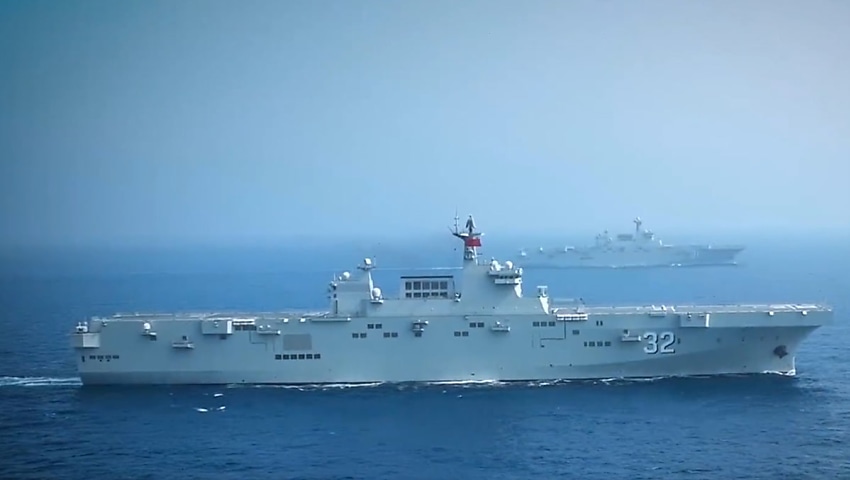
China now fields the world’s largest navy by hull count, well over 370 ships and submarines, and its strike forces are beginning to appear in regions once out of reach. Advanced Type 055 “stealth” destroyers and new amphibious assault ships give China a substantial sea‐control capability.

Three aircraft carriers are in service (the newly commissioned Fujian and the older Shandong and Liaoning) and reports suggest China aims for six or more by the early 2030s, directly challenging America’s tactical and strategic dominance in the region.
This expansion is accelerating: China’s PLAN is building vessels at “breakneck speed”, adding about six submarines a year and dozens of surface ships. The Fujian made headlines in late 2025 by transiting the Taiwan Strait, a demonstration of reach that both signalled Beijing’s ambitions in the region and sent alarm through regional capitals.
Indeed, a June 2025 analysis conducted by the Center for China Analysis revealed that China’s navy even exercised with both the Shandong and Liaoning carriers deploying beyond the Second Island Chain (east of Japan), a milestone in blue‐water training and a rehearsal of scenarios like countering US reinforcements in a Taiwan contingency.
But this is just a taste of things to come.
A shrinking moat, a rising power
As Australia experienced in March and April of 2025, the Chinese naval circumnavigation revealed that we are now very much fair game and our once celebrated geographic isolation embodied by the so called “tyranny of distance” was now more of a hindrance than a tactical or strategic advantage.
Australian officials publicly stressed that all operations were in accord with international law, even as they quietly tracked every move. Minister Marles later noted that from the moment the ships entered Australia’s area, they were “being tailed and tracked by Australian assets”, underscoring Canberra’s resolve to monitor any Chinese projection of power.
Beijing defended the voyage as routine training, with foreign ministry spokespersons insisting Chinese vessels “always operate at sea in accordance with international law. But the spectacle of Chinese live-fire exercises bristling off Australia’s shores resonated widely. “That [the world’s biggest military build‐up] is happening without strategic reassurance means … a response is demanded,” Minister Marles warned at an Indo-Pacific security conference in late 2025.
In the background, China has grown only more emboldened in recent years, with 2025 emerging as a major turning point. Over the past decade, the PLA has undergone the most ambitious modernisation drive since its founding. Official figures from the Pentagon show China’s defence budget has grown at roughly 6 per cent annually (adjusted for inflation) from 2013 to 2023, in essence nearly doubling in real terms.
In fact, experts believe Beijing’s real military spending far exceeds the headline numbers, likely on the order of US$330–450 billion (AU$498.9-680.3 billion) in 2024, which when compared to Australia’s own paltry defence budget of approximately US$30 billion (AU$55–60 billion) magnifies the quantum of difference between the two nations.
This flood of resources has been channeled into new platforms, advanced weapons and expanded personnel. China now boasts missile forces to rival any other, a stealth fighter fleet the envy of many powers, cyber and space forces on par with and, in some cases, exceeding the West, and conventional forces increasingly being honed for far‐sea combat.
The pace is breathtaking and not merely confined to a single domain: the PLA is buying new jets, ships and missiles at a speed unmatched by historical standards.
The People’s Liberation Army Air Force (PLAAF) is rapidly being transformed, trading quantity for high‐end capability, with a clear, yet simple mandate: match or exceed traditional Western advantages and dominate the skies of the Indo-Pacific.
In a few short years, Beijing has fielded several hundred fifth‐generation fighters. Open‐source tallies now count over 300 Chengdu J-20 “Mighty Dragon” stealth fighters in service as of late 2025, making the PLAAF’s fifth‐generation fleet the largest outside the United States. Production has accelerated; more than 50 new J-20s were delivered between mid‐2024 and late‐2025.
Meanwhile, the PLAAF also continues to modernise its bomber and transport wings: nearly 160 H-6 strategic bombers (capable of carrying long‑range cruise missiles) and some 80 Y-20 heavy airlifters now bolster China’s long‐range reach as work continues on the long awaited H-20, Beijing’s answer to the Northrop Grumman B-2 Spirit and B-21 Raider.
A new two-seat J-20S variant was publicly observed in 2025, intended as a mobile command/platform for networked combat while work continues on the J-35, with more than 50 in service as of October 2025 with both the PLAAF and the PLAN expected to field the variants of the aircraft en masse.
Concurrently, Beijing is rapidly expanding its strategic missile force, with an emphasis on casting off the previous model of a “minimum viable deterrence” force, or more conventionally explained, a viable second strike capability, with the completion of three new missile fields in western China, together capable of fielding at least 300 intercontinental ballistic missiles according to Pentagon assessments.
In addition to these efforts, the PLA is developing new solid‑fuel ICBMs with multiple independently targetable re-entry vehicles, boosting the number of warheads it can deliver. Some analysts even warn China may be working on conventionally armed ICBMs capable of striking the US and Australian homelands.
This rapid growth is partly driven by a steep expansion of China’s nuclear stockpile, with the Stockholm International Peace Research Institute estimating China adds roughly 100 nuclear warheads per year and could reach in excess of 600 warheads by 2025, with this surge in missile and nuclear capability underwriting Beijing’s vision of a strong deterrent, as spelled out in Chinese defence policy: one intended to “deter and counter third‑party intervention” in regional crises.
Seeking to offset a long-held Chinese “Achilles heel”, Beijing is rapidly narrowing the technological and qualitative gaps between itself and that of the United States and its regional partners, including Australia.
In October 2025 PLA researchers unveiled a prototype hypersonic “morphing” glide vehicle, whose wings adjust shape in flight to minimise drag or improve manoeuvrability. Such cutting-edge experiments reflect China’s growing prowess in aerospace and microelectronics. In fact, China has disclosed dozens of new hypersonic missile designs and reportedly deployed an air-launched hypersonic anti-ship missile (the YJ-21) on bombers.
Meanwhile, the 3 September national parade famously rolled out new ballistic and cruise missiles, some nuclear‐capable, some conventionally armed. The West also saw a suite of advanced autonomous vehicles, both for aerial and maritime uses and, of course, the revelations that Beijing was pursuing a sixth-generation air combat capabilities at pace, underscoring just how far China’s defence industry and, more broadly, its national industrial base has come.
Space remains a central warfighting focus for Beijing, with the PLA’s Strategic Support Force, responsible for space and cyber warfare, essentially being split into dedicated space, cyber space and information support commands, emulating and echoing the model established by the United States and at a smaller scale, Australia.
Beijing now fields over 1,100 satellites including more than 500 with high‐end sensors to watch oceans and airspace, with these assets giving China unprecedented situational awareness and the ability to target US and allied forces at increasingly longer ranges across the region.
A force in transition but significant growth since 2015
The PLA of 2025 is a very different force from 2015.
Most branches have shifted from territorial defence to power projection. Where once China’s navy and air force largely patrolled home waters, they now routinely operate far beyond its coastline – through the South China Sea, East China Sea, Western Pacific and even the Indian Ocean.
China has established or is negotiating overseas bases, from Djibouti to Pakistan to Cambodia, and signed military‐to‐military agreements around the Pacific Islands, with its navy now conducting “routine” patrols in waters stretching to the US second island chain and beyond.
The PLARF’s long‐range missiles can range Guam and Alaska, while Chinese bombers have crossed the Pacific in joint exercises. All this growth is in service of an expanding strategic agenda: Xi Jinping’s China aims to be the pre‐eminent power in Asia.
That includes “reunifying” Taiwan (using force if deemed necessary) and locking down the South China Sea as a “core interest” by 2027.
Indeed, Beijing’s 2025 defence white paper explicitly asserts that stabilising Asia will emanate from Chinese leadership and that it “justifies” use of force to defend its claims (from Taiwan to maritime disputes) if needed. South China Sea claimant states are warned they must deal with China bilaterally, a position that undercuts regional multilateralism and has already prompted neighbours to deepen ties with extra‐regional powers for balance.
For Australia, the picture is daunting. Once considered a middling neighbour, China now sits across the sea with vastly superior firepower and a global vision. Canberra has repeatedly protested what it calls “unsafe and unprofessional” PLA moves.
Over the past year alone Australian forces have been menaced by lasers, warships using active sonar on divers, fighter jets dropping flares across patrol aircraft, and now this around-Australia naval deployment. Australian Strategic Policy Institute analyst Jennifer Parker warned that these incidents are no accident but part of “a clear pattern of aggressive and reckless behaviour” by the PLA.
These developments only serve to endanger Australian lives and clip the wings of freedom of navigation through its own backyard. Australia’s own defence secretary, Greg Moriarty, has similarly cautioned that Australia’s strategic circumstances are “deteriorating” and that the risk of dangerous incidents is rising.
Final thoughts
Fundamentally, China’s rise, from jagged coastline to global stages has rewritten the regional security script. It is a world of carrier battle groups in the Pacific, hypersonic missiles threatening far‐off targets, and satellites watching Australia’s harbours. Canberra’s challenge is to adapt.
As one former officer puts it, each “unsafe” PLA incident or fleet movement is a rehearsal for a high‐stakes contest over Asia’s future.
The question now is how Australia, an island continent of huge seas, will shape its defence strategy to navigate this new reality. For Canberra, the message is clear: Chinese ambitions in the Indo-Pacific are only growing, and Australia must grow with them, or risk being left behind in the rising tide of Beijing’s power.
Get involved with the discussion and let us know your thoughts on Australia’s future role and position in the Indo-Pacific region and what you would like to see from Australia’s political leaders in terms of partisan and bipartisan agenda setting in the comments section below, or get in touch at

Want to see more stories from trusted news sources?
Make Defence Connect a preferred news source on Google.
Click here to add Defence Connect as a preferred news source.