

 iscover
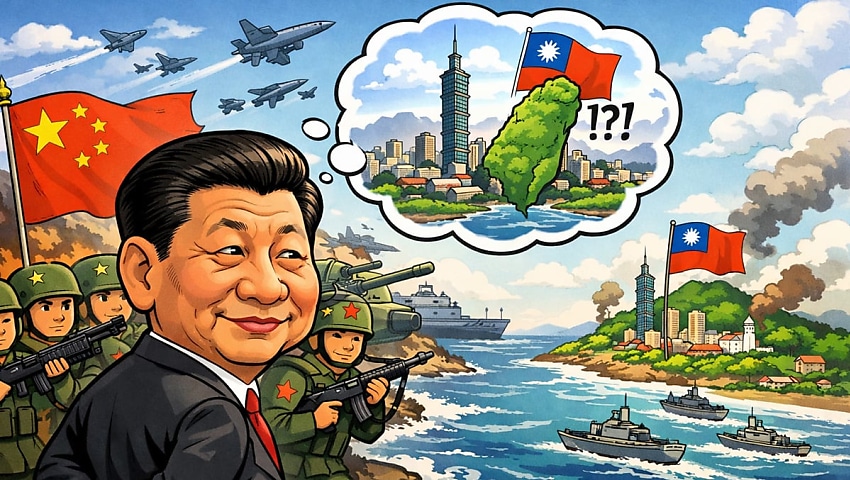
China’s top diplomat in Australia is no stranger to causing controversy. Now he has warned that Australia must accept the “reunification” of Taiwan with the mainland, or face “no forgiveness”, but we seem to be continuing on in blissful ignorance.
Australia and China have spent three decades knitting together a complex and interdependent relationship that now sits uneasily atop a widening strategic chasm.
For Canberra, the challenge is starkly practical: China is not merely a geopolitical competitor but Australia’s largest two-way trading partner, accounting for roughly a third of goods and services trade and absorbing about 30–37 per cent of Australian exports in recent years.
That economic intimacy, and indeed exposure, particularly through iron ore and liquefied natural gas for Chinese industry and Australian agriculture and services for Chinese consumers, has underpinned prosperity but also left Canberra unusually exposed to shocks that would follow any serious deterioration in Sino–US relations.
Those shocks are not abstract. Canberra has signalled repeatedly that it views a peaceful status quo across the Taiwan Strait as essential and has publicly criticised military coercion in the region.
At the same time, Australia has been fortifying its security posture: the trilateral AUKUS pact, expanded trilateral and quadrilateral cooperation with the United States, United Kingdom and Japan, and a national defence strategy that emphasises preparing for a more contested Indo-Pacific have all shifted Canberra’s posture from hedging to hardening.
A conflict over Taiwan would therefore present a compound dilemma for Australia simultaneous economic vulnerability and strategic obligation.
Economically, analysts warn that the abrupt severing of trade ties, whether through deliberate Chinese coercion or the cascading effects of war, would inflict immediate damage across mining, agriculture and services and ripple through manufacturing, retail and construction.

An Australian Strategic Policy Institute scenario exercise concluded that a loss of China sales would produce widespread job losses, shortages and significant fiscal strain unless mitigated by rapid, large-scale policy responses.
In short: prosperity is deep but brittle.
Militarily, even a geographically remote conflict could become immediate. Australia’s logistics lines, sea lanes through the South China Sea and supply chains that feed its armed forces and civilian economy would be likely targets or collateral victims.
Canberra’s AUKUS investments and closer interoperability with Washington and regional partners are intended to raise the costs of coercion against Australia and its allies, but they also risk drawing Australia into a great-power confrontation if deterrence fails.
There are also political and societal reverberations to consider. A Taiwan conflict would test the resilience of Australia’s bipartisan foreign policy consensus, strain relations with the diaspora communities that link Canberra to both Beijing and Taipei, and force difficult trade-offs between economic recovery and strategic alignment.
Domestic debates over rapid decoupling, whether to urgently reorient supply chains and accelerate sovereign industrial capacity, would intensify, but so would short-term pain for consumers and firms as price shocks and shortages bite.
Yet the longer-term strategic calculus is less transactional than transformational. Canberra’s policy choices in the aftermath of a Taiwan crisis, whether to double down on alliance commitments, pursue deeper regional security architectures or attempt a more independent balancing act, would shape Australia’s economic diplomacy and defence investment horizon for a generation.
The imperative is clear: reduce critical dependencies where practicable, deepen resilience across logistics and energy, and sustain diplomatic channels that keep dialogue possible even amid strategic competition.
In the end, the Taiwan question is not merely a cross-Strait issue: for Australia, it is a stress test of how a middle power secures prosperity while navigating intensified great-power rivalry.
Canberra’s options are constrained but consequential. How it balances ties to Beijing with commitments to allies and how quickly it can absorb economic shocks while maintaining credible deterrence will determine whether Australia is swept up in a wider conflagration or emerges from it with its strategic interests intact.
Enter Beijing’s top diplomat in Australia, the ever provocative Xiao Qian who has issued a stark and confronting warning for Australia and any nation who seeks to interfere in the “reunification” of the mainland and island democracy of Taiwan.
Speaking to Anthony Galloway of The Australian, ambassador Qian compared Taiwan to Tasmania, warning that any effort to undermine the longstanding, One-China status quo would be met with devastating results.
Stay out of Taiwan
As part of this warning, ambassador Xiao warned that Australia could not simultaneously benefit from deep economic ties with China while opposing Beijing’s push to bring Taiwan under its control. Continued resistance, he suggested, would carry consequences.
While countries that supported reunification would be “appreciated and reciprocated”, those that sought to undermine it would “find no standing” and no forgiveness, particularly concerning for Australia given our economic dependence on Beijing.
Ambassador Qian said, “Given the unstoppable trend of reunification across the Taiwan Strait, Australia should prepare for engaging with a reunified China ... The Chinese people will appreciate and reciprocate the goodwill of those who support China’s reunification but will not forgive anyone that attempts to obstruct or undermine the process of reunification.”
In addition to this, the ambassador sharply criticised a recent Department of Foreign Affairs and Trade statement condemning Chinese military and coast guard drills around Taiwan as destabilising. Those exercises, which saw Chinese ships approach closer to Taiwan than ever before and almost 90 fighter aircraft fly near the island, were portrayed by Beijing as legitimate actions in defence of national unity, rather than escalatory moves.
Highlighting a seeming contradiction in Australia’s approach, ambassador Qian added, “It is both inadvisable and unacceptable on moral grounds to seek co-operation with and benefits from China while simultaneously disregarding China’s concerns and undermining its core interests .... Taiwan is a province of China, just as Tasmania is a state of Australia. This is the only correct understanding of ‘one China’.”
In pointing this out, ambassador Qian did seek to calm the storm he had created by reiterating Beijing’s commitment to a “peaceful reunification” but reinforced President Xi Jinping’s commitment to reserving the right to use force to “reclaim” Taiwan, should all other avenues be exhausted.
He told Galloway, “The Chinese government strives for peaceful reunification, but if provocations and coercion by ‘Taiwan independence’ forces continue to escalate, we will resolutely crack down on them. In essence, this is no different to the logic behind the US’ decision to go to war to safeguard its national unity in the mid-19th century.”
It is this interesting analogy and comparison, particularly to America’s efforts to enforce the Monroe Doctrine of the 19th century, particularly (although not naming it) drawing comparisons to America’s war with the Spanish in 1898 which saw America claim Spanish colonial holdings in the western hemisphere and the Indo-Pacific.
Qian added, “The Taiwan question is China’s internal affair ... There is no room for compromise or concession on the Taiwan question, nor will China allow any country to use it as a bargaining chip ... We hope Australia will keep abreast of the historical trend on the Taiwan question, understanding and supporting the Chinese people’s endeavours for national reunification.”
Confronting the ’new’ realpolitik
This attempt is clearly an effort to draw an equivalence and legitimise Beijing’s own designs and ambitions, both for Taiwan and then subsequently more broadly across the First and Second Island Chains, something that will no doubt only be ramped up following the US raid on Venezuela.
But here is the kicker, and it is something that a lot of critics of President Donald Trump will either conveniently overlook or completely neglect to accept: Beijing is playing you by using these comparisons to justify its actions and ambitions, it was always going to pursue its ambitions and desires.
Beijing’s efforts to play into the widely held Trump Derangement Syndrome among many in the political, policymaking and analyst class does more to undermine our national security and the legitimacy of the post-war, “global rules-based order” by dividing and subverting us from within.
Now does that mean we should give the United States or any of our other partner nations a free pass? Absolutely not. But it does require nuance and maturity and above all, to quote Michael Corleone, “Don’t ever take sides with anyone against the family again. Ever.”
At least not in public anyway. What happens behind closed doors is an entirely different matter. While I know that might be a bit hard for some, it may ultimately prove necessary.
Simultaneously, Australia rapidly needs to begin diversifying its economic interests away from overdependence on any single market, whether that is China, India, or for that matter the United States or Europe.
We will also be required to embark on a serious and considered effort to rebuild the nation’s economic and industrial capacity, a robust and unwaveringly sovereign defence capability, providing us with a greater degree of national autonomy, resilience and sovereignty in an era of renewed great power competition.
Final thoughts
For too long, Australia has coasted on the assumption that things will somehow work out.
That instinct, the national shrug of “she’ll be right” is no longer good enough. In a far more contested and unforgiving world, it’s increasingly clear that she won’t be right unless we choose to make it so.
Building Australia’s weight as an independent power is no longer an abstract aspiration. Developing the economic depth, diplomatic influence and military capability to act with real autonomy is fast becoming a core expression of our sovereignty.
It is about more than defence spending or foreign policy settings; it is a declaration that Australia is willing to take full responsibility for its own security and to play a shaping role in a stable, prosperous Indo-Pacific.
For decades, we have allowed ourselves to be hemmed in economically reliant on China, strategically anchored to the US alliance, and exposed to the consequences of rivalry between much larger powers.
Recent signals from Beijing, particularly on Taiwan, underline just how uncomfortable that position has become. But this is not an immutable fate.
As the international system hardens into competing blocs of authoritarian and democratic states, Australians deserve a frank, unsentimental conversation about who we are, what we stand for, and how much control we intend to exercise over our own future.
That conversation cannot be confined to Canberra. It must involve the Australian people – the ones who will pay the price, shoulder the risk and, if it comes to it, defend the decisions made in their name.
National strategy without public consent and understanding is inherently and inescapably brittle by design.
Real progress depends on rebuilding trust between government, industry and the community. It requires transparency about risks, trade-offs and costs, and a shared commitment to a national project that strengthens the economy, secures critical industries and reduces our vulnerability to economic coercion, whoever it comes from.
A strong, diversified and resilient economy is the foundation of national power. It underwrites our diplomacy, sustains our defence and provides the most credible protection against external pressure. Without it, strategic autonomy is an illusion.
We also need to be honest about our ambitions. Are we content to drift as a diminishing “middle power”, or are we prepared to step up as a serious regional leader one that helps shape outcomes rather than merely reacting to them?
Because without decisive investment in capability, innovation and self-reliance, the risk is clear. Australia slides into complacency, then stagnation, and eventually a managed decline marked by the slow erosion of our prosperity, our influence and, ultimately, our independence.
Get involved with the discussion and let us know your thoughts on Australia’s future role and position in the Indo-Pacific region and what you would like to see from Australia’s political leaders in terms of partisan and bipartisan agenda setting in the comments section below, or get in touch at

Want to see more stories from trusted news sources?
Make Defence Connect a preferred news source on Google.
Click here to add Defence Connect as a preferred news source.