

 iscover
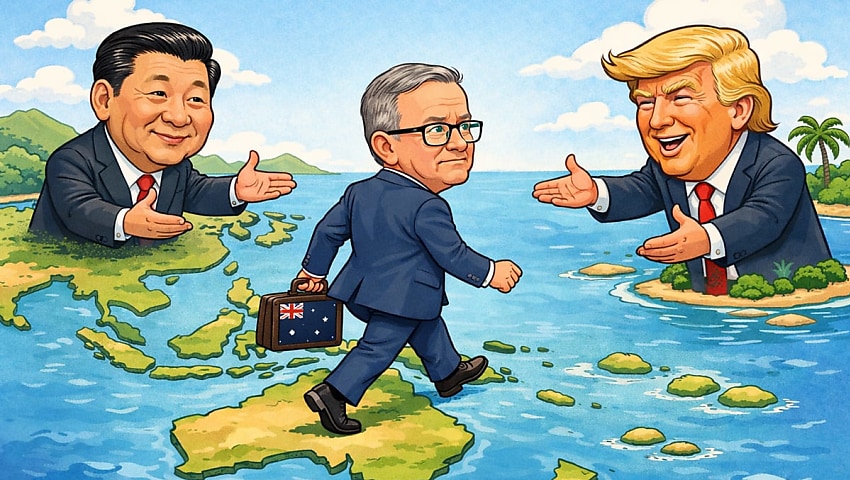
As the United States continues to emphasise locking down the western hemisphere, Beijing continues to expand its reach across the Indo-Pacific, with some claiming a Chinese-led region is preferable to a pseudo-imperial US-led order, but what does that look like?
Since the end of the Second World War, Australia’s economic, political and strategic outlook has been shaped above all by two external relationships: its longstanding alliance with the United States and its increasingly consequential and complex relationship with the People’s Republic of China.
Together, these relationships have underpinned Australia’s prosperity and security while also generating the central strategic tensions confronting the country today.
The Australia–United States relationship emerged directly from the experience of the Pacific War. The fall of Singapore and Britain’s inability to defend Australia decisively ended any lingering reliance on the United Kingdom as Australia’s principal security guarantor.
In its place, Australia turned to the United States, a shift formalised in the 1951 ANZUS Treaty. Throughout the Cold War, this alliance was reinforced by shared democratic values, deepening intelligence cooperation, and Australia’s participation alongside the US in major conflicts, including Korea and Vietnam.
Politically, the alliance became a bipartisan pillar of Australian foreign policy, while strategically, it embedded Australia within a US-led regional and global order.
Economically, the US has long been a major investor in Australia and a critical source of technology, capital and innovation. Although never Australia’s largest trading partner in pure volume terms, the United States has exerted outsized influence through foreign direct investment, financial markets, defence industry integration and education.
In the post-Cold War era, the alliance broadened further, encompassing joint military operations in the Middle East, expanded intelligence sharing, and deep cooperation in space, cyber and advanced defence technologies. The alliance remains central to Australia’s strategic planning and deterrence posture.

By contrast, Australia’s relationship with China followed a very different trajectory. For the first decades after 1949, relations were distant and often adversarial, shaped by the Cold War, Australia’s alignment with the US, and China’s revolutionary politics.
Diplomatic recognition in 1972 marked a turning point, but it was the economic reforms launched under Deng Xiaoping from the late 1970s that fundamentally transformed the relationship.
Over the following four decades, China became Australia’s largest trading partner, driving unprecedented growth through demand for iron ore, coal, gas and other commodities, and later through education, tourism and services.
This economic interdependence delivered immense benefits to Australia, helping to sustain growth through the Asian financial crisis and the global financial crisis.
However, it also created new vulnerabilities. As China’s economic weight translated into growing political and strategic influence, differences in political systems, values and regional ambitions became more pronounced.
In recent years, bilateral relations have been strained by disputes over foreign interference, trade coercion, human rights, technology and regional security, even as trade volumes have remained substantial.
Contemporary Australia now faces the challenge of navigating between its principal security partner and its largest economic partner at a time of intensifying great power competition.
Maintaining national sovereignty, economic resilience and strategic autonomy while remaining deeply integrated into global markets and alliance structures is no longer a theoretical question, but a practical and pressing policy dilemma.
How Australia manages these competing pressures will shape its prosperity, security and international role for decades to come.
Enter the critics of Australia’s longstanding relationship with the United States and their increasingly vocal criticism of the United States, particularly under Donald Trump, amid claims of pseudo-imperialism. Conversely, these same critics advocate and argue that Australia would benefit far more from a region dominated by Beijing than under the existing order that has served us well for nearly a century.
Highlighting this growing chorus of voices is Andrew Forrest, a former policy adviser on China in the international division of the Department of the Prime Minister and Cabinet, writing for the Australian Strategic Policy Institute in a piece titled Critics of US need to explain Australia’s place in a China-dominated region, in which he articulated the evidence (or lack thereof) for claims of a better outcome for Australia.
To understand why Forrest’s argument resonates with many policymakers and why critics see it differently, we need to unpack the assumptions and stakes embedded in this argument.
Walking a tightrope – balancing giants
First and foremost, it is important to understand and accept that one central question sits at the heart of Australia’s foreign policy tension in 2026: how to balance security imperatives anchored in the US alliance with economic realities tied to China, the world’s second-largest economy and Australia’s largest trading partner.
Forrest’s piece begins with a challenge: he claims he cannot envision “a flourishing future for Australia in a region dominated by China (and without a US presence)”.
He suggests that many proponents of disengagement from the US alliance fail to articulate such a vision in clear, long-term terms.
This frames the debate around sovereignty and strategic agency. Forrest warns that Australia risks losing both if it finds itself in a region where Chinese power is unchallenged and the United States, Australia’s principal security partner since 1951 – withdraws or recedes. Implicitly, here are two linked assumptions:
- That China seeks to remove or diminish US influence in Asia as a strategic objective.
- That a region shaped by Chinese primacy would inevitably be less hospitable to Australian sovereignty and independent decision making.
These assumptions reflect a broadly realist view of geopolitics: major powers pursue material advantage and influence and smaller states must anchor themselves where their security is best assured.
In this view, China’s economic rise is not merely a market phenomenon but a strategic shift with implications for regional balance and national autonomy. For critics of this line of thinking which are found across academia, media and parts of the strategic community, the assumptions warrant interrogation. They argue that:
- US reliability as a security guarantor is no longer certain: With periodic gyrations in Washington’s domestic politics, scepticism about US commitments has grown among some Australian commentators. Polling data shows Australians are divided on deepening ties with China, with significant minorities open to closer economic engagement, even as defence ties with the US remain valued.
- Being too closely aligned with the US may drag Australia into conflicts not of its choosing: Some scholars and former officials have argued that Canberra could be pulled into a US–China confrontation, particularly over Taiwan, because of alliance obligations. While Forrest acknowledges this as a concern, he insists that the right response is not decoupling from the US but deepening strategic thinking about long-term structural challenges.
This dispute is not just about policy preferences but how each camp interprets the trajectory of great power competition and the likely behaviour of the United States and China over coming decades.
Confronting our ’new’ strategic reality
The Australia–US alliance, formalised in the ANZUS Treaty, has been the bedrock of Canberra’s defence strategy for 75 years.
It binds Australia to coordinated security cooperation with the United States and through arrangements such as Five Eyes intelligence sharing embeds Canberra in a broader Western security architecture. This alliance has shaped Australian strategic culture and defence planning through multiple eras of shifting geopolitics.
In recent years, this has translated into cooperation in the Indo-Pacific, expansion of joint military exercises, integrated force posture arrangements, and deeper defence industrial ties such as AUKUS, the pact with the US and UK that will see Australia acquire nuclear-powered submarines.
While AUKUS is designed to boost regional deterrence, it also accentuates Australia’s dependence on US technologies and strategic guarantees.
For proponents of the alliance, its value lies in deterrence against coercive revisionism, particularly by an assertive China. Forrest’s article takes this as a given: without US power as a balancing force, he argues, the structural pressures of China’s rise would work against Australian sovereignty.
Meanwhile, at the same time, China’s rise has reshaped Australia’s economic landscape. China is Australia’s largest trading partner by value and this trade underpinning has served as a critical engine of growth for commodities, education and tourism sectors. That economic reality is why Canberra continues to pursue stable relations with Beijing even as strategic tensions rise.
Yet as experts have emphasised, economic ties coexist uneasily with geopolitical friction. Chinese military modernisation, expanding naval capabilities and coercive conduct in the South China Sea have alarmed Western partners and regional states alike.
Australia’s engagement in freedom of navigation operations alongside allies and deeper ties with regional frameworks like the Quad reflect these strategic concerns.
Australia’s policymaking thus faces a dual imperative: safeguard economic interests tied to China while maintaining strategic linkages that deter coercion, a balancing act that Forrest suggests is better anchored in alliance with the United States.
The counter argument
Many argue that Canberra should cultivate greater strategic autonomy by diversifying partnerships and developing independent defence capabilities that do not rely excessively on a single great power.
Some propose strengthening ties with regional powers such as Japan, India and ASEAN states to form a broader balance of influence that dilutes the risk of unilateral dominance by either Washington or Beijing.
This view aligns with academic research portraying Australia as a “balancer” in a multipolar Asia rather than a straightforward client of US strategy.
Others, including strategic realist voices like Professor Hugh White, have questioned whether Australia’s deep investment in AUKUS and reliance on US security guarantees actually enhances, rather than undermines, long-term autonomy.
White’s work, which has drawn both criticism and praise, suggests that Australia’s foreign policy establishment has yet to fully reckon with the structural transformation of the international order and what that means for middle powers.
There is also a domestic dimension to this debate. Polling data from the 2025 federal election campaign referenced by the ABC showed that Australians were split on whether ties with China should deepen, with around a third supporting closer engagement and a similar proportion opposed. Meanwhile, votes on defence spending signalled broad backing for increased military capability.
This suggests a public that is neither wholly comfortable with pivoting away from the US nor eager to decouple from China, reflecting broader anxieties about economic stability, security risk and national identity in a contested regional order.
Our core question – security v strategic choice
Forrest’s critique centres on one uncomfortable question for some analysts: Can Australia genuinely envision a future in which China’s primacy shapes the regional order and Canberra remains both prosperous and sovereign without deep ties to the United States?
If so, what are the institutional, military and diplomatic strategies that would underpin such a future?
His article insists that critics of the alliance must go beyond rhetoric about neutrality or middle power status and offer detailed answers to these questions.
To simply argue against the status quo without delineating a viable alternative, he suggests, is insufficient given the magnitude of the strategic shifts under way.
This is a fundamentally analytical challenge: articulating a strategic vision for Australia that accounts for economic interdependence, geopolitical competition and the inherent uncertainty of great power relations.
It requires not just normative assertions about autonomy or balance but credible assessments of military capability, alliance reliability, regional perceptions and the economic levers that shape national power.
Final thoughts
Australia’s place in a rapidly changing Indo-Pacific remains contested terrain. Forrest’s analysis, simple in its rhetorical device but profound in implication highlights a core dilemma: as China’s influence grows and the United States recalibrates its global posture, what strategic architecture best preserves Australia’s security and prosperity?
At one level, this is a debate about the value and future of alliance. At another, it is about how Australia perceives its own agency as a sovereign middle power in an era of great power competition.
Resolving this tension will require more than slogans; it demands sustained intellectual effort, transparent policy choices and a willingness to articulate the often uncomfortable trade-offs inherent in any grand strategy.
Australia’s leaders may not agree on every aspect of this debate, but the underlying questions about sovereignty, alignment, deterrence and economic integration will define the country’s foreign policy priorities for decades.
As Forrest and others have underscored, what Canberra decides now will shape not just diplomatic posture but the very contours of national security and identity in a contested regional order.
Get involved with the discussion and let us know your thoughts on Australia’s future role and position in the Indo-Pacific region and what you would like to see from Australia’s political leaders in terms of partisan and bipartisan agenda setting in the comments section below, or get in touch at

Want to see more stories from trusted news sources?
Make Defence Connect a preferred news source on Google.
Click here to add Defence Connect as a preferred news source.