

 iscover
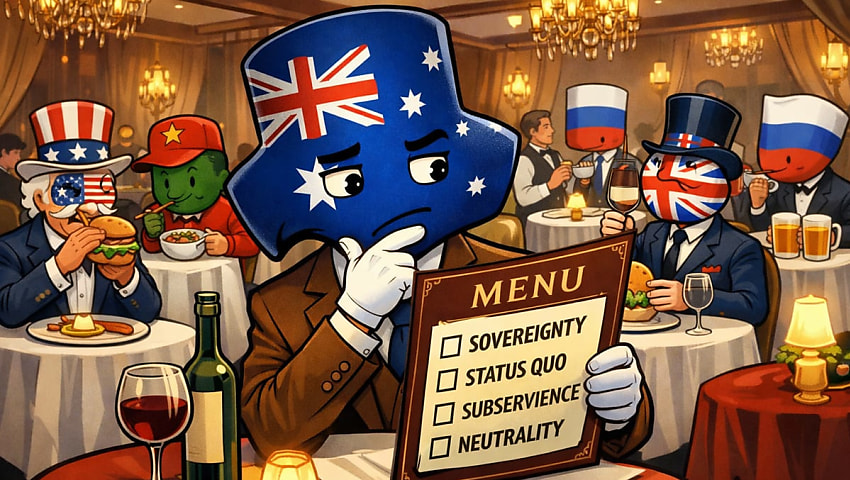
The concept of sovereignty is something successive Australian governments and the public have both struggled to understand, particularly in an era of hyperglobalisation. Now with conflict and its biting ramifications closer to home, this means we have to truly understand what makes us sovereign and plan accordingly.
For much of human history, the concept of sovereignty has been linked to the authority of an individual, be it a king, queen or emperor from whose “Divine Right” to rule stemmed all power and jurisdiction.
As fiefdoms and kingdoms gave way to continent and eventually globe spanning empires, the complexity of these systems required new systems of understanding and comprehending the organisation of states.
This, in turn, gave rise to the Peace of Westphalia in 1648 following the aftermath of the Thirty Years’ War, ending the centuries-long practice of feudalism and formalised the key principles around our contemporary understanding of nation-states and the pillars which undergird their sovereignty.
However, as the world inevitably became more complex, kingdoms and empires rose and fell, the theoretical concept of sovereignty and our understanding has also morphed into an amalgam of factors, with a few core principles remaining sacrosanct in an otherwise fluid intellectual environment.
At the core of this was a very tangible “real world” understanding of sovereignty, particularly the understanding that states retain the exclusive authority to rule over their own territory, population and resources, which was anchored around the borders of a state as defined and legally recognised, limiting external intrusion.
Perhaps more important, or at least central to these pillars, is the recognition and legal “equality” of all nations, which established for the first time in history the idea that regardless of size, states were to be treated equally under the then infant forms of international law and cementing the nation-state as the principle actor in geopolitical and international affairs.
Today, however, the era of globalisation that began in the 1980s and then accelerated in the aftermath of the Cold War, combined with the post-Second World War “global rules-based order” – formalised through multilateral organs like the United Nations, World Bank, International Monetary Fund and others – served to blur the lines of what constituted sovereignty.

This only became more apparent as nations, including Australia, became entangled with an array of international treaty obligations (e.g. the 1972 Lima Declaration) that, in effect, undermined the long-established concept and understanding of sovereignty in favour of membership and an assumed safety within the international communion of nations.
The gradual decline of the post-Second World War “global rules-based order” since the mid-2010s, combined with the rise of Beijing and its parallel international order, in conjunction with other revisionist powers, including Russia, Iran and North Korea and other, more democratically “aligned” nations like Brazil, India and South Africa, threw into doubt the traditional conceptualisations of sovereignty.
The emergence of this parallel world order, coupled with hyperglobalisation and the economic, social, demographic and political fallout across “developed nations”, including the United States, the United Kingdom, Australia, Canada and Western Europe, all of which have begun to once again question what it means for a nation and, indeed, it’s people to be truly sovereign in an era of multipolarity and more “traditional” power dynamics.
In Australia’s context, this conversation and debate have only been amplified by the outbreak of conflict in the Middle East and the impact on the nation’s liquid fuel reserves, which, despite the government’s repeated efforts to reassure concerned Australians, continues to be under strain, raising questions about just how “sovereign” Australia really is.
Highlighting this is former NSW state government minister Pru Goward in a surprising and radical departure from her traditionally socially focused areas, in a piece for The Australian Financial Review, titled Sovereignty is the new black in a post-globalisation world, in which she argue: “Rebuilding Australia’s lost sovereignty will take serious money, either through subsidy, strategic deregulation or regulatory incentives.”
Definitions are important
First things first, Australia needs to have an agreed upon definition for what constitutes sovereignty in the modern era, and importantly, what doesn’t. From there we are better able to engage with the Australian public, delegate lines of effort and plan a coordinated and resilient response to a series of shocks that may challenge Australia’s sovereignty over the coming decades.
With this in mind, I have developed (hopefully) an easy-to-digest understanding of sovereignty in the modern context, where sovereignty can be explained as Australia’s ability to independently make decisions and act in its own national interest while maintaining the economic strength, industrial capacity, social cohesion and security needed to actually enforce those decisions in a complex, interconnected world.
Breaking that down into the individual components or ingredients should again, hopefully, make it easier to understand at a more granular level across each of those respective parameters, beginning with political sovereignty or, more simply, we decide what we do.
In this instance, political sovereignty affords Australia the ability to govern itself through its democratic institutions, making laws without external coercion (see foreign interference or influence via other nations, multilateral treaties or organs) and the capacity to choose its alliances (e.g. ANZUS, AUKUS) without losing or sacrificing independence on the global stage.
At the economic level, contemporary sovereignty means the nation has a resilient economy that can withstand shocks (both foreign and domestic) while maintaining and exercising control or security over critical sectors (e.g. energy, food, fuel, pharmaceuticals and finance) while maintaining the ability to trade globally without being overly dependent on a single partner.
Again, taking it back to its most simple, bare-bones principle: this means Australia can keep the country running even under pressure, whether that is in the face of local, regional or global headwinds.
Branching off from this economic focus is the matter of industrial sovereignty, which has, in recent years, figured prominently in the politicking of both sides of Australian politics, where they have sought to polish their credentials on building or rebuilding the nation’s “sovereign industrial capability”; again, a slogan that sounds good on paper but many Australians would struggle to understand the material reality of it.
Industrial sovereignty is infinitely more complex, particularly in the era of globalisation, dogmatic neoliberal economics, debt-driven growth and inflationary monetary policy, combined with the industrial relations, energy and regulatory environments, which further impact the viability and competitiveness of industry in so-called “developed” nations like Australia.
For the sake of simplicity, industrial sovereignty requires that the nation can produce, maintain or reliably access critical goods (e.g. fuel, pharmaceuticals, fertilisers and pesticides, weapons, infrastructure) while being able to sustain defence capability domestically where it matters and avoiding total reliance on fragile global supply chains, as we are increasingly exposed to.
This means Australia is able to build, fix and sustain what we need in large part without foreign support, but doing so can’t be done at the expense of cost competitiveness, which is where the policy and regulatory leavers need to be optimised to focus on growth, resilience and competitiveness on the international stage, providing us with much-needed depth and opportunity.
Shifting focus to one of the more traditional pillars of “sovereignty”, strategic sovereignty, which some commentators and pundits have raised significant concerns about, particularly following the announcement of the AUKUS trilateral partnership to deliver conventionally armed, nuclear-powered submarines, and the increasing rotation of strategic American military forces in Australia all complicating the ongoing debate.
Accordingly, we need to have a simple, easy-to-understand definition of strategic sovereignty for the Australian public and policymakers to understand. Keeping it simple, Australia needs to have the ability to protect ourselves or as articulated in the government’s own 2023 Defence Strategic Review, which states that Australia needs the capacity to “unilaterally deter any adversary”.
Responding to some of the criticism and concerns about Australia’s strategic sovereignty, such an approach can and must ensure that Australia can defend what is “ours” while also establishing and maintaining the capability to operate independently if required, even while working with allies as part of larger efforts.
Shifting to the domestic front, particularly the double-edged sword of demographic and cultural sovereignty, both of which have ramifications at home and abroad, both theoretically and practically, something often overlooked by policymakers and the public alike.
At the most simple and basic level, these two components of sovereignty can be best explained as: we will decide how we grow as a people, securing our borders and our core cultural principles, all of which contribute to our social cohesion, unity and, critically in today’s day and age, resilience.
Combined, all of this delivers a simple and easily digestible model of sovereignty for both policymakers and the Australian public, for example: sovereignty for Australia today means having the freedom to choose our path and the capability to sustain and defend that choice.
Bringing me back to the analysis and opinion from Goward, who explained: “Our failure to prioritise sovereignty as a national responsibility extends further than liquid fuel, although that is the crisis du jour. Sovereignty must become ‘the new black’ – as important to the national interest as economic prosperity and security, if not as sexy.”
Luck isn’t enough anymore
Both Australia’s policymakers and our public have long prided themselves on living in the “Lucky Country”, enjoying the nation’s geographic isolation from major disruptions and global conflagrations, sharing an abundance of natural wealth and a (still somewhat) world-leading standard of living.
However, the reality is (and has been for some time) that our luck is indeed running out. This was demonstrated during the COVID-19 pandemic and is amid the confluence of domestic and global challenges which have continued to accelerate, something that, at the most individual level, everyday Australians are feeling.
Goward hinted at this, saying, “It does not pay for a country to be too lucky; banana republic status is only ever one crisis away, and now we have a running series of them. If the Middle East war does not end soon, the fuel crisis will become a food crisis when we are unable to harvest and transport fruit and vegetables around our vast continent. Then it morphs into a work crisis and a health crisis.”
In many ways, this statement articulates that Australia is, in many ways, a victim of our long-lasting economic, political and strategic stability, security and, above all, success, even if that success for the most part wasn’t particularly earned through hard work, discipline and gusto.
Rather, as Donald Horne, progenitor of the “Lucky Country” moniker, long argued, “Australia is a lucky country run mainly by second-rate people who share its luck. It lives on other people’s ideas, and, although its ordinary people are adaptable, most of its leaders (in all fields) so lack curiosity about the events that surround them that they are often taken by surprise.”
With these salient words ringing in our ears, it is clear that yet again, Australia has been taken by surprise.
Seduced by the power of the dark side
Building on these points, Goward detailed (with some oversimplification and both fair and unfair criticism of Australia’s union movement) just how Australia has been seduced by the post-Cold War “normal” in particular, saying, “It has all been too easy. The globalisation of the last 30 years made sovereignty unfashionable. The ‘fifth column’ role of the union movement in driving manufacturing – including the production of essentials like armaments, pharmaceuticals and petrol – offshore and out of our control must never be forgiven. Call centres, online service centres and insurance claim processing were among the many services we also drove offshore to remove them from the grip of greedy unions.”
Unpacking it further, she added: “Globalisation is very seductive in a stable world order. But the geopolitical plates have moved and Australia is now straddling them with increasing discomfort.”
These points make more sense when one simply looks at the state of Australia’s economy, the diversity of our economic system and the nations over-dependence on a two-speed “holes and houses” economy, that being the simple extraction of our mineral wealth and the power of real estate speculation. Now yes, we also have a “services” economy, including higher “education”, financial services and consulting services, which provides the third pillar of our national economic dumpster fire.
At the core of their success is the low effort, maximum return promise of these systems, which fed into Donald Horne’s long-argued culture of complacency and laziness which permeates the Australian public and political consciousness.
We are now seeing the fruit of these trees, and they’re far from optimal, and despite the rhetoric, media conferences and releases from governments across the Commonwealth, which Goward lashes, saying, “Rebuilding Australia’s lost sovereignty will take serious money, either through subsidy, strategic deregulation or regulatory incentives. Not a great time when the budget is already blown out with unrestrained recurrent expenditure on the NDIS and the care economy; the threat of further interest rate rises looms large. This is where, to reference a well-known saying, the importance of saving for a rainy day comes in.”
Now, we just need the political will to recognise that sovereignty is once again back on the menu, and act accordingly.
Or as Goward articulated: “It is well past the time to prioritise what we must have over what we would like to have. There are many vested interests to take on, and votes to be lost. That will take statesmanship, leadership and probably bipartisanship – all as short in supply as liquid petroleum.”
Final thoughts
Australia and Australians need to grasp just how serious this moment is. We owe it to future generations to face honestly the world we’re moving into and the choices now in front of us.
This calls for more than small, incremental changes. It demands a fundamental rethink of who we are as a nation, how we understand ourselves, and how we position Australia in an increasingly contested and uncertain region and world.
The Indo-Pacific is now the main theatre of strategic, economic and political competition. Countries like China, India, Pakistan, Thailand and Vietnam are growing their influence and capabilities, while Japan and South Korea are re-emerging as major regional powers. This isn’t some distant possibility, it’s the defining reality of our time. Australia’s national strategy needs to keep pace.
Without sustained investment, discipline and long-term planning, we risk more than standing still, we risk falling behind. If we don’t act with purpose, the Australia our children inherit could be diminished in influence, prosperity and strategic weight.
For too long, governments of all stripes have favoured short-term political ease over long-term national strength. That approach won’t cut it anymore. The strategic environment is shifting quickly, and complacency has real consequences. We need to anticipate change, seize new opportunities, and prepare now for challenges that will only become more complex.
The question is no longer whether these pressures will grow, they already have. The real test is whether Australia’s leaders can set out and deliver a clear, credible national plan that brings together industry, government and the public behind a shared vision.
Australia now faces a defining choice: accept a passive role in a region shaped by others, or act with confidence and intent to help shape the Indo-Pacific ourselves. The decisions we make this decade will determine whether Australia remains secure, prosperous and influential, or is left navigating a future shaped by the ambitions of others.
Get involved with the discussion and let us know your thoughts on Australia’s future role and position in the Indo-Pacific region and what you would like to see from Australia’s political leaders in terms of partisan and bipartisan agenda setting in the comments section below, or get in touch at

Want to see more stories from trusted news sources?
Make Defence Connect a preferred news source on Google.
Click here to add Defence Connect as a preferred news source.