

 iscover
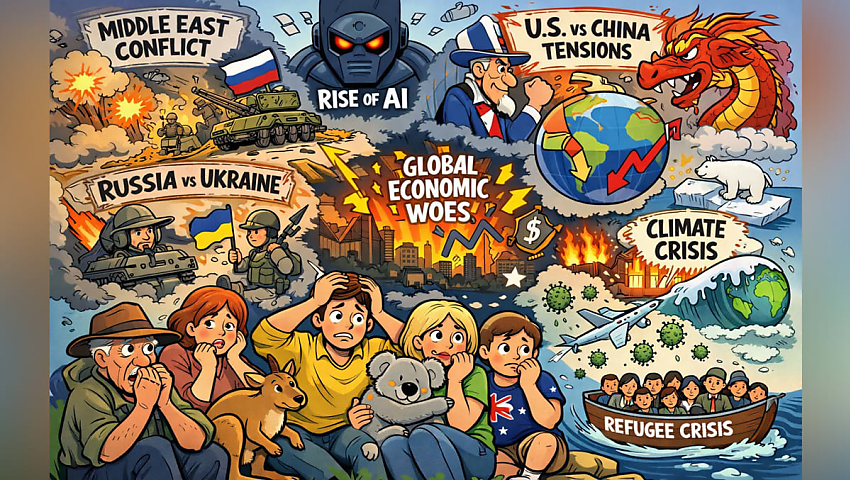
Australia now appears to be living in the reality of the ancient Chinese curse: “May you live in interesting times”, with a growing proportion of the public recognising maybe things aren't quite as rosy as they'd been led to believe.
As a people, Australians have long prided themselves on coming from a lineage and a culture of rugged, resilient, audacious rogues who tamed a vast and unforgiving landmass.
This effort to draw direct comparisons to the drovers, the Anzacs and others from our past continues in many ways to this day, with successive governments eagerly seeking to rekindle these psychological links in order to unify the nation during times of crisis.
We see this social condition whenever there is a devastating bushfire season, a series of “unprecedented” floods or a tropical cyclone, and we saw this on full display during the COVID-19 pandemic.
However, by and large, Australia, and many Australians, only have little connection to that history or that sociocultural consciousness, making it harder for governments to pull on those once trusty leavers. This reality is further complicated by the nation’s formerly cocooning geographic isolation from the world’s major crises of the past century.
Now yes, while Imperial Japan came close to the mainland, and even struck us as far south as Sydney, broadly speaking, Australia and Australians have been shielded from the real ramifications of conflict, economic turmoil, political instability and broader geopolitical chaos that shaped much of the 20th century.
While this stability has been enjoyed by successive generations of the “Lucky Country”, our long holiday from history is coming to an abrupt and increasingly violent end, as the crushing weight of reality smashes through the naive and idealistic view of the world we live in.
Nowhere is this more on show than in the Middle East, as the ramifications of the ongoing conflict between Iran, Israel and the United States continues to have wide-reaching ramifications for global prosperity, security and stability, with Australia, in particular, at the mercy of an increasingly contested and multipolar world.

For Australians, the abrupt and rather confronting tearing of the veil – revealing a peak behind the curtain into how the “sausage is really made” – is serving to utterly and irreparably shatter the confidence of the Australian public in the global “rules-based order” we have been invested in since the end of World War II.
In response, Australians and the Australian government have faced increasing levels of anxiety and uncertainty as the world we were promised following the collapse of the Soviet Union and by the “End of History” narrative no longer exists, presenting a series of significant challenges we must at least acknowledge before we even begin to think about confronting them.
Highlighting this is a recent in-depth poll of 20,000 Australians conducted by the Australian National University’s National Security College, titled No worries? Australian attitudes to national security, risk and resilience, conducted in “three nationally representative surveys (November 2024, July 2025 and February 2026)” and across eight focus groups in November 2025 to reveal the nation’s shifting levels of confidence.
Perhaps most concerningly is this revelation (perhaps unsurprisingly): “In aggregate, our survey data reveals a public where worry about security has risen rapidly, from a large minority to an almost two-third majority in little over a year.”
Safety over ‘national security’
Australian culture has long struggled to differentiate between the competing concepts of safety and security, presenting significant hurdles for policymakers seeking to mobilise the population for a cohesive response to a national security challenge.
However, when it comes to one’s safety, the ambiguity and confusion dissipates fairly quickly. The nation’s response to the COVID-19 lockdowns and the emphatic enforcement of mask mandates through cultural and real policing serve as the most potent and prominent recent examples.
Yet for many Australians, COVID-19 wasn’t viewed as a “national security” concern and was merely a personal safety concern first and foremost. Reinforcing this confusion and convoluted understanding of safety versus national security, the ANU report, spearheaded by the head of the National Security College, Professor Rory Medcalf AM, articulated: “Australians see security as about safety, resilience and the continuity of everyday life.”
At the most basic level, however, safety can be extrapolated and expanded out to be more consequential at the national level, where Australians “prioritise safe and peaceful communities”. National security experts and policymakers would argue that our social cohesion, particularly its declining nature, is a national security concern.
Indeed, the ANU polling stressed that Australians “rate most serious the threats they already feel, related to technology, economics, disinformation, climate and social cohesion” which directly conflicts with: “A threat they consider catastrophic – foreign military attack – is also the one most see as least likely, though a large minority still consider it could happen within the next five years.”
Now that is not to say that “national security” didn’t figure strongly in the consciousness of the Australian public, with the respondents demonstrating a rising anxiety about national security, with the anxiety increase from 42 per cent of respondents in November 2024 to 50 per cent in July 2025, and 64 per cent by February 2026.
Again, however, it is important to recognise the dominance of “non-military” threats in Australians’ threat considerations, with the findings demonstrating that in in “July 2025, Australians rated AI-enabled attacks (77 per cent), severe economic crisis (75 per cent), disruption to critical supplies (74 per cent) and disinformation (73 per cent) as more serious threats than a foreign military attack on Australia over the next decade”.
Interestingly, however, Australians are not naive to the possibility of further shocks, either foreign or domestic, and ones that aren’t necessarily “man-made” either, with the data revealing “on six issues – climate change impacts, AI-enabled attacks, disinformation, foreign interference, economic crisis and critical supply disruption – the proportion who consider the risk more likely than not ‘to happen as a threat to Australia’ within five years was between 85 per cent and 89 per cent”.
What this all reveals is that Australians do have at least a passing knowledge, if not a better understanding of the world’s major events, and indeed, those closer to home that shape our conceptualisation and understanding of security, safety and the responses Australia needs in order to deliver to respond.
Nature abhors a vacuum: Australians want to know more
Critically, Australians want to know more, while there is a lack of knowledge and information from our decision makers, particularly honest and frank assessments by them regarding the challenges but also the opportunities available to Australia if we respond accordingly.
Medcalf hinted at this explaining: “In a time when our security landscape is changing, it would be wrong to assume that Australians are complacent. Most are concerned and want to know more.”
This was echoed by Medcalf’s colleague, Tim Wilford, director of the Community Consultations initiative at NSC, who added: “We found that Australians draw a distinction between resilience in community spirit and resilience in capability, which they perceived as inadequate and under-resourced.”
It is critical to note that despite the sentiment around Australians wanting to be more engaged and informed, one of the key findings of the report was that Australians increasingly felt like the nation was unprepared for any number of shocks that may impact the safety and security of the nation and its people.
Indeed, in July 2025, fewer than one in five respondents believed the nation is “very” or “fully” prepared across every one of the 15 threats surveyed, while on most issues surveyed, most respondents said Australia is either “slightly” or “moderately’” prepared, this also includes the growing recognition by Australians that war is no longer impossible.
Expanding on this further, ANU added: “In no scenario did that level of confidence in national preparedness exceed 18 per cent and on most issues it was between 4 per cent (AI-enabled attacks) and 10 per cent (foreign military attack on Australia). Across two-thirds of the threats, more than half the public feels Australia is ‘not prepared at all’ or only ‘slightly prepared’.”
The ANU report articulated this, saying, “Australians are not oblivious to the risk of war. In our survey of July 2025, 68 per cent consider it more likely than not that the nation would be involved in military conflict with another country within five years. Most saw such a contingency as having major (46 per cent) or catastrophic (18 per cent) consequences for Australia.”
Going further, the ANU report added: “In every case other than military attack, more than two-thirds of respondents considered the risk more likely than not to ‘happen as a threat to Australia’ within five years. In six cases – climate change impacts, AI-enabled attacks, disinformation, foreign interference, economic crisis and critical supply disruption – the proportion who considered the threat more likely than not was extremely high: between 85 per cent and 89 per cent.”
It should now be clear that Australia faces significant challenges and the public wants to know more. They want to be involved in the response, so it’s up to the government to engage us and present the path forward.
Final thoughts
Australia and Australians must recognise the seriousness of the moment we’re in. We owe it to future generations to face honestly the world we’re moving into and the choices that come with it.
This calls for more than small, incremental change. It requires a clear-eyed reassessment of who we are as a nation, how we see ourselves, and how we position Australia in an increasingly contested and uncertain region and world.
The Indo-Pacific is now the centre of strategic, economic and political competition. Countries such as China, India, Pakistan, Thailand and Vietnam are expanding their reach and capabilities, while Japan and South Korea are stepping forward again as major regional powers.
This isn’t some distant possibility; it’s the defining reality of our time and Australia’s national strategy must adapt to it.
Without sustained investment, discipline and long-term thinking, we risk falling behind not just standing still. If we fail to act with purpose, the Australia our children inherit could be diminished in its influence, prosperity and strategic standing.
For too long, governments of all stripes have favoured short-term political comfort over building long-term national strength. That approach is no longer sustainable. The strategic environment is shifting quickly, and complacency comes at a real cost. We must anticipate change, grasp new opportunities and prepare now for challenges that will only become more complex.
The question is no longer whether these pressures will grow, they already have. The real test is whether Australia’s leaders can define and deliver a clear, credible national plan that brings together industry, government and the public behind a shared vision for the future.
Australia now faces a defining choice: accept a passive role in a region shaped by others, or act with confidence and intent to help shape the Indo-Pacific ourselves. The decisions made this decade will determine whether Australia remains secure, prosperous and influential or is left navigating a future shaped by the ambitions of others.
Get involved with the discussion and let us know your thoughts on Australia’s future role and position in the Indo-Pacific region and what you would like to see from Australia’s political leaders in terms of partisan and bipartisan agenda setting in the comments section below, or get in touch at

Want to see more stories from trusted news sources?
Make Defence Connect a preferred news source on Google.
Click here to add Defence Connect as a preferred news source.