

 iscover
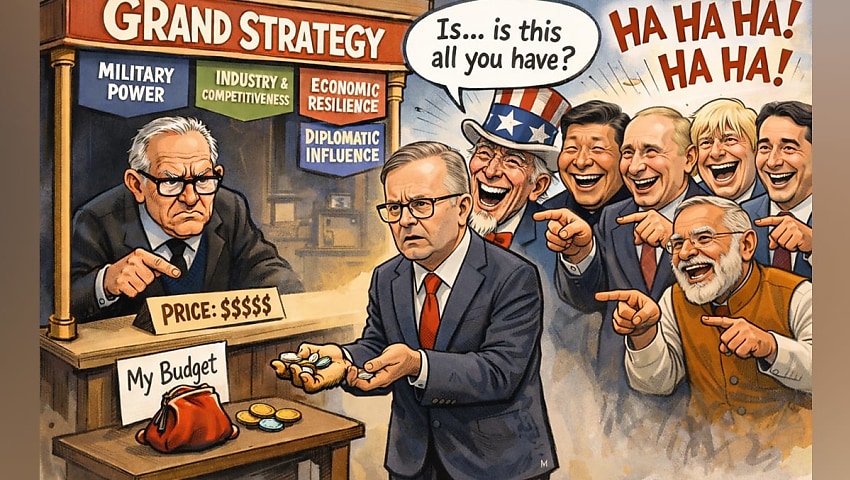
Yet again Australia’s “efforts” to develop and implement a form of “grand strategy” have been left wanting, as pivotal voices in the debate call for Australia to consider looking for a “Plan B” as America becomes increasingly unreliable.
It is not hyperbole to describe Australia’s relationship with the broader international order as one of complacency, confusion and disconnection, born as a result of the nation’s geographic isolation and protection by larger, more “consequential” and considered nations since the earliest days of settlement.
This dysfunctional relationship with the broader world has often resulted in us merely going with the flow, shielded from the harsh realities of the “real world” by the benevolent protection of the British Empire and, more recently, the United States, while affording us the opportunity to benefit economically, politically and strategically from the world these great powers built.
However, today, that worldview and indeed our approach to the global balance of power, the very real competition of the world’s great powers, of which we are increasingly caught in the middle of is coming home, with the reality now hitting every aspect of contemporary Australian life with vengeance.
Now periodically, Australian policymakers and strategic thinkers have sought to shake the nation from its enculturated apathy and banality when it comes to recognising that the world is in fact a competitive environment, where the thinly tied mask of realpolitik has slipped and once again we confront a world we are very disconnected from.
This national failure to develop and deliver at least some modicum of national “Grand Strategy” has ultimately brought us to the position Australia currently faces at every level of public policymaking, a position which is serving to reignite debate among our policymaking elite, and growing interest from a broader cross-section of Australian society.
Capitalising on this, former prime minister Malcolm Turnbull, working with UNSW Canberra’s Professor David Kilcullen – acclaimed author, strategist and counterinsurgency expert – hosted a series of experts at a day-long forum at the National Press Club, titled the “Sovereignty and Security Forum 2026”, during which they unpacked a host of challenges facing the nation in the contemporary geopolitical and security environment.
Front and centre as the core, underlying theme was Turnbull’s favourite cause, decoupling Australia from the United States and our need for a more considered “Plan B” as a matter of urgency, particularly in light of the ongoing conflict in the Middle East and the very real economic, sociopolitical and strategic ramifications closer to home.

Turnbull detailed this, saying, “I felt that our Parliament was gaslighting the Australian people in pretending that nothing had changed, and that everything was the same, and that anybody that suggested we were living in a different environment was somehow or other unpatriotic or alarmist.”
“A year ago, some people thought that when I said the new world order overseen by President Trump is one of might is right, and that international law was no longer to be regarded as applying to the great powers, many thought that was a bit alarmist. Or they hoped that ‘might is right’ was just a subtext. Well, friends, we know that today it’s not a subtext, it’s the headline. It is the headline,” Turnbull added.
We’re living in a very, very different environment
At the core of Turnbull’s longstanding push towards Australia embracing and enacting a “Plan B” is the (correct) recognition that the world we live in, and indeed the one that has guaranteed our economic prosperity, political stability and strategic security over the past eight plus decades, is well and truly at an end.
In particular, it is Turnbull’s disdain for US President Donald Trump and his “brutish” ways that conflict directly with Turnbull’s own assessments of himself as an erudite and infallible leader, one far removed from the harsh realities of life and the distasteful, and inescapable nature of power dynamics and politics, in particular ALWAYS being about one’s capacity to not only give a punch but to take one and keep fighting.
A world Turnbull is no doubt very unfamiliar with.
He does, however, correctly diagnose the challenges we face as a nation, saying, “So we are living in a very, very different environment. We’re reminded of that, of course, with the war currently underway between Israel, America, Iran, and increasingly Iran’s neighbours.”
While this might clash with Turnbull’s sensitivities and Europhile view of the world (look at how well that is working out for them), his diagnosis, as I have alluded to, is in part correct, particularly around the nation’s urgent need to take a more considered and committed effort to developing and implementing a national “Grand Strategy” as part of our pursuit of a “Plan B”.
Bringing me to the fourth panel of the forum hosted by Turnbull, which focused on “A grand strategy for middle powers. Autonomy, alliances and the institutions that shape national power” and included Justin Bassi, executive director of the Australian Strategic Policy Institute; Mike Pezzullo, former secretary of the Department of Home Affairs; high commissioner for Canada in Australia Dr Julie Sunday; and public policy mandarin, Peter Varghese AO, FAIIA.
As the consummate multilateralist, Turnbull framed the concept of a “grand strategy” for middle powers and the resulting need for a post-America “Plan B” as something that can only be done within the confines of multilateral institutions as a means to, as he described, “enhance our sovereign autonomy”.
This push comes following the recent comments by Canadian Prime Minister Mark Carney at Davos, which saw him describe the shifting paradigm of global affairs as a “rupture” which is, as Sunday explained, resulting in Canada taking a “no regrets approach” which means, in Sunday’s words: “Whether it’s a rupture, whether we’re rupturing, whether we go back to a situation more like it has been, we’re going to take actions that will ensure that we’re better off.”
“So no matter what those actions are, we feel it’s worth the effort and the energy, regardless of the world and how it progresses,” Sunday added.
Don’t worry, if this sounds a little bit like “Canada First” as opposed to “America First”, you’re not the only one who had this thought because I certainly did, just don’t mention it to Turnbull.
A ’Grand Strategy’ for middle powers versus ’Plan B’
This push towards a “no regrets” posture is to be reinforced by a considered and determined effort to which, as Sunday explained, “build strength at home”. This then paves the way for Canada to build “strategic autonomy”, although it is something that they concede cannot be done in isolation, hence the link to other middle powers like Australia in an effort for them to establish themselves as “stabilisers” on the global stage.
At the centre of this shift is seeking to avoid engaging with or negotiating with, for that matter, a great power from a position of weakness, whether that great power is the United States, Russia, China, India or any other emerging great power.
Conversely and true to form, Peter Varghese called for less “grandeur” in Australia’s strategy, citing the success built up over the past eight plus decades built upon our alliance with the United States, our links and relationship with the Indo-Pacific region and broader efforts to draw legitimacy and protection from multilateralism.
Varghese then asked: “How much needs to change within those three pillars to reflect what is a very different external environment?” Then pivoted to: “My basic argument is that we will need substantial renovation but we don’t need demolition” if Australia is to survive and thrive in this new world order.
Two of Varghese’s key points is the continued failure of successive Australian governments to accept that the Australia-US alliance is far from the guarantee some within our policymaking community seem to romanticise it as and the repeated and longstanding failures of the same policymakers to adequately and appropriately invest in the sorts of capabilities that would have, to date, provided us with a degree of strategic autonomy and sovereignty and would no doubt position us well to exercise greater strategic sovereignty in the current environment.
This is further reinforced by Varghese’s claims that Australia has steadily shifted towards an unofficial policy and doctrine of “Forward Defence” embodied in the AUKUS trilateral partnership, and the belief in his words that America’s global primacy can wane and Australia will still survive.
Now yes, on the practical level that is correct. Australia as a nation state would continue to survive if America’s unrivalled primacy was called into question (as it appears to be happening now in the Middle East), however, our position within the global order would be significantly diminished unless we appeal to other great powers.
However, Varghese does seek to walk some of his particularly bleak rhetoric, stressing that Australia can have both strategic autonomy and the US alliance; however, it will require considered and significant investment in order to deliver that materially for Australia, the cost of which he doesn’t “want to dwell on”.
Interestingly, Varghese concluded his comments by detailing that in order to survive in this era, far from dependence on a single security or economic benefactor, Australia will need to revive a serious reform agenda in the country, “if we are to have any hope of dealing with our strategic and other challenges”.
Going further, Varghese added: “We’re not going to be a lonely country, but we’re going to have to rely so much more on our own wits and capacity and vision if we’re to make a living in the future.”
Bringing us to Mike Pezzullo’s thoughts, particularly around what he framed as the “conceit and fiction” that Australia can afford to have a grand strategy when as he framed it, “powers such as Australia are always going to be a strategy taker”. flying in direct contrast to the language used by Prime Minister Carney and the ambitions outlined by his high commissioner.
Pezullo articulated that nations like Australia will always: “Derive choices from conditions that are largely set for us. To the extent that Australia’s had a ’Grand Strategy’ and I use that term loosely, we have been a sub-imperial power. We’ve been a sub-imperial power under the British era of maritime supremacy and a sub-imperial power during the period of American strategic ascendency.”
However, where I depart from Pezzullo’s analysis is that Australia can and should cast off these vestiges of “sub-imperial power” to develop a considered “Grand Strategy” that operates within the confines and consideration of the era of renewed great power competition, particularly as it continues to gather steam.
Importantly, this period presents equal challenges and opportunities that will not only serve to shape the nation but the degree of strategic autonomy we will be able to operate and maintain, while doing so within the broader international community.
This brings us finally to the input from Justin Bassi, executive director at ASPI, who begins by arguing against the use of the term “Middle Power” in reference to Australia, saying, “I don’t like the phrase middle power for Australia. It begs us to say that we’re middling and that we really have no ability to talk about sovereignty or having our own agency because the great powers will do what they do.”
Bassi continued, saying, “I think Australia should and has viewed ourselves as a regional power”, however, the traditional frame of reference for this view, something Bassi overlooked is that Australia tends to solely view ourselves as a “regional power” in Oceania and the South Pacific, not the Indo-Pacific, but why?
Well, I would strongly contend it is because Australia is almost allergic to the reality of what is required to be truly considered a “regional power”, particularly within the confines of the broader Indo-Pacific, whereby any standard, we would be currently ranked as a minor power.
However, Bassi argued that Australia will need to be able to “walk and chew gum at the same time” while also recognising that by seeking a “silver bullet”, as we are often wont to do, will leave us in a worse position, which would only be further compounded by seeking to apply the specific lessons for a nation like Canada to Australia.
This brings Bassi to his most concerning observation: “There is no Plan B. There isn’t a guarantee”, which ultimately means Australians are going to have to work it out ourselves, lest we find urgent need of one, especially as we may find ourselves in Bassi’s words “no longer on the strongest side” for the first time in our history.
So what path do we choose?
Final thoughts
Look, I’m probably sounding like a broken record by now, but the reality hasn’t changed: Australia needs a massive wake-up call, and we need it yesterday. We owe that much to the kids coming up, my son and daughter, my niece and nephew, who are going to inherit whatever mess or masterpiece we leave behind.
The truth is that the world is moving a hell of a lot faster than our national conversation. We are currently stuck in a mindset that no longer fits the map. Australia needs a fundamental “factory reset” on how we view ourselves: our economy, our security, and our ultimate ambition in a region that is becoming more crowded and contested by the day.
The Indo-Pacific isn’t just a “neighbourhood” anymore; it’s the global engine room and the primary arena for strategic competition. This isn’t just about the titans like China or India. We’re seeing a surge of ambition from middle powers like Thailand and Vietnam, while established industrial heavyweights like Japan and South Korea are stepping up their game.
This isn’t a “future trend”. It’s the water we’re already swimming in.
Australia’s national strategy is lagging. We’ve spent decades drifting, prioritising the next election cycle over the next generation. We’ve relied on old habits and reactive policies that simply don’t cut it in a hybrid world order where economic leverage is used as a weapon and technology moves at breakneck speed.
If we keep drifting, the next generation will inherit a country that might look wealthy on paper but is essentially a bystander powerless to influence its own backyard.
To thrive, we must stop being a passenger in our own region. We need to build true strategic autonomy. This isn’t about isolation; it’s about having the backbone to act in our own interests, distinct from the constraints of legacy relationships.
To get there, we need:
- Economic and industrial resilience: We can’t just be a “farm and a quarry”. We need a sophisticated industrial base that can innovate and scale.
- Material defence capability: “Fit for purpose” isn’t enough. We need hard power that gives us the weight to shape regional outcomes, not just observe them.
- Sovereign competitiveness: We must mobilise industry and government behind a clear-eyed plan to secure our supply chains and technological edge.
The pressures we face aren’t hypothetical; they are unfolding right now. Canberra has a choice: we can remain a polite bystander while others decide the future of the Indo-Pacific, or we can step up as a nation determined to shape it.
Incremental shifts won’t save us. We need the foresight to spot shocks before they hit and the ambition to lead. The next decade will decide whether Australia is a player or just a prize. It’s time to choose.
Get involved with the discussion and let us know your thoughts on Australia’s future role and position in the Indo-Pacific region and what you would like to see from Australia’s political leaders in terms of partisan and bipartisan agenda setting in the comments section below, or get in touch at

Stephen Kuper
Steve has an extensive career across government, defence industry and advocacy, having previously worked for cabinet ministers at both Federal and State levels.
Want to see more stories from trusted news sources?
Make Defence Connect a preferred news source on Google.
Click here to add Defence Connect as a preferred news source.