iscover
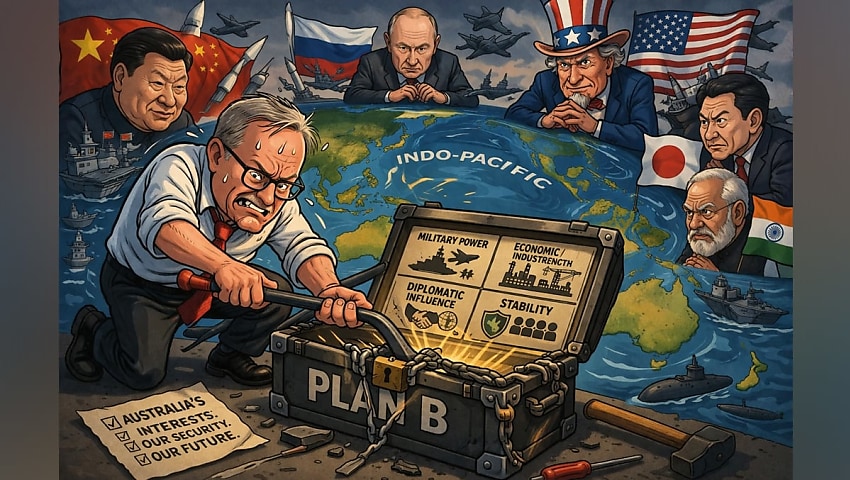
The fallout of America’s disastrous campaign against Iran, coupled with the continued fraying of the “rules-based order”, has Australia being urged to seriously consider a Plan B, but what exactly does that look like?
Australia stands at the edge of an immense and rapidly approaching precipice. Behind us is the old world, led by the unrivalled United States, stalwart in its self-confidence and its position atop the global order, providing security and stability, which have served as the building blocks of modern life.
Ahead of us, however, is a world of chaos and disruption, driven in part by the increasingly mercurial and seemingly demolition-minded American president, coupled with a rapidly beleaguered American public tired from decades of conflict in the Middle East and other “Forever Wars”, and of course, the emergence of a constellation of powers seeking to rival and, in some cases, usurp the global order.
Not least of these is the People’s Republic of China, which has transformed rapidly since the “liberalising” days of Deng Xiao Ping into the world’s premier industrialised economy with the economic, political and strategic ambitions and drive to challenge the established world order.
Flanking China’s rise and adding further complicating factors are the likes of Indonesia, India, Russia, Brazil, South Africa, Pakistan, Vietnam, Thailand and a host of formerly developing nations, all with their own unique ambitions, driving principles that are rapidly accelerating up the world’s economic, political and strategic power rankings to directly challenge the established, post-World War II order.
In light of these factors transforming the global balance of power, Australia’s policymakers have been increasingly urged to seek a “Plan B” in the event that our primary security benefactor, the United States, becomes increasingly unpredictable or incapable of acting in what Australia perceives as its own “best interest”.
These calls have seen various models proposed, ranging from neutrality ala Switzerland through to the long-championed “Echidna Strategy”, which is by its very nature a doubling down on the “Defence of Australia” doctrine first articulated in the late 1980s as part of the nation’s formalised shift away from the era of “Forward Defence”.
While other proposals take a far more assertive view of Australia’s role in the Indo-Pacific, particularly as the global and regional balance of power continues to shift and evolve before our very eyes. Each of these proposals has both strengths and weaknesses, as is to be expected, but in the words of American Founding Father Benjamin Franklin: “If you fail to plan, you are planning to fail.”

But what is the best path forward and how should Australia go about developing its own “Grand Strategy” as the foundational bedrock of any true “Plan B”?
Avoiding single points of failure to secure our sovereignty
As previously mentioned, each of the proposed strategies have their own unique set of pros and cons, presenting Australian policymakers with an equally complex set of challenges to navigate, account for and, in turn, overcome.
It is worth stating upfront that the risk-reward equation of adequately preparing a “Plan B” strategy as a form of national insurance, more than anything else, is too high a cost to bear, particularly as Australians are already exposed to the real-world ramifications of global geopolitical tensions on the daily.
With this in mind, it becomes rapidly clear that entirely designing and implementing a single version of the long-championed strategies for an Australian “Plan B” are not going to cut it in the modern world, rather, Australia requires a hybrid approach to confront, survive and, indeed, thrive in a world where we require a “Plan B”.
By their very nature, rigid adherence and overinvestment in any single strategy is inherently brittle and serves to leave Australia exposed to any host of shocks that may occur, therefore we need a hybrid strategy to form the basis of our “Plan B”, one that combines the strengths of each proposal and seeks to minimise the inherent weaknesses in each.
But what exactly does this hybrid “Plan B” look like?
Australia’s hybrid ’Plan B’
First and foremost, Australia’s “Plan B” is an insurance policy that prepares for a number of possible realities that could unfold, whether in the Middle East, Europe or closer to home in the Indo-Pacific, requiring a degree of flexibility, adaptability and agility to adequately protect the nation and its sovereignty.
Let’s begin with the “Echidna Strategy”, which would seek to transform Australia into one of the hardest places on earth to project force against, sacrificing expeditionary capability for overwhelming Integrated Air and Missile Defence, continental-based long-range strike and homeland defence.
What this approach fails to account for is the limited ability to shape events offshore in the region and directly “reach out and touch someone” if we were to face challenges to critical supply chains and sea lines of communication upon which the Australian economy and way of life overwhelmingly depends.
Ultimately, this would leave us dependent on the enduring goodwill and benevolence of regional neighbours and is best described as an idealistic and optimistic view of the world.
That isn’t to say that we should take a purely zero-sum view of the world and region, nor should we let that zero-sum approach completely shape the nation’s “Plan B”.
Shifting to the second option, this disproportionally shapes Australia into the primary Indo-Pacific middle naval power, capable of providing theatre level sea control, escort and a degree of expeditionary strike. This would, in essence, shape Australia into the region’s “hegemon-lite”.
However, this approach equally isn’t without its weaknesses and while it would enable us to assertively control the sea lines of communication across the region, it would be by far the most cost-prohibitive model, while also baking in a degree of vulnerability to missile saturation against a peer competitor.
Bringing us to the third model, or what could be colloquially termed the “Ausraeli” model that combines elements of Australian strategy and Israel’s prioritisation on technology, supported by large-scale mobilisation and heavily defended nodes within the nation’s boundaries; however, it too faces significant issues requiring societal buy-in, a slower initial response versus standing force.
Finally, we have the “Indo-Pacific Balancer” model which sees the nation position itself as the indispensable coalition integrator, optimised to fight with allies, not alone. This model is highly efficient, provides strong alliance leverage; however, it too makes us overwhelmingly dependent on allies and provides less independent deterrence capability.
But what if we create a hybrid of these models?
Such a hybrid would result in a force that can fight independently if required but is optimised to be the decisive coalition integrator in the Indo-Pacific while remaining resilient, scalable and survivable.
By 2040, Australia’s optimal force structure reflects a deliberate shift towards sovereign resilience, maritime power and coalition leadership, built on a balanced mix of denial, sea control, integration with partners and national mobilisation depth.
The result is not simply a larger defence force but a more integrated and strategically coherent system designed to operate independently where required, while remaining the Indo-Pacific’s most capable coalition partner.
At its core, the force is anchored by a powerful Navy, supported by a highly capable Air Force and a more focused Army. The maritime domain becomes decisive.
A fleet centred on nuclear-powered submarines, advanced surface combatants and autonomous systems provides both sea denial and sea control, ensuring Australia can secure its northern approaches and key sea lines of communication.
Long-range strike capabilities, previously distributed across land forces, are now concentrated in naval platforms and airpower, delivering greater reach, survivability and flexibility.
The Air Force underpins this approach as the primary strike and integration arm, combining crewed platforms with uncrewed systems to deliver precision effects across vast distances. Its expanded ISR and battle management capabilities position Australia as a coalition enabler, able to fuse data, direct operations and sustain joint forces across the region.
Meanwhile, the Army is reshaped into a highly mobile, defensive and enabling force, focused on protecting critical infrastructure, providing integrated air and missile defence, and supporting amphibious and regional operations.
Crucially, this structure is reinforced by a substantial Strategic Operations Command, integrating space, cyber, special operations and autonomous systems into a single “kill chain” that connects sensors to shooters across all domains. Complementing this is a robust reserve system, ensuring Australia can scale rapidly in crisis and sustain prolonged operations.
However, such a force cannot exist in isolation from the broader economy. Delivering and sustaining this capability demands a step change in economic diversity and industrial competitiveness.
Australia must move beyond its reliance on resources and services to develop a sovereign, dual-use industrial base, spanning advanced manufacturing, shipbuilding, missile production, space systems and autonomous technologies.
This is not simply about defence procurement; it is about national resilience. A more complex, innovative economy enables secure supply chains, technological advantage, and the workforce depth required to sustain high-end military capability.
Ultimately, this force structure is both a product of and a catalyst for a more self-reliant Australia, one capable of defending its interests, shaping its region and underpinning its sovereignty through both military strength and economic power.
Final thoughts
Australia can no longer afford the luxury of sleepwalking through history. The era of incrementalism is dead; the era of consequence has arrived.
The Indo-Pacific isn’t just a geographic neighbour; it is the world’s primary arena for power. As giants like China and India surge and regional powers like Japan and South Korea redefine their roles, Australia’s old playbook has become a relic. This isn’t a “future scenario”. It is our current reality.
To survive and thrive, we must strip away the complacency that has defined our politics for decades. For too long, we’ve traded long-term national strength for short-term political comfort. That bill is now due.
The stakes
- The risk: without immediate discipline and massive, sustained investment, we don’t just stall, we decay.
- The cost: if we fail to act, we hand our children a diminished nation – one with less influence, less prosperity and less control over its own destiny.
The choice
We are at a fork in the road. We can either:
- Accept a passive role: watching from the sidelines as more ambitious nations dictate the terms of our security and economy.
- Act with intent: forging a credible national plan that aligns industry, government and the public towards a singular, assertive vision.
The pressures are already here. The only question left is whether our leaders have the spine to shape the Indo-Pacific or if they will settle for an Australia shaped by the ambitions of others.
The clock is ticking.
Get involved with the discussion and let us know your thoughts on Australia’s future role and position in the Indo-Pacific region and what you would like to see from Australia’s political leaders in terms of partisan and bipartisan agenda setting in the comments section below, or get in touch at

Stephen Kuper
Steve has an extensive career across government, defence industry and advocacy, having previously worked for cabinet ministers at both Federal and State levels.
Want to see more stories from trusted news sources?
Make Defence Connect a preferred news source on Google.
Click here to add Defence Connect as a preferred news source.