

 iscover
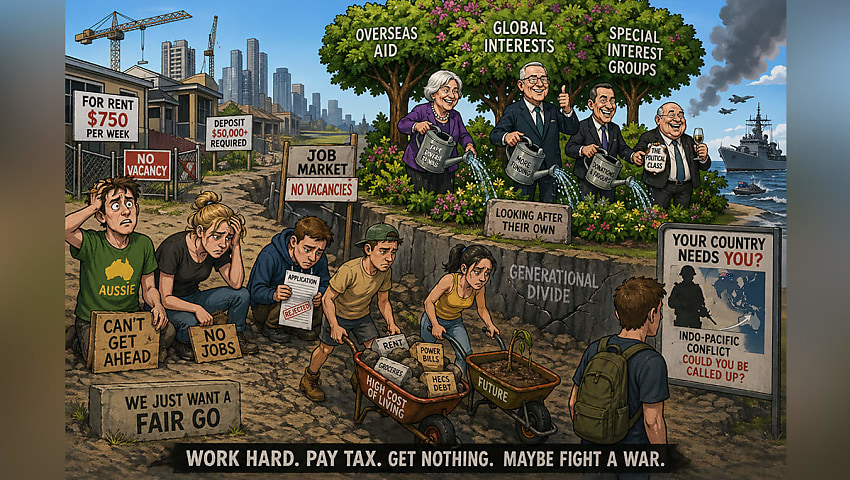
Generations of Australians aren’t just disillusioned, they’re done. Done with a system that ignores them, a dream that was sold out from under them, and leaders who never saw the danger coming. Until now.
For the better part of a decade, Australian society and politics have seen a bubbling anger, apathy, jealousy and solipsism simmering just beneath the surface, as successive generations of Australians continue to clamour for the last remaining crumbs of what appears to be an ever shrinking pie.
This intergenerational conflict really emerged in the public consciousness in large part with the disastrous federal budgets of 2014 and 2015, respectively, handed down by then treasurer Joe Hockey; however, it is fair to say that many of the structural issues that continue to characterise the collision course which both older and younger Australians have been placed on with wide-reaching ramifications are only just starting to be felt.
Most will recall the now infamous quote attributed to Hockey (it came from Australian millionaire Tim Gurner) about young Australians needing to “find a good-paying job” and abandon luxurious dining options like “smashed avocado” breakfasts to get themselves onto the property ladder, or put more simply, pulling themselves up by their boot straps and just working hard like their parents and grandparents before them.
Understandably, younger Australians felt rather put out, something that has only continued to filter down through successive generations of young Australians who have only become more disenfranchised, atomised and disconnected to the future direction of the country.
Conversely, on the other side of the economic, political and demographic ledger stands the Boomer generation, born in the heady days post the Second World War, who, unlike their descendants, were blessed with a nation characterised by stability, prosperity and opportunity throughout the end of the 20th century.
Now in their golden years, many of the older generations look down their noses at the plight and struggles of their children and grandchildren, seemingly disconnected from the reality of contemporary life for young Australians, instead defaulting to name-calling and minimising the concerns of their descendants.
All of this has ultimately served to ultimately exacerbate and enflame the tensions that have been simmering for the better part of the last decade, resulting in mounting social cohesion, economic, political and strategic issues as young Australians feel increasingly disenfranchised by the nation and their place in it

I can already hear many of you asking, what does all of this have to do with Australia’s defence and national security? Well, thankfully, the Australian National University has conducted some useful analysis, revealing some startling revelations into just how atomised and nostalgic modern Australians are, despite what some in our political class would have us believe.
Leading the charge is Australian National University professors Nicholas Biddle and Matthew Gray, who, in a study titled Holding together, just: Wellbeing, economic strain, and democratic resilience in Australia, March 2026 , shed light on the average life satisfaction that has dramatically fallen, with some shocking results and even more shocking results for Australia’s national security.
Setting the scene, Biddle said: “Australia in March 2026 is a country under considerable strain .. Average life satisfaction has fallen to 6.22 on a scale of zero to 10, the lowest recorded in the ANUpoll series and below levels reached during COVID-19 lockdowns.”
“Unlike the lockdown periods, this decline is not a sharp shock from a higher base: life satisfaction was already depressed, making the current reading the culmination of a sustained deterioration rather than a sudden fall,” Biddle added.
Also, just for the record, “anemoia” is a nostalgia for a time, place or experience one has never actually known or lived through; if you’re wondering why this is relevant, you’ll see shortly.
Life was better 50 years ago
The report paints a bleak picture of national mood. Wellbeing is at a low: average self‐rated life satisfaction fell to 6.22/10 in March 2026, the lowest in the series (which began in late 2019). This level is below even lockdown-era lows in 2020, reflecting a steady decline. For the first time, more Australians are dissatisfied than satisfied with the country’s direction (54 per cent versus 46 per cent).
Meanwhile, the report recognised that economic stress is high. About 34.9 per cent of respondents report it is difficult or very difficult to live on their current income (a record high for ANUpoll). Most people have taken at least one significant “coping” action (cutting spending, seeking help etc) in the past year. Employment anxiety is severe: employed respondents assess a 26.8 per cent chance of losing their job – statistically the same level as during the height of COVID-19 lockdowns – even though official unemployment is only ~4.3 per cent.
The ANU report also revealed a major driver of this economic concern is automation fears: 30.3 per cent of workers now worry machines/computers will replace their jobs (nearly double the 2018 rate), something that has increasingly figured strongly in concerns raised by Millennial workers in what has charitably been referred to as the “laptop class”.
Ultimately, this has resulted in the return of nostalgia for a simpler, more connected and stable period, something that many young Australians envy their parents for, with the ANU report establishing, nearly three in five Australians saying life was better 50 years ago and a similar sharing they expect it will be worse 50 years hence. The gap between optimism and pessimism is stark. For example, 65.0 per cent believe today’s children will have worse lives than their own (only 19.0 per cent think the next generation will be better off) – a “pessimism gap” of 46.1 percentage points, up from just 18.6 points in 2008.
While in the short term, too, more Australians think their personal life and the economy have gotten worse (since Jan 2025) than better (see Box 2 in the report). Overall, on a composite optimism index (scale 8–40), the average Australian scores only ~19.6, well below neutral. However, there are pockets of optimism: Box 2 of the report noted that younger Australians (especially age 18–24) and university graduates are considerably more hopeful about the past and future than older or less-educated people.
Similarly, those born overseas or speaking a non-English language at home tend to hold sunnier views. (Gender and regional differences were not prominent or detailed in the report’s summary.) Importantly, education emerged as the strongest predictor of positive outlooks: degree holders report higher life satisfaction, more confidence in institutions and lower financial stress.
Despite the gloom on well-being, support for democracy remains resilient. Nearly two-thirds (65.7 per cent) said they are satisfied or very satisfied with the way democracy works and broad majorities endorse core democratic values (e.g. ~90 per cent agree nobody should be above the law). As one finding puts it: “The resilience of Australians’ democratic attitudes stands out as one of the paper’s most striking findings.”
Regardless of that small ray of sunlight the study revealed, the report authors detailed: “For the first time in the data we have been collecting in the 2020s, more Australians are dissatisfied with the direction of the country than satisfied ... Almost three-in-five Australians (59.1 per cent) believe life has worsened over the last 50 years, while only 15.3 per cent believe it has improved.”
Starling feedback as we are told on an almost daily basis that our lives are better than at almost any other point in history and something that also spells major trouble for Australia’s national security.
Nostalgic for a life we never had, or is it?
The ANUpoll’s finding that Australians are “yearning for the good old days” reflects a broader mood of discontent. High living costs (inflation, housing, energy) and global uncertainties (e.g. wars, supply shocks) have hit public morale. The perception that life in 1976 was better may partly reflect economic and social conditions of that era (e.g. university fees gone, cheaper housing relative to income, job security, social cohesion and quality of life) or simply nostalgia bias.
It is reasonable to argue that psychologists note a “well-documented tendency” for people to recall the past fondly and view the future pessimistically, particularly in a country where the GI generation and Baby Boomers (now age 60+) are a large cohort, their memories of the 1970s may dominate survey results.
However, the sharp swing in attitudes since January 2024 (when majorities thought the past 50 years had been improving) suggests current concerns strongly colour perceptions. It may indicate rising anxiety about whether younger people will have a fair go. Indeed, the record gap (65 per cent versus 19 per cent) on whether children will have better lives points to fears of intergenerational decline, a signal that may bear on debates about housing, jobs and climate policy for youth.
For policymakers, this pessimism is worrying: disillusionment can fuel political disengagement or, as is more concerning for liberal democracies like Australia, drive support for radical ideas.
The persistence of high democratic satisfaction (in spite of economic anxiety) is notable. It suggests Australians’ faith in institutions has not collapsed, but the report cautions that this may hold “only just” as pressures mount. Historically, periods of economic strain have tested Australian social cohesion (e.g. recessions or the 2020 bushfires). The authors suggest we are not seeing democratic breakdown, but a “fragile” balance.
However it is worth nothing that if unhappiness deepens (e.g. in future polls), risks could emerge (as in other democracies showing “resentment” trends). Overall, the results reflect a society under stress.
The ANUpoll authors highlighted that attitudes are not uniform: younger, educated and migrant communities are relatively more positive about Australia’s direction (perhaps due to optimism bias or different reference experiences). These subgroup nuances matter for understanding electoral politics and policy responses.
Ultimately, this is reflective of broader trends, particularly for young Australians. In particular, those believing life was better 50 years ago is more than a mood point; it is a warning sign about social contract stress.
ANUpoll’s March 2026 wave found 59.1 per cent of Australians think life has worsened over the past half-century, while 58.5 per cent expect it to be worse again in 50 years’ time. The same survey found average life satisfaction had fallen to 6.22 out of 10, its lowest level on record, and 34.9 per cent of Australians were finding it difficult or very difficult to live on their current income.
For young Australians who feel atomised, dislocated and betrayed by older generations, the national security implication is not simply anger – it is erosion of cohesion. A generation that believes the country has traded its future for the present is less likely to trust institutions, less likely to accept sacrifice, and more likely to see the system as rigged against it.
That matters because national resilience depends on consent, legitimacy and a shared sense of purpose, not solely on tanks, missiles and budgets. As the ANUpoll also found, employed Australians’ expected probability of losing their job had risen to 26.8 per cent, while concern about automation had nearly doubled since 2018 to 30.3 per cent, deepening the sense that work itself is unstable.
In security terms, this kind of resentment can become a force multiplier for instability. It can weaken recruitment into the Australian Defence Force and the broader public sector, blunt willingness to support hard choices in a crisis, and make younger people more receptive to anti-establishment politics, conspiracy thinking or foreign influence and information warfare narratives that portray Australia as decadent, divided or self-serving.
While that does not mean democratic breakdown is imminent, the warning is clear: when people feel abandoned, they stop defending the system with the same conviction.
The most important strategic task, then, is repairing intergenerational confidence. The report suggests younger Australians, degree holders and migrants (particularly those of recent years where the life they’re coming to, no matter how hard compared to what we have known) are relatively more optimistic, which implies the problem is not universal despair but a fractured national story.
For many young Australians (even myself with a young family) in particular, we ask a simple question: what is the point?
Final thoughts
Australians believing life was better 50 years ago is not just a backward glance, it is increasingly becoming a forward-looking risk. When that sentiment converges with what younger Australians are now calling “nostalgiamaxing”, it reflects something deeper than cultural longing. It is a reaction to perceived dispossession: a belief that the economic security, social mobility and national confidence once taken for granted have been structurally denied to them.
What is striking is not simply the frustration, but its breadth. Despite visible polarisation, younger Australians across the political spectrum are converging on a shared diagnosis – that the system is no longer delivering and that decline is being managed rather than reversed. This convergence matters. It suggests the issue is not ideological fragmentation alone but a loss of faith in the underlying settlement itself.
From a national security perspective, this is where the risk sharpens. A generation that feels unheard and excluded is less likely to internalise the obligations that underpin national resilience, from civic participation to military service. The tension becomes particularly acute when warnings of a deteriorating strategic environment are paired with calls for sacrifice. For many younger Australians, the implicit question is unavoidable: defend what, exactly, and for whom?
The emerging signs of political radicalisation, while still contained, reinforce this trajectory. The coexistence of protest movements on both ends of the spectrum, from pro-Palestinian activism to anti-migration rallies and fringe extremist activity, points to a system under strain but not yet broken. History suggests that this “pre-threshold” phase is critical. It is the point at which grievances can either be absorbed (and some would argue that the waves of recent mass migration would be an effort to absorb or contain these grievances) or addressed or allowed to compound into something more destabilising.
The path to stabilisation is neither abstract nor particularly novel, but it is politically difficult. It requires older and more economically secure cohorts to acknowledge that these grievances are not exaggerated but grounded in material realities, housing access, cost of living, job security and long-term opportunity. More importantly, it requires a rebalancing of who carries the burden of adjustment.
Absent that shift, the trajectory is unlikely to remain static. Social cohesion will continue to erode, trust in institutions will decline further, and governments may increasingly rely on coercive or regulatory mechanisms to maintain order, treating symptoms rather than causes.
The strategic question, then, is not whether Australia can afford to act, but whether it can afford not to. Because once a generation concludes it has no stake in the future, the foundations of both prosperity and security begin to hollow out, quietly at first, and then all at once.
Get involved with the discussion and let us know your thoughts on Australia’s future role and position in the Indo-Pacific region and what you would like to see from Australia’s political leaders in terms of partisan and bipartisan agenda setting in the comments section below or get in touch at

Want to see more stories from trusted news sources?
Make Defence Connect a preferred news source on Google.
Click here to add Defence Connect as a preferred news source.