

 iscover
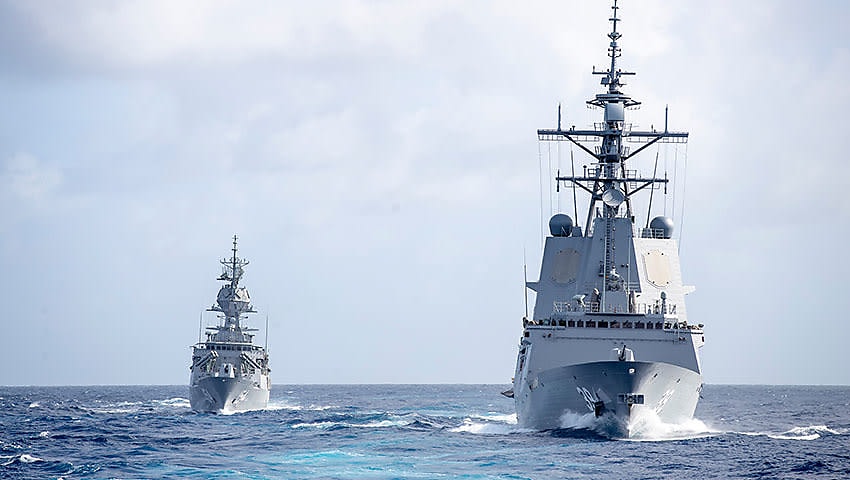
With all the talk around the level of defence spending as a percentage of GDP, I thought I would run an interesting thought experiment: ask AI what a credible middle power military would look like for Australia. What it gave me was interesting, but not surprising.
Australia has long prided itself on being a reliable, dependable “middle power” firmly invested in the economic, political and strategic norms established in the ashes of the Second World War and largely enforced by the United States as the global hegemon.
However, as time has continued and the world has evolved from a bipolar world throughout the Cold War to a monopolar moment dominated by the United States in the aftermath of the Cold War (which seems to have passed in the blink of an eye to be replaced by a multipolar world), the conceptualisation and understanding of what makes a contemporary “middle power” hasn’t really changed.
Australia, its policymakers and its people are immensely guilty of falling into a trap of not evolving with the times, ensconced in the enduring protective cocoon of the “tyranny of distance” and our seemingly infinite confidence in our great and powerful friend.
As a result, this naivety and hubris often results in the nation embracing and entrenching outdated models, concepts and resulting policy decisions being implemented, leaving us at the mercy of the ebbs and flows of the global tide, with little-to-no agency, and nowhere is it clearer than in the way Australia prepares and shapes its military capabilities.
The first mistake in any discussion of a “middle power” today is to treat it as a diplomatic rank rather than a force-design problem. As I have alluded to, that may have worked in the benign, rules-heavy, post-Cold War years when globalisation lowered the cost of interdependence and the United States underwrote much of the strategic order.
The reality is it is a much poorer guide in 2026.
Indeed, Australia’s own 2026 National Defence Strategy (like all of its predecessors going back as far as the 2009 Defence White Paper) said the strategic environment was already deteriorating and that the response must be more self-reliant, stronger industrial foundations and trusted regional partnerships.

The Stockholm International Peace Research Institute’s (SIPRI) latest figures show why that matters: world military spending reached US$2.887 trillion in 2025, the 11th consecutive annual rise, with Asia and Oceania up 8.1 per cent and the global military burden at 2.5 per cent of gross domestic product (GDP), the highest since 2009. The Australian Parliamentary Library’s assessment is even starker, noting that the Indo-Pacific has significantly deteriorated and that major conflict is now possible with little warning.
Important context
Against this context, it is becoming increasingly clear that the concept of traditional middle power thinking needs an urgent rethink. The early post-Cold War model assumed that capable but not dominant states could compensate for limited hard power through niche diplomacy, institution-building, and a kind of moral leverage that came cheaply.
A lot of that thinking was formed in what one recent Pacific Forum analysis called the “early post-Cold War era”, and it argued those assumptions are no longer fully valid. The same piece noted that Indo-Pacific middle powers are now concentrating more explicitly on power, self-sufficiency, coalition-building and minilaterals such as the Quad and AUKUS.
Recent analysis by the Carnegie Endowment for International Peace made a similar point from the opposite direction: the old rules-based order has fractured, multilateralism is in crisis, and middle powers now have to operate as power-aware actors rather than as passive norm entrepreneurs.
Ultimately, this has important and often overlooked impacts on the way middle powers, like Australia, go about building their militaries and broader national security and defence capabilities. Where in the Australian context, we have sought to move away from the concept of a “balanced force” towards an “integrated, focused force”, it becomes clearer that the right outcome is a force balanced by effect.
The prompt
With all of this in mind, I decided I would run an interesting thought experiment, I would ask AI with a strict prompt how it would shape the Australian Defence Force along some strict parameters outlined in the below prompt:
“How would you design/build the armed forces of a credible middle power? For reference, this middle power is a parliamentary democracy, with a population of 25-30 million, with an economy worth approximately US$2-2.5 trillion, with a spending target of 2.5-3 per cent of GDP per annum, while keeping pace with inflation, and strong equities and interests in global economic, political and security norms.
"As part of this, please provide a comprehensive force structure model, including manpower requirements and structure, platforms and growth pathways and reasoning. Additionally, please provide the best model for forces available from a 2.5 per cent spend versus a 3 per cent of GDP spend. As part of this, please provide a detailed narrative including the justification for the capabilities proposed and their role both in a sovereign force and as part of a contribution to a coalition force.”
Just for awareness, I gave Australia an economy of between US$2–2.5 trillion, as this is likely to be the size of the national economy in the coming five years on current growth modelling (we are currently at approximately US$2.12 trillion as at 1 May 2026, according to the analysis by the International Monetary Fund and Commonwealth Bank of Australia, with an approximate growth rate of 2.2 per cent per annum).
So let’s see what it came back with.
At the high level, there is some similarity. Critically, AI identified that in this context, the best military is one that can do five things at once: deny an adversary easy access to your maritime approaches; absorb and survive strikes; impose costs at range; operate credibly with allies; and keep fighting when supply chains are disrupted.
In practical terms, that means a sea denial and air denial core, a land force built for littoral defence and expeditionary reinforcement rather than continental mass, and joint enablers that make the whole system resilient, networked and survivable. The 2026 NDS’ emphasis on self-reliance and industrial depth is exactly the right direction of travel.
2.5 per cent – A ’minimum credible denial force’
At 2.5 per cent of GDP, roughly US$50–62.5 billion a year for the economy specified, the force should be designed as a minimum credible denial force.
It should not try to be everything; it should try to be hard to ignore. The active force could sit at about 67,500 personnel (as it stands, the Australian Defence Force has a full-time force of “over 61,000” personnel according to the NDS, while targeting 80,000 by 2040 as planned under the previous government).
Additionally, the AI called for a reserve force of roughly 25,000 Reserves (down from the current overall force of approximately 33,000) for surge, infrastructure defence, cyber, logistics and reinforcement. Unsurprisingly, the Army would account for about 23,000 of the active component, the Navy 18,500, the Air Force 17,000, and Joint/Cyber/Space/Special Operations Forces about 9,000–10,000.
The Army in this model should be built around two combined arms brigades and one littoral manoeuvre brigade, rather than a large number of under-resourced formations.
One brigade should be the heavy counter-attack and anti-landing formation, with an armoured regiment, mechanised infantry, self-propelled fires, engineers, air defence and attack aviation support. A second should be a medium formation optimised for rapid movement, regional deployment and contingency operations.
The littoral brigade should be lighter, with protected mobility, drones, loitering munitions, anti-armour weapons, small boat mobility, engineers and air defence.
Around that core force should sit a long-range fires brigade with precision rocket artillery, counter-UAS and mobile air defence, plus a lean but serious army aviation element. In platform terms, a sensible minimum is around 96 main battle tanks, 250–300 infantry fighting vehicles, a substantial protected mobility fleet, and roughly 48–54 long-range precision launchers.
The point is not to build a continental army; it is to build one that can stop a landing, punish a lodgement and contribute a brigade-sized formation to a coalition.
Shifting gears towards the maritime navy, AI proposed a force not dissimilar to the current Royal Australian Navy’s force structure, with an emphasis on delivering a “true combat navy, not a presence fleet”, with a backbone of six submarines, three modern air warfare destroyers, four anti-submarine frigates, two amphibious ships for regional lift and coalition entry operations, two replenishment ships plus mine warfare, seabed surveillance and a growing uncrewed surface and undersea flotilla.
The submarine force is the critical element: in a contested Indo-Pacific, it is the most survivable way for a middle power to impose uncertainty, complicate enemy planning and tie up far larger forces. The surface fleet should be tuned for escort, air defence, ASW and task group command, not dispersed constabulary tasks. The amphibious force matters because a middle power that cannot move troops, disaster relief and equipment across the littoral cannot shape its immediate region, nor can it support coalition operations with any speed.
Again, the air force at 2.5 per cent should prioritise range, survivability and sortie generation over raw size. A credible baseline would be three fighter squadrons or around 72 multi-role combat aircraft, backed by six airborne early warning aircraft, six to eight tankers/transports, eight to 10 maritime patrol aircraft, and a growing uncrewed wing for ISR, electronic warfare, decoying and strike. Sounds all oddly familiar, right?
Integrated ground-based air and missile defence should be treated as part of the air force ecosystem, not a separate afterthought. The right idea here is not exquisite scarcity; it is enough mass to keep a combat air picture alive, enough tanking to extend reach, enough maritime patrol capability to maintain undersea awareness, and enough drones to multiply the effect of every manned platform.
In coalition terms, this is the niche that matters: air domain awareness, aerial refuelling, maritime strike, electronic support and integrated air defence.
Finally, at a 2.5 per cent of GDP spending, joint capabilities are what make the whole structure credible. A Joint/Space/Cyber/SOF command of about 9,000 personnel should centralise cyber defence and offence, electromagnetic warfare, space support, strategic intelligence, targeting, special operations, health, logistics and joint fires coordination.
In a digitally contested Indo-Pacific, this is not a luxury layer. It is the command system that allows the force to survive first contact, see first, shoot first and stay connected. The most important investment here is not a flashy new platform but a hardened and redundant command-and-control architecture, sovereign data links, prepositioned stocks, dispersed fuel and ammunition, and enough trained Reserve specialists to keep the system alive under pressure.
3% – depth, mass and persistence
At 3 per cent of GDP, which roughly equates to US$60–75 billion a year, the concept of a denial force does not change, rather the force gains depth, persistence and growth margins.
At the high level, the active force could rise to around 80,000 personnel (Australia’s current 2040 objective), with a Reserve component of about 35,000 (approximately comparable to the current Australian Reserves Force).
This increase in spending would see the Army grow to 28,000 active, the Navy to 22,500, the Air Force to 20,000 and Joint to about 9,500, critically, while minor personnel increases are split across the force. The central philosophy does not change, rather the scale of the hedge against failure.
The Army at 3 per cent should add a third combined arms brigade and an integrated air defence brigade, creating a genuinely resilient land component able to rotate forces, defend infrastructure, and support multiple domestic and regional contingencies at once.
That allows the state to hold a more forward posture in the north and east without hollowing out readiness. It also gives the government a more credible contribution to coalition land operations, especially if allied planners need a formation that can deploy with its own fires, engineers and sustainment.
Meanwhile, the Navy at 3 per cent should deepen to eight submarines, four air warfare destroyers, six anti-submarine frigates, two amphibious ships, and three replenishment/support vessels, with a more mature autonomous maritime layer and greater magazine depth.
That extra pair of submarines matters enormously: it creates a force that can sustain pressure, not just generate it episodically. The additional frigates and replenishment ships are what turn a capable navy into a persistent Indo-Pacific actor. They enable more escort availability, more time on station and more options for coalition task groups. In a region where presence is often mistaken for persistence, that distinction is decisive.
Air Force at 3 per cent should move to four fighter squadrons or about 96 combat aircraft, with more tanking, more airborne warning, and a larger uncrewed strike and ISR component. The purpose of the extra squadron is not simply more aircraft. It is more surge capacity, more deterrent visibility, more resilience against attrition, and more freedom for training and maintenance cycles without collapsing operational tempo.
Critically, a middle power in a high-threat Indo-Pacific cannot afford a “one squadron down and the whole concept fails” air force.
The difference between the two spending bands is therefore straightforward. At 2.5 per cent, the state fields a minimum credible force: it can deter opportunistic aggression, defend its immediate approaches, and contribute meaningfully to coalition operations.
At 3 per cent, it fields a strategically durable force: one with enough depth to absorb shocks, enough stocks to fight for longer, and enough mass to remain relevant if the regional crisis turns into a prolonged contest. SIPRI’s latest spending data underline why that extra margin matters: the arms race in Asia and Oceania is real, and uncertainty over US support is already pushing allies and partners to spend more and hedge harder.
The sovereign role of this force is clear. It should defend the home territory, the approaches, offshore energy and communications, critical bases, maritime choke points and the industrial system that sustains the state. It should be able to complicate blockade, deter coercion, resist strike, and impose unacceptable costs on any power that tries to dominate the sea-air approaches.
The coalition role is equally important. It should provide undersea warfare, long-range strike, integrated air defence, ISR, logistics, special operations, and command-and-control contributions that are valuable because they are hard to replace. That is where middle powers still matter most in the Indo-Pacific: not as rhetorical mediators but as hard contributors to deterrence, resilience and operational burden-sharing.
If all of this sounds oddly familiar, don’t worry, you’re not the only one who found the proposals oddly similar to the force models proposed by virtually every piece of Australian strategic policy and force doctrine planning since 1987 and more recently formalised in the 2026 National Defence Strategy and Integrated Investment Program.
Now yes, there is a legitimate argument to be made about large language model-based AI systems simply being aggregators and regurgitators of already publicly available information, but given the lack of change in the Australian Defence Force’s force posture and structure since at least 1987, is it fair to ask that maybe we need to be more ambitious in our approach?
Final thoughts
One thing that is becoming increasingly clear is a blunt recognition that a credible middle power in today’s Indo-Pacific cannot afford an old-style, diplomacy-first, capability-light model.
Rather any force must be built around denial, resilience and a balance of sovereign national interests and priorities, coalition utility with industry, munitions, basing and sustainment treated as part of the combat system.
At 2.5 per cent of GDP, the state gets a serious force. At 3 per cent, it gets strategic depth. The decisive difference is not prestige; it is whether the nation can still shape events after the first strike, the first week and the first year.
Get involved with the discussion and let us know your thoughts on Australia’s future role and position in the Indo-Pacific region and what you would like to see from Australia’s political leaders in terms of partisan and bipartisan agenda setting in the comments section below or get in touch at

Want to see more stories from trusted news sources?
Make Defence Connect a preferred news source on Google.
Click here to add Defence Connect as a preferred news source.