

 iscover
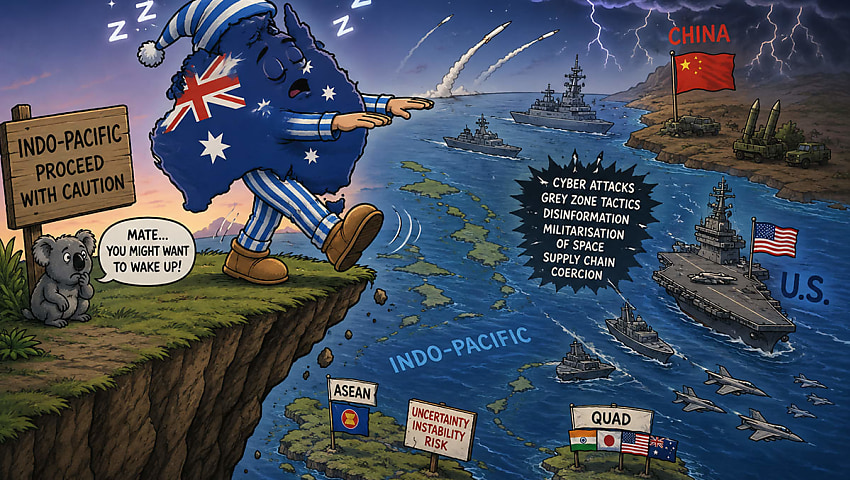
Time and again, Australia’s policymakers and the public have been warned that time is running out, conflict is more likely than not, yet as a nation, we seem to be sleepwalking towards calamity.
From the earliest days of European settlement and the establishment of the modern nation of Australia, collectively as a people and a nation, we have taken our security for granted.
Ensconced in the protective cocoon of geographic isolation from the epicentre of the great power competition and conflict of the 18th, 19th and much of the 20th century, we could afford to take a relative backseat on the international stage.
Instead, we elected to outsource most of our heavy strategic and foreign policy thinking and muscle to our “great and powerful friend” of the day, first the British Empire and more recently, the United States.
As a result, Australia and Australians are caught in a state of semi-permanent arrested development when it comes to the realities of the world, particularly the harsh and unforgiving world of great power competition, ambition and desire for global and regional influence and dominance. While the era of the Pax Americana or American Peace, which dominated the post-Second World War world until recently, provided a reprieve from the historical norm of competition and conquest.
This period of benevolence only served to entrench Australia’s culture of apathy when it came to strategic and defence policy and, for that matter, taking our own security seriously beyond the pages of glossy, well considered, but verbose and often vague government white papers, bringing us to contemporary Australia – a nation and a people far removed from the harsh realities of the new era of great power competition and multipolarity and reality of Australia’s current defence strategy, posture and procurement pipelines as the Indo-Pacific becomes the epicentre of 21st century multipolarity.
Enter former secretary of the Department of Home Affairs Mike Pezzullo in a piece for The Weekend Australian, titled This needs to be our modus on defence: War is coming, in which he unpacked in detail the nation’s sleepwalking towards calamity.
Pezzullo began his analysis by stating: “Since the 1880s, Australian governments have grappled with the problem of how best to defend Australia against potential adversaries, where others might not be able, or willing, to arrive in force to save the day.”

“The Defence Strategic Review of 2023 and the National Defence Strategy of 2026 sit within this long tradition of independent Australian thinking. This is not to say that Australian governments have always turned such aspirations into effective strategies, plans and budgets. Too often they have not. It has usually taken the storm of war to shake us out of strategic complacency,” he added.
But Pezzullo isn’t the only former senior policymaker calling for greater action on enhancing our defence capabilities and self-reliance, with architect of the 1987 Defence white paper and the progenitor of The Defence of Australia doctrine, which in many ways continues to guide our national defence strategy and force structure: Paul Dibb echoing Pezzullo’s calls.
But Pezzullo isn’t the only former senior policymaker calling for greater action on enhancing our defence capabilities and self-reliance, with Paul Dibb – architect of the 1987 Defence white paper and the progenitor of The Defence of Australia doctrine, which in many ways continues to guide our national defence strategy and force structure – echoing Pezzullo’s calls.
Speaking to The Australian’s Cameron Stewart, Dibb said: “The US is undergoing radical change under (President Donald) Trump as a serious and competent power. Australia needs a greater level of defence self-reliance if we are to continue to survive as a large and influential middle power in Asia.”
An inflection point
For both Pezzullo and Dibb, it is clear that Australia stands at a clear and inevitable inflection point, one where the historic norm of competition between nation states is dominated in large part by the spheres of influence of the world’s major powers and their own unique designs and ambitions for the global order.
Further complicating this “devolution” of the post-Second World War “rules-based order" is the relative decline of the United States as the global hegemon and the corresponding rise of China, India and other potential great powers that in aggregate, outmatch the United States and its declining sphere of Western allies, Australia included.
For some, this may be an unpopular and even uncomfortable analysis, but unfortunately, a bomber gets the most flak when it is right over the target.
And to date, Australia’s approach to strategic and defence policy has reflected the benevolence of the world order prior to this inflection point. Pezzullo detailed this stating: “Since the 1960s, defence policy has sought to hedge against the rise of the only proximate regional power that might one day be able to threaten Australia militarily – namely, a very different Indonesia, one that had perhaps turned down the path of military dictatorship, or Islamist theocracy.
“Faced with such a threat, Australia would need a heavier force that could independently deter and, if necessary, defeat an attack by an aggressive and militarily capable Indonesia. Today, the probability of this occurring is close to zero. Were Indonesia to begin to go down this path, we would detect such a change.”
“We would have at least 10 years’ worth of strategic warning. This would afford us the time to build the heavier force that we would need in order to be able to defend ourselves independently, without having to rely on foreign combat forces,” Pezzullo added.
Bringing us conveniently to the genesis of Australia’s enduring defence policy, posture and force structure, the 1987 Defence white paper, which as Pezzullo stated: “Australia would seek to be ‘self-reliant’ in defence terms – that is, be able to conduct combat operations independently in the defence of our territory, sea-air approaches and maritime access, where combat support from allies might not be forthcoming, at least initially.”
Leading perfectly into commentary from Professor Dibb, who said: “The assumption still reigns in Australia that military threats are something that happens to other people and will never come to our homeland. With that belief, we have indulged ourselves in the luxury of merely incremental increases in our defence budgets, rather than the transformative investment that is now needed to Australia’s defence spending.”
Going further, Professor Dibb added: “Australia’s defence organisation needs to get on with purchasing this capability as a matter of urgency. We can significantly increase the ADF’s ability to sustain high-technology operations and credibly support powerful force expansion based on modern long-range precision strike and targeting. This approach is much quicker and cheaper than buying yet more large and costly platforms.”
This analysis perfectly described the challenges facing Australia’s strategic zeitgeist and, by extension, our planning in the face of this broader global and regional inflection point. But there are still some challenges left to be overcome for Australia.
Don’t throw the baby out with the bath water
Despite the challenges, a key and central pillar to both men’s analysis is avoiding “throwing the baby out with the bath water” when it comes to shifting towards greater self-reliance, particularly as it relates to the Australia–US alliance.
Pezzullo articulated this, saying, “Defence self-reliance does not mean that we would seek to develop independently every conceivable element of military power, something that would be beyond our economic and industrial base.”
“Today, we are still heavily reliant on the US for key military enablers, such as space-based intelligence and surveillance systems; to operate key platforms such as the F-35 Lightning II; and, of course, for the acquisition of nuclear-powered submarines under AUKUS,” Pezzullo added.
Echoing this, Professor Dibb added: “My proposal is for Australia to stay in the ANZUS Treaty but lessen its heavy dependence on America for a great deal militarily and, in addition, show Washington that Australia can credibly operate by itself in its region of primary strategic importance in the eastern Indian Ocean as well as in Southeast Asia (including the South China Sea) and the South Pacific.”
Importantly and perhaps unsurprisingly, both men call for a sizeable increase in Australia’s levels of defence spending. Pezzullo added: “Today, the government’s defence policy sits within this tradition. It seeks to make tailored investments in a base force-in-being, which is funded at around 2 per cent of GDP, using the traditional definition of how much is spent on defence as a proportion of GDP.
"Most of the new money for Defence that was announced in the National Defence Strategy of 2026 is skewed towards the latter part of the decade to 2035–36, and most of the significant new capabilities are not due to arrive until the mid-2030s.”
Professor Dibb added: “This new ADF will mean spending more on Australia’s defence at about 3 per cent to 4 per cent of GDP, compared with barely 2 per cent at present. Let me be clear: this is quite a radical change for Australia which will mean a much stronger military force that will be capable of acting alone, including in Southeast Asia.
“The assumption still reigns in Australia that military threats are something that happens to other people and will never come to our homeland. With that belief, we have indulged ourselves in the luxury of merely incremental increases in our defence budgets, rather than the transformative investment that is now needed to Australia’s defence spending.”
So let’s get to it before we find ourselves sleepwalking into disaster.
Final thoughts
Australia is no longer playing in a forgiving world.
The comfortable assumptions that shaped this country’s strategic posture for three decades and arguably longer – assumptions about American primacy, economic interdependence, the so-called rules-based order – are fracturing.
What is replacing them is a harsher, more contested international environment, and Australia’s response remains, at best, incomplete.
The Indo-Pacific has become the central theatre of global competition: the locus of economic output, military modernisation and geopolitical coercion. Australia can no longer assume that geography or alliance membership alone will deliver strategic stability.
Yet despite increasingly urgent signals from government, the institutional mindset shaping capability acquisition, force structure and industrial policy often remains anchored to the logic of a world that no longer exists.
As Professor Peter Dean has observed, Australia is navigating a genuine “polycrisis” – geopolitical, economic, industrial, and technological pressures compounding simultaneously. This is not a sequence of isolated shocks. It is systemic transformation.
The material constraints are real and should not be wished away. Australia remains deeply dependent on maritime trade, access to global markets and American power in the region. Geography still matters.
Sea lines of communication still matter. Industrial resilience still matters. Any strategy that ignores these realities is not bold, it is reckless. But the inverse is equally dangerous.
Strategic Analysis Australia has warned there remains no shift in planning or thinking commensurate with the scale of deterioration in Australia’s strategic environment. Incrementalism, in a period of accelerating disruption, is its own form of failure.
Strategy demands choices.
It demands prioritisation, trade-offs, and sustained national commitment measured in decades, not electoral cycles. It requires governments to align economic policy, industrial capacity, technological development and defence planning into a coherent whole, not manage them as separate bureaucratic silos that occasionally make eye contact.
Australia possesses genuine latent advantages: its geography, natural resources, advanced research capacity, alliance access and proximity to the Indo-Pacific’s economic centre of gravity. But latent advantages do not convert themselves. Leveraging them requires moving beyond defending the remnants of the old order and adapting to the emerging one faster and more coherently than competitors.
The window for that adaptation is narrowing.
The coming decade will not simply test Australia’s policy settings. It will test its capacity for strategic imagination, institutional agility and political honesty about what the moment actually demands.
In a world where the old certainties are fragmenting in plain sight, the consequences of getting that balance wrong are unlikely to remain theoretical for long.
Get involved with the discussion and let us know your thoughts on Australia’s future role and position in the Indo-Pacific region and what you would like to see from Australia’s political leaders in terms of partisan and bipartisan agenda setting in the comments section below or get in touch at

Want to see more stories from trusted news sources?
Make Defence Connect a preferred news source on Google.
Click here to add Defence Connect as a preferred news source.