

 iscover
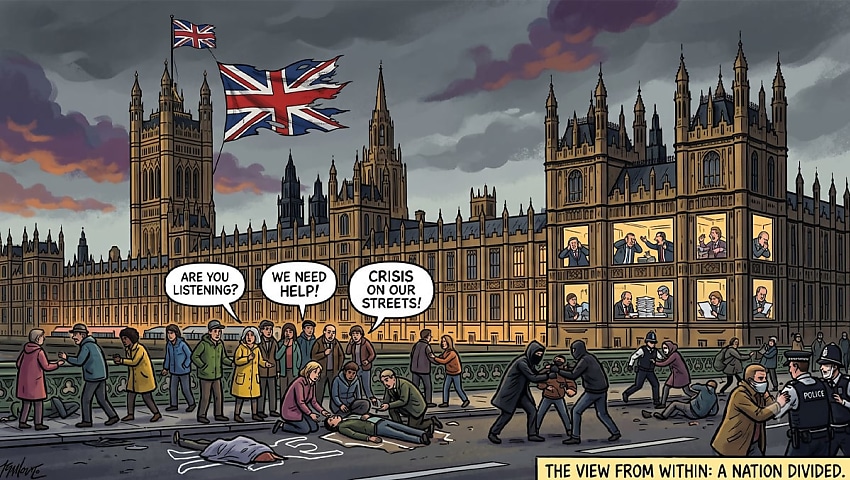
Social media was awash with footage of an alleged beheading attempt by a Sudanese “asylum seeker” in Belfast, yet another stark warning of growing social tensions in Britain. With experts like Professor David Betz warning of escalating instability, how can Australia prevent similar migration-driven pressures from eroding social cohesion and national security?
Fair warning, this is going to discuss some uncomfortable topics and may even shatter some of the long-held shibboleths regarding migration, integration versus assimilation, social cohesion, the demographic debate and the intersection with national security.
Over the past few years, the world has borne witness to just how disunited the United Kingdom and, indeed, broader Europe seems. But for the sake of this piece, we will be focusing entirely on the United Kingdom, particularly following the release of details about the devastating case of Henry Nowak raises questions about policing, social cohesion, integration and the broader stability and reliability of one of NATO’s central powers.
These fault lines have been further on display overnight following the attempted decapitation of an Irishman on the streets of Belfast by a Sudanese “asylum seeker”, resulting in the former hotbed of the Irish Republic Army descending into riots and chaos as people across the United Kingdom declare they’ve had enough.
Predictably, many within the media and political commentariat will claim that the violence erupting in the aftermath of the latest incident in Belfast and following the revelations of the clearly two-tier approach to policing and law enforcement when dealing with the death of Henry Nowak is the result of right-wing agitators seeking to capitalise on division and racial tensions. The reality is they are a symptom of the issues, not the cause.
In fact, we saw similar efforts here following the horrific attacks at Bondi Beach, by both the Prime Minister and even his state counterpart, Premier Chris Minns, who declared that in order to maintain social cohesion and prevent the breakdown of Australia’s great “multicultural” experiment, freedom of speech had to be curbed so as not to offend or enflame already sky-high tensions.
It goes without saying that on the basis of this, it is pretty easy to see that there are very real national security ramifications not only for the United Kingdom and the broader European experience but also for the broader Anglosphere, with Australia in particular at risk of similar challenges.
Bringing me to the work of Professor David Betz, professor of war in the modern world in the Department of War Studies, King’s College London, who has conducted extensive research and analysis into the powder keg of challenges facing the Western world as part of a two-part series of analysis, titled Civil war comes to the West and Civil war comes to the West, Part II: Strategic realities, in which he established that “the major threat to the security and prosperity of the West today emanates from its own dire social instability, structural and economic decline, cultural desiccation and, in my view, elite pusillanimity”.

With these factors in mind, what lessons can Australia learn from the (dis)United Kingdom and Europe and, importantly, how can we avoid the same domestic national security challenges, particularly as young Australians already feel disconnected, atomised and uninvested in their nation’s future?
Multiculturalism: All hail the mighty GDP and atoning for ‘original sin’
Across the Western world, multiculturalism is frequently cited as one of our greatest developments to date – not the abolition of slavery, invention of modern scientific method, modern standards of living or any other developments over the past three centuries. Equally, multiculturalism is often promoted as salve to prevent Western societies and cultures from descending into the dark days of colonial expansionism or dare we say it, mid-century Austrian painter-man politics.
Examples of this, particularly in Australia, default to the post-Second World War waves of migrants (which my own family is part of) as the legitimising argument as to why Australia and other pseudo-propositional nations like Canada and the United States must accept ever-increasing numbers of migrants from increasingly diverse parts of the world for the sake of our continued economic growth, the sustainability of our health and aged care sectors, or to stave off impending demographic collapse.
It is well-documented that all of this has been done against the express wishes of the respective host populations and has increasingly served to increase sociopolitical tensions, and yes, it is true that in the early days of post-war European migration, Australians weren’t crash-hot on that idea either, until the next wave of migrants started to show up en masse.
But there are important and very distinct differences between now and then.
Nations like Australia, the United States, Canada and even post-war Britain (to a degree) were far better equipped to not only accept migrants, they were better equipped to absorb and integrate them into their respective societies, largely because of the close cultural (often pre-existing familial links), linguistic, legal and political links between Europeans, ranging from common faith (Christianity), linguistic (Anglo-Germanic and Romance languages all share similarities) and legal and political links through things like common law and liberal(ish) democratic processes prior to the advent of fascism, Nazism and Stalinism.
Equally important is the fact that these nations had robust and diverse economies, buoyed by triumphalism, self-belief, patriotism and nationalism, driven by long-term planning that rapidly established a culture of what can be crudely be described as “fit in, or get out”, or commonly referred to as assimilation, which meant that continental Europeans became an intrinsic and inescapable part of the Australian narrative, in ways that were echoed across much of the Western World.
For Britain, however, its post-war experience was vastly different as it dealt with the slow and, frankly, humiliating dissection of its globe-spanning empire and was forced, as part of its “original national sin”, to absorb people from across the Empire, which has continued to this day and was accelerated under Tony Blair’s “New Labour” movement beginning in 1997.
Meanwhile, for Europe, a continent that spent the better part of last century divided or at war with itself, its “original sin” comes from the waves of European empire-building beginning in the 15th century and, in some cases (cough France cough), continuing to this day, has meant that following the end of the Cold War and the formalisation of the bureaucratic, pseudo-totalitarian European Union, that respective nations must forgo their sovereignty and accept tens of millions of people from Africa, the Middle East, central and south Asia as a form of penance.
Fast forward to today and we find a United Kingdom in complete disarray and in borderline “soft” civil war and a Europe that is itself a hotbed of social, ethnic and political division, waiting for a spark to ignite into the continent into a fiery display of ethno-religious and sectarian conflicts that will make the Catholic–Protestant conflicts look like an activewear-clad pre-Pilates warm-up session.
Indeed, even the most ardent supporter of European “multiculturalism”, former German chancellor Angela Merkel, has admitted multiculturalism has failed. These statements were equally echoed by former British prime minister and self-declared heir to Blair, David Cameron, something Betz cited, saying, “Chancellor Angela Merkel once pointed the finger directly at multiculturalism, declaring that in Germany it had ‘utterly failed’, an idea that was echoed six months later by then Prime Minister David Cameron in Britain. He elaborated that ‘It ghettoises people into minority and majority groups with no common identity.’ Such statements by leaders, both noteworthy centrists, of large, ostensibly politically stable, Western states cannot easily be dismissed as populist demagoguery.”
As previously mentioned, much of the reasoning and justification by our political classes, respectively, for the policies of multiculturalism, ultimately came down to economic arguments – that we needed it for the continued growth of GDP and that all our lives would, in fact, improve and benefit from the increasing diversity of these multicultural melting pots that our nations have become.
I would dare argue that for many Australians, particularly young Australians, like their contemporaries across the Western World, would overwhelmingly argue against that reality, as our cost of, and standard of living rapidly declined, communities are increasingly atomised, ability to form meaningful relationships is undermined and our streets have become battlegrounds for ethnic-driven violence (as is the case in Europe, Britain and closer to home, Melbourne).
So why would any older generation reasonably expect young Australians (or Europeans, Americans or Canadians) to pay into a system that actively, it seems, to discriminate against them and their futures, let alone expect us to potentially fight and die for the said system?
Sectarian politics and being cut out of the conversation
While all of this occurs, young people across these nations are, in essence, gaslit by successive governments into believing that things like the murder of Henry Nowak, the Bondi massacre or the mass rape of women at New Year’s Eve festivities in Cologne in 2015 are isolated events, or for that matter that their inability to buy a home, find an entry-level job and build a life as their parents did are all worth it for a Tika Masala, Shawarma or African street food.
With this in mind, is it any wonder that young Australians and young people across the West are revolting against the system and looking to increasingly extreme solutions and ideologies to have their voices heard, when mainstream political parties become the playground of ethno-religious, sectarian-pandering politics? Don’t believe me? Look at the rise of elements in the UK and across Europe, with the rise of the Gaza MPs and Greens Party in Britain, AfD in Germany, and on the left, Denmark’s Socialist People’s Party, Sweden’s Swedish Social Democratic Party and others.
Indeed, at home, we have seen the meteoric rise of One Nation in response to increased disenfranchisement with the major political parties, as people turn away from parties who continue to fiddle while Rome burns and are seemingly afraid and/or unwilling to have difficult but necessary conversations when it comes to issues of concern like migration, integration, assimilation and the future direction of the country.
Rather, we see our own leaders discussing nebulous concepts like “values”-driven migration and integration efforts through ever-increasing funding for social and cultural community groups because once again, the United Kingdom has demonstrated just how well these approaches work and that all of this can simply be done away with by increasing access to youth clubs and sports.
Newsflash, tell that to the young girls massacred at a Taylor Swift dance class by Rwandan migrant Axel Rudakubana in Southport and prompted massive social backlash by fed-up Brits who were once again branded as being “far right” by an administration refusing to see the root cause of the problem and stand up for its own people.
With this in mind, how long before Australians are subjected to the same gaslighting, on a scale similar to that seen in the United Kingdom, the United States or across Europe? And wouldn’t it actually be easier to listen to our concerns and act accordingly, or do new political client groups matter more than us? Because that is how it is starting to feel.
Once again, Betz summarised the predicament perfectly, saying, “The peculiarity of contemporary Western multiculturalism, relative to examples of other heterogenous societies, is threefold. Firstly, it is in the ‘sweet spot’ with respect to theories of civil war causation, specifically the supposed problem of coordination costs is diminished in a situation where White majorities (trending rapidly toward large minority status in some cases) live alongside multiple smaller minorities.
“Secondly, thus far what has been practiced is a sort of ‘asymmetric multiculturalism’ in which in-group preference, ethnic pride, and group solidarity – notably in voting – are acceptable for all groups except whites for whom such things are considered to represent supremacist attitudes that are anathematic to social order.
“Thirdly, because of the above what has emerged is a perception that the status quo is invidiously unbalanced, which provides an argument for revolt on the part of the white majority (or large minority) that is rooted in stirring language of justice. From a strategic communications perspective, a morally inflected narrative which has a clearly articulated grievance, a plausible and urgent remedy, and a receptive conscience community is powerful.”
With all of this in mind, I am pretty sure no Australian has voted for sectarian politics, rather we embraced the opportunities of a colour and race blind society. Now it seems the door is being shut in our face, with dramatic implications for our national security at the local and global level.
Final thoughts
Australia stands at a crossroads and the choices made in the coming decade will determine whether this nation charts a fundamentally different course to the United Kingdom and Europe or sleepwalks into the same catastrophic failures that are now playing out on the streets of Belfast, London and Cologne.
The uncomfortable truth that our political class, on both sides of the aisle, refuses to confront is this: a nation that cannot maintain social cohesion simply cannot maintain national security.
These are not separate conversations. They are the same conversation, and the longer we pretend otherwise, the more we guarantee the very instability we are trying to avoid.
None of this is an argument against migration per se. Australia has benefited enormously from well-managed, culturally considered and economically grounded migration programs. The post-war European experience demonstrates what is achievable when the receiving society has the confidence, the institutional strength and frankly, the backbone to say: “Welcome, and here is what we expect of you in return.”
Assimilation, for all the contempt now heaped upon the word, worked. Integration as a policy, increasingly, has not.
What Australia urgently needs is a frank, adult conversation, free from the suffocating weight of ideological orthodoxy and the ever-present threat of being labelled a bigot for daring to ask reasonable questions about migration levels, integration policy, social cohesion and what we actually owe one another as citizens of this country. That conversation must include young Australians who are already bearing the economic and social costs of policy settings they had no say in designing and who are increasingly concluding that the system has nothing to offer them.
If that conversation doesn’t happen, and soon, then the lesson from Britain and Europe won’t be cautionary tales. They will be a preview.
Betz is right. The greatest threat to Western security today is not found on some distant battlefield. It is found in the fractures we have spent decades pretending don’t exist and in the silence of those who should have known better.
Importantly, we don’t have to live like that.
Get involved with the discussion and let us know your thoughts on Australia’s future role and position in the Indo-Pacific region and what you would like to see from Australia’s political leaders in terms of partisan and bipartisan agenda setting in the comments section below or get in touch at

Stephen Kuper
Steve has an extensive career across government, defence industry and advocacy, having previously worked for cabinet ministers at both Federal and State levels.
Want to see more stories from trusted news sources?
Make Defence Connect a preferred news source on Google.
Click here to add Defence Connect as a preferred news source.