

 iscover
Opinion: A first-principles framework for redesigning Australia’s Sovereign Defence Industrial Priorities, separating sustainment from manufacture across three tiers and 14 recommendations, explains Air Marshal (Ret’d) John Harvey AM.
Australia has maintained successive priority designation frameworks since 2007, each showing genuine intent but perpetuating the same analytical failures.
Numbers grew and contracted without clear and published criteria. Sustainment and manufacture were consistently conflated – the Collins Class submarine was correctly designated in 2007 for its sovereign combat system, yet the designation progressively absorbed continuous construction of successor vessels without explicit justification.
Enabling infrastructure – dry docks, test ranges, common user facilities, aviation fuel – was explicitly designated in 2010 and 2014 before disappearing through consolidation, not because it was no longer sovereign but because frameworks had no mechanism for its mixed government-asset/industry-workforce character.
Analytically sound recommendations from the 2014 review – for electronic systems maintenance and professional and logistic support services – were not adopted and remain outside the framework today. And the word “Priority” was never applied in practice: without intervention thresholds, monitoring indicators or designated accountability, each iteration was a restatement of intent rather than a managed program.
The framework also never fully tracked the progressive commercialisation of functions previously performed in-house – what the Commercial Support Program began in the 1990s transferred sovereign requirements from government to industry, creating a systematic blind spot for every capability commercialised since.
International experience
France, the United Kingdom, the United States, Japan, and South Korea have each, through different institutional pathways and without reference to a common framework, arrived at the same structural conclusion: sustainment and production are different sovereign requirements demanding different policy instruments.

All five also concluded that enabling infrastructure is a sovereign consequence of sustaining systems domestically – not a category requiring its own independent designation. Every effective framework backs designation with explicit legal authority, measurable thresholds and clear accountability – instruments Australia’s Sovereign Defence Industrial Priorities (SDIP) framework has never had.
The UK’s 2025 Defence Industrial Strategy introduced metrics with a 2035 horizon and a National Armaments Director with end-to-end life cycle governance responsibility.
Japan’s 2023 Act names the life cycle phases for which sovereign industrial capability is required and provides government authority to own critical production facilities where commercial viability cannot sustain the facility.
The consequence is systemic. Industry is now recognised as a Fundamental Input to Capability (FIC) in its own right while simultaneously supporting multiple other FIC elements including support, supplies, facilities and ICT.
Weaknesses within the industrial base can therefore create vulnerabilities across several capability inputs simultaneously. It follows that sovereign industrial capability should be understood not simply as a manufacturing issue but as an enabling component of the broader Defence capability system.
A rigorous, explicable approach
What both the Australian and international records demonstrate is that effective sovereign industrial prioritisation requires a principled framework that applies consistent criteria, produces explicable and auditable results, and is sized to what can actually be resourced and managed. The first principles approach proposed in this paper applies two threshold tests:
- The capability must be dependent on industry capability for effective delivery.
- The capability must be essential for Defence across at least one of three planning scenarios: steady-state preparedness, conflict sustainment, or mobilisation and reconstitution.
The framework then asks which industrial functions, at which stages of the capability life cycle (from concept through to sustainment and disposal), must be available from Australian industry.
Four conjunctive selection criteria govern every designation: predominantly in industry; essential for Defence; overseas industry not suitable; and, for consumption-sensitive capabilities, credible domestic replenishment capacity. Current industry health, cost-effectiveness and policy-choice objectives are excluded from designation criteria.
Policy choices to support Australian industry for employment, coalition signalling, or industrial ecosystem maintenance are legitimate – but they belong in a government policy priority instrument with separate criteria and accountability, not embedded in SDIP designations.
The unreliability of international industrial support
A foundational premise of the framework is that Australia cannot rely on international industrial support in the contingencies that matter most.
Allied industrial bases will face simultaneous demands in a major Indo-Pacific conflict; political willingness to prioritise Australian requirements cannot be contractually guaranteed; supply chains for critical components extend through adversary-controlled chokepoints; and technical knowledge for sustaining complex systems cannot be procured on demand when the original equipment manufacturer or parent nation is unable or unwilling to provide it.
Collaboration with allied partners amplifies sovereign capability – it does not substitute for it. This is why field-level maintenance as a minimum sovereign threshold is essential for all platforms/systems.
The proposed three-tier structure
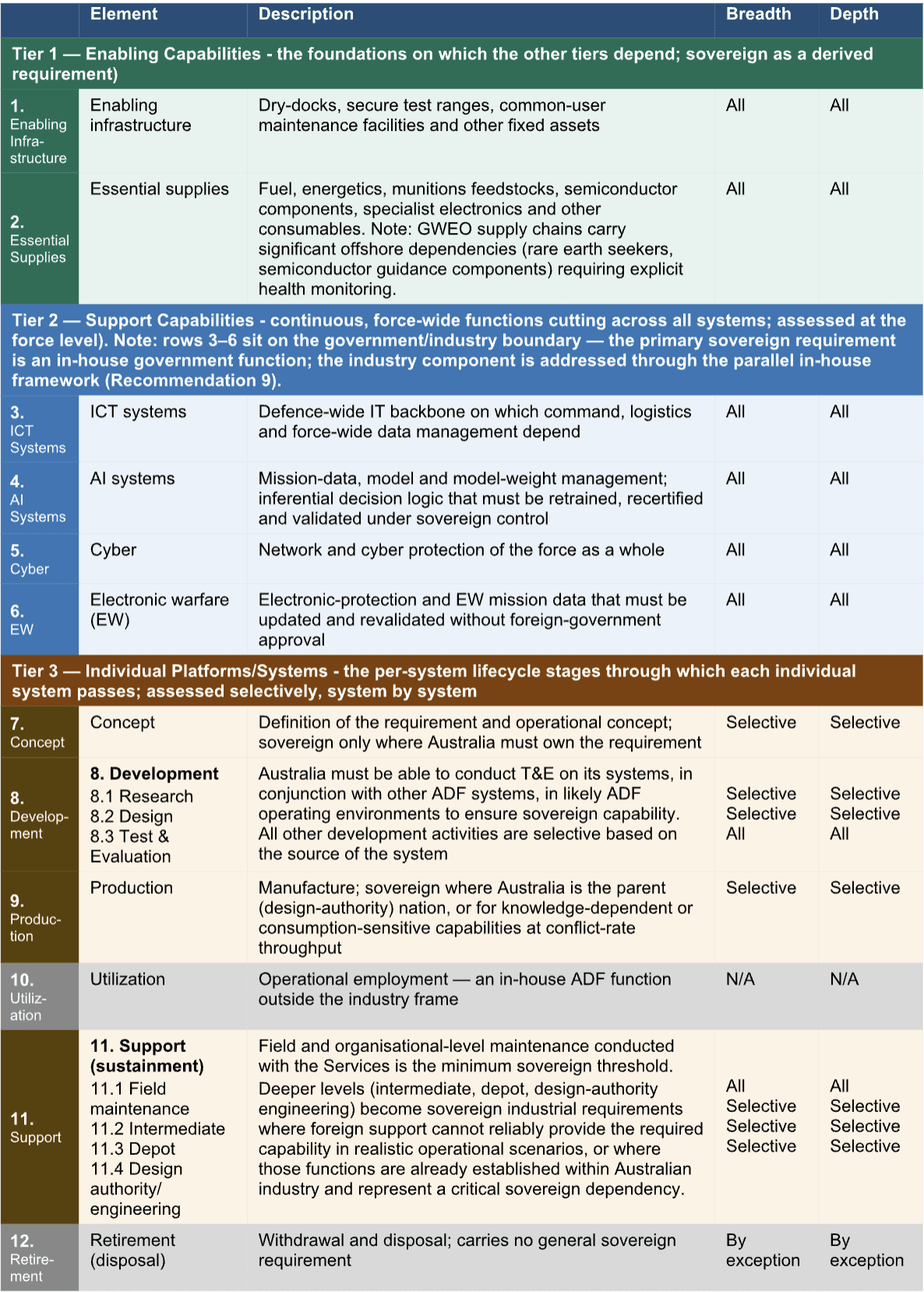
The proposed framework for identifying sovereign defence industry capabilities comprises three tiers arranged by dependency. Tier 1 covers enabling capabilities – the foundational requirements on which all other sovereign industrial functions depend. It includes enabling infrastructure such as dry docks, test ranges and common-user facilities, together with essential supplies including fuel, energetics, semiconductor components and other critical consumables.
Tier 2 covers support capabilities – continuous force-wide functions such as ICT systems, AI systems, cyber capability and electronic warfare support that cut across individual platforms and systems.
Tier 3 covers life cycle functions associated with individual platforms and systems, from concept and development through production, sustainment and retirement. Some life cycle functions apply universally; others apply selectively depending on design authority, knowledge dependency and replenishment requirements.
A critical distinction within Tier 3 concerns the level of sustainment that must remain in Australian industry: field and organisational-level maintenance conducted in conjunction with the services is the minimum sovereign threshold.
Where maintenance has been progressively contracted to industry – intermediate, depot and design-authority engineering work – that contracted level becomes the sovereign industrial requirement where foreign support cannot reliably provide the required capability in realistic operational scenarios, or where those functions are already established within Australian industry and represent a critical sovereign dependency.
Application of the proposed tiered approach
The table below maps the tier structure and the systems to which each applies. The central distinction it enforces – and that no previous SDIP iteration has enforced – is between sustainment and manufacture.
Every Australian Defence Force system must be sustainable at least to field and organisational level in Australia; not every system needs be manufactured here. A structural tension exists in Australian defence industry policy where Royal Australian Air Force aircraft are all manufactured overseas but there is a policy objective to build naval vessels and some land systems in Australia.
In practice, Australian industry represents an assembly capability for these “Australian” platforms, relying on the supply of major systems and subsystems which are themselves subject to supply disruptions and long lead times. While there may be sound policy reasons to build platforms in Australia, that should be identified separately from sovereign industrial capability requirements.
Design and manufacture are selectively sovereign – required for parent-operator systems, including JORN, Bushmaster, Hawkei, Collins, Ghost Bat, Ghost Shark – for Australia-developed systems where no other nation holds design authority on Australia’s behalf and for consumption-sensitive guided weapons and explosive ordnance, and for attritable autonomous systems where conflict-rate attrition exceeds what stockholding and allied supply can meet.
Conclusion and recommendations
The framework produces 14 recommendations against the current SDIP designations.
- Adopt the three tiers and four-criterion framework and direct the DDA to review all current SDIPs against it.
- Adopt the foundational principle that in-service sustainment across all systems – from field level upward as contracted to industry – is the universal baseline sovereign requirement from which all SDIP designations derive.
- Redefine SDIP 1 as one domain-specific instance of a cross-domain sustainment principle, not a standalone priority.
- Redefine SDIP 2 – designate naval fleet sustainment as a sovereign SDIP and continuous build separately as a government policy priority with explicit objectives and transparent resource allocation.
- Update SDIP 5 to encompass AI training pipelines, model development, and inference infrastructure as discrete sovereign requirements.
- Update SDIP 7 to treat AI model behaviour validation as a distinct T&E obligation.
- Restore Tier 2 enabling infrastructure within each designation’s health assessment.
- Assess two longstanding gaps – electronic systems maintenance and professional and logistic support services – for formal designation.
- Establish a parallel in-house health framework for government-held capabilities and a mechanism to assess newly commercialised functions against SDIP criteria as the government/industry boundary moves.
- Specify SDIP management requirements – observable intervention thresholds requiring escalation to the National Armaments Director, the premium allowable in source selection, and supply chain health indicators, including AI training data and model currency.
- Adopt a tiered declaration policy – public designations, protected health data.
- Treat IP access for Category 3 and 4 acquisitions as a sovereign instrument negotiated at the point of acquisition.
- Align each SDIP review with the latest NDS review.
- Formalise an ASCA assessment pathway for Australian-developed systems.
The framework restores visibility to sovereign requirements that successive consolidations obscured without eliminating. By identifying enabling capabilities, support capabilities and life cycle functions separately, it makes explicit the dependencies that earlier frameworks progressively absorbed into broader labels.
This allows critical sovereign requirements to be monitored, resourced and managed directly rather than assumed to be captured within increasingly broad designations.
The disciplining principle throughout is that a better-defined, actively managed SDIP set – grounded in explicit, rigorous criteria and backed by formal commitment – will deliver more genuine sovereign industrial capability than any previous iteration of the framework.
John Harvey is a former Air Marshal in the RAAF and has a PhD in computer science from UNSW Canberra. His postings have included Chief Capability Development Group, F-35 project manager, director Military Strategy and director Air Power Studies Centre.
Want to see more stories from trusted news sources?
Make Defence Connect a preferred news source on Google.
Click here to add Defence Connect as a preferred news source.