

 iscover
Australians are largely divorced from the reality and costs of war. With few, if any, Australians alive today able to remember and even fewer remembering how it felt to be directly under fire during the Second World War. But what can we expect if Beijing decides to strike?
When it comes to conflict close to home, Australia has been blessed and protected by our geographic isolation and the long celebrated “tyranny of distance”, which has shielded us from the worst of the great conflagrations of the past two centuries.
Despite this, the nation’s relationship with the outside world has been characterised by anxiety and paranoia, particularly in the early days of European settlement. This anxiety and paranoia culminated in the myriad of fortresses and naval guns that dot the Australian coastline designed to ward off Russian or French assaults on the far-flung Australian settlements.
With the outbreak of the First World War and the proximity of German colonial holdings to our immediate north prompting greater anxiety and national concern, the nation launched its first offensive operation to wrestle claim over these holdings to secure the Australian mainland and our interests throughout the region.
The outbreak of the Second World War in the Pacific, the sinking of HMAS Sydney by German raider Kormoran off the coast of Western Australian in late 1941 and Japan’s own blitzkrieg through south-east Asia, culminating in the routing of British Imperial power in the region and the fall of Singapore in 1942 served to foreshadow a protracted and costly war that would encroach ever closer to our doorstep.
Then came the Japanese attacks on Darwin and northern Australia, which would continue to well into the middle of the war, culminating in the sinking of the Sydney ferry HMAS Kuttabul and shelling of Sydney by Japanese fleet and midget submarines, bringing the war “home” to many Australians in a real, visceral way.
The end of the war and ultimate emergence of the United States as the world’s industrial and strategic hegemon for the Western world, replacing the British Empire as the nation’s primary strategic benefactor, also served to rebuild and in many ways, reinforce the nation’s cultural belief in the protective cocoon that is the “tyranny of distance”.
As the Cold War progressed and eventually came to an end, so too did the threats to the security of Australia’s mainland outside of a direct but admittedly unlikely nuclear strike on facilities like Pine Gap, and localised lone wolf or group terrorist attacks increased in likelihood, both the Australian public and policymakers defaulted to the comforting narrative surrounding our geographic isolation.

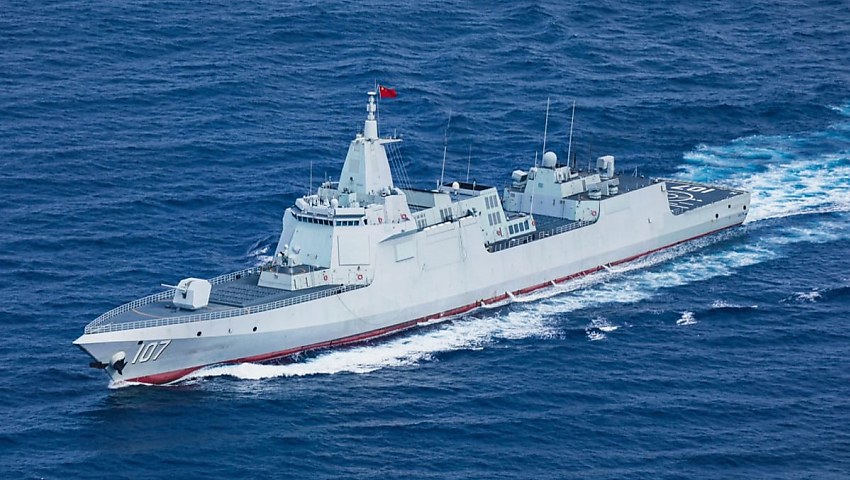
However, on April 2025, that all came to a head as the People’s Liberation Army-Navy (PLAN) circumnavigated Australia and, most provocatively, conducted a series of live-fire drills in the Tasman Sea, exposing a new and uncomfortable reality: mainland Australia is now firmly in the crosshairs should conflict break out in the region.
Of course, in isolation, such an incident is evocative but not necessarily provocative. However, one should consider the rapid expansion and modernisation of the People’s Liberation Army across the warfighting domains and critically the ambition, designs and seeming intent of the regime in Beijing to establish or re-establish the “Middle Kingdom” at the centre of the Indo-Pacific balance of power and influence.
But where questions remain is in the area of just what the Australian mainland and, by extension, average Australians can expect to experience should the conflict come to our doorstep and we find ourselves firmly in the firing line. Seeking to address this critical question in part is the Lowy Institute’s Sam Roggeveen, in a piece for The Australian titled What damage could China’s military inflict on Australia?, in which he attempts to provide a clear assessment of the sort of damage Australia can expect.
Roggeveen established a key point at the end of his analysis, saying, "“Australia’s security interests are not confined to territorial threats. There are many ways Chinese military power can damage Australia’s interests, not least by becoming a regional rival to our ally, the United States. As Marine Corps Lieutenant General Stephen Skalenka recently said of China’s military: ‘Don’t listen to this garbage about them being a near peer. They’re a peer because they rival us in nearly every single measure of national influence.’”
“The effort to better understand China’s military only begins by examining its capabilities to strike Australia directly, but it does not end there. The growth of the PLA is the most important thing to happen to Australian security since the collapse of the Soviet Union, and there is a pressing need for a more informed Australian discussion about it,” he said.
Don’t fall for the ’tyranny of distance’ trap
It is important to identify upfront that Roggeveen is a passionate advocate for Australia embracing an “Echidna Strategy”, which emphasises, much like its namesake, the Echidna, that Australia embrace a solitary, non-aggressive strategic posture that emphasises defensive self-reliance and deterrence over offensive capabilities.
At its core, the “Echidna Strategy” seeks to make Australia as inoffensive, unprovocative and as small a target as possible, lest we draw the ire, discontent or hostility of other powers, even those who are largely viewed as benign today but may – as their own relative wealth, power, prestige, military capability and ambitions – evolve and become more willing to use hard power to achieve their goals.
However, as has become abundantly clear over the past five years, particularly through the COVID-19 pandemic and in the aftermath of the outbreak of the Russia–Ukraine conflict in 2022, followed by the impact on global shipping following the October 7 attacks on Israel and the ensuing conflict in the Middle East, Australia, as a nation, and Australians, as a people, are increasingly exposed far from home.
Accordingly, this necessitates a radical rethink about how we quantify the levels of damage and pain that can be inflicted upon Australia and its interests both far beyond our borders and closer to home, where arguably by the time an attack happens on the Australian mainland, it is already too late.
Roggeveen approached his analysis from within the confines of the “Echidna Strategy” and as a result, bases any strategy around the geographic realities that separate Australia from an adversarial China, saying, “Domestic defence debates must be grounded in sober, fact-based assessments of the threat that are neither hawkish nor dovish, neither complacent nor alarmist.”
“Any such assessment must start with an appreciation of the limits imposed by distance. Australia and China are far apart (Beijing is closer to Berlin than to Sydney), and that makes it difficult for China to project significant amounts of military force against us,” he said.
Building on this, he compared Australia’s geographic isolation and the protective insulation it affords to the predicament of proximity faced by Taiwan, saying, “A simple comparison with Taiwan illustrates the point. The entire PLA missile and air force can cross the narrow strait that separates China from Taiwan. China has even practised using artillery from its coastline to hit the island. It can also use its navy to block outside access to Taiwan’s ports.”
“Only a fraction of that military power could be used against Australia because most of those systems can’t bridge the huge divide that separates us. So, we need to focus on China’s long-range systems such as naval ships that can cross oceans, as well as bombers and missiles that can travel thousands of kilometres,” Roggeveen said.
To this end, Roggeveen argues (somewhat correctly) that Beijing’s immense military build-up and modernisation has transformed the PLA from a second-rate, largely early-Soviet-era military into one of the world’s premier, integrated, increasingly globally capable fighting forces designed to expand the reach and influence of the Middle Kingdom.
Beijing’s modernisation continues at pace, but gaps remain
Citing the aforementioned Chinese naval circumnavigation of the Australian landmass in April 2025, Roggeveen said: “Australia should expect more such unwelcome visits because the PLA now boasts a substantial ocean-going navy with two decades of experience of long-distance deployments.
“That includes a fleet of three aircraft carriers which the Pentagon assesses will grow to nine. China also boasts a growing fleet of amphibious ships which are so large that the PLA must intend them for faraway missions and not merely to cross the Taiwan Strait. One area where China has lagged in the past is nuclear-powered submarines, which can be deployed for months at a time to any world ocean. There is now clear evidence that the PLA is at the cusp of a nuclear-powered submarine building boom, with new shipyards producing modern designs.”
Now none of this is to say that Beijing is invincible and isn’t without its own capability gaps, something Roggeveen is quick to highlight, particularly given the lack of truly contemporary air-based strategic strike capabilities, instead defaulting to the tried and true, H-6-series of strategic bombers which have, like their American counterparts, been modernised extensively from their Cold War progenitors.
“The big gap in China’s long-range capabilities is in aviation. Ballistic missiles fired from home soil are a massively expensive way to deliver relatively small warheads onto distant targets. If you want to deliver a bigger bomb load and do it persistently, it is far more efficient to use bombers.”
Going further, Roggeveen said: “Rumours persist that China is working on an equivalent to the American B-2 stealth bomber, and although there is no photographic evidence for it yet, the so-called H-20 may break cover this year. Then again, China has been an innovator in drone aircraft too, so it may skip the crewed bomber altogether. Some satellite photos have emerged of what could be a long-range bomber drone.”
“Another handicap for China’s long-range capabilities is its lack of foreign basing – if your air and naval assets must constantly make the long trek home to refuel and re-arm, they cannot achieve a persistent presence. There is credible evidence that China has sought support from Pacific Islands countries for military basing in Australia’s region,” he said.
Importantly, none of these are insurmountable, particularly for a committed, motivated and well-resourced military, backed by the world’s premier industrial power, as the People’s Liberation Army now is, so we must be careful to put too much stock in the impact of these existing limitations and the intersection of our geographic isolation as a protective shield.
Ultimately this means, as Roggeveen argued, that we need to have a grounded, sober and fact-based assessment of the threats to the nation and critically bring the Australian public along on the journey towards our best course of action.
Impactful projection and deterrence by denial
Since the 2023 Defence Strategic Review, Australia has sought to move away from the prior model responsible for delivering a “Balanced Force” designed in effect to deliver Roggeveen’s “Echidna Strategy” via the Defence of Australia policy formalised in the 1987 Defence White Paper.
Rather, Australia has sought to develop an integrated, focused force designed to deliver, as Deputy Prime Minister and Defence Minister Richard Marles has championed, “impactful projection” and unilateral “deterrence by denial” in what seems to be a dramatic and seismic shift in the nation’s force posture and corresponding force design.
However, outside of the planned acquisition of the conventionally armed, nuclear-powered submarine fleet and a growing fleet of High Mobility Artillery Rocket Systems, Australia’s ability, or perhaps inability to materially deliver impactful projection and deterrence by denial is going to be swiftly demonstrated the next time there is a major Chinese military exercise in proximity to the Australian mainland.
Critically, all of that comes AFTER any direct action against the critical sea lines of communication or for that matter, critical economic hubs upon which Australia’s economic prosperity depends across the Indo-Pacific, by which point the national economy has doubtless been plunged into recession at best or depression at worst and our already splintering social cohesion is coming apart at the seams.
Ultimately, addressing these shortfalls in a meaningful manner are going to require a significant program of narrative building, working with the Australian public to ensure they understand not only the costs of securing our interests far from home, but also the costs of not doing so.
Final thoughts
Australia is no longer operating in a forgiving strategic environment.
The assumptions that underpinned our national security settings for decades – American primacy, deep economic interdependence and a stable rules-based order – are eroding. What is emerging in their place is a more contested, competitive and uncertain world.
The Indo-Pacific is now the centre of global economic, military and geopolitical competition. Geography and alliances remain critical advantages, but they are no longer sufficient guarantees of security.
Despite increasingly stark warnings from government, much of Australia’s capability planning, force structure development and industrial policy still reflect the logic of a bygone era.
As one of the chief architects of the 2023 Defence Strategic Review, Professor Peter Dean has argued that Australia is confronting a genuine “polycrisis” – geopolitical, economic, industrial and technological pressures converging simultaneously. This is not a series of isolated challenges. It is a structural shift in the strategic environment.
The constraints are real. Australia remains dependent on maritime trade, global markets and continued access to American military power. Sea lanes matter. Industrial resilience matters. Geography matters.
But so does urgency.
Strategic Analysis Australia has warned that Australia’s planning and thinking have yet to adjust to the scale and speed of strategic deterioration occurring across the region. In an era of accelerating disruption, incrementalism is not prudence – it is risk.
Strategy is ultimately about choices.
It requires prioritisation, trade-offs and national commitment sustained over decades, not election cycles. It demands the alignment of defence, industry, technology and economic policy into a coherent national effort rather than a collection of disconnected bureaucratic activities.
Australia is not without advantages. Our geography, resource base, research sector, alliance network and location at the heart of the Indo-Pacific provide a strong foundation. But advantages are only valuable if they are converted into capability and national power.
The challenge now is not preserving the assumptions of the old order. It is adapting to the realities of the new one.
The window to do so is narrowing.
The decade ahead will test Australia’s strategic judgement, institutional agility and political willingness to confront hard realities. As the certainties of the past continue to fade, the cost of getting that balance wrong is unlikely to remain theoretical for long.
Get involved with the discussion and let us know your thoughts on Australia’s future role and position in the Indo-Pacific region and what you would like to see from Australia’s political leaders in terms of partisan and bipartisan agenda setting in the comments section below or get in touch at

Want to see more stories from trusted news sources?
Make Defence Connect a preferred news source on Google.
Click here to add Defence Connect as a preferred news source.