

 iscover
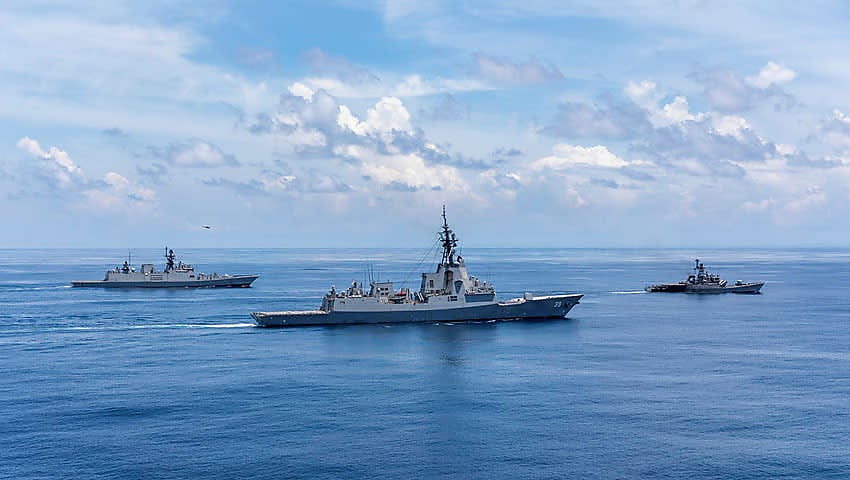
Opinion: Australia should prioritise defending its northern approaches and sustaining coalition operations, arguing that its greatest value in a Taiwan contingency lies in strategic depth and support rather than front-line combat, explains Air Marshal (Ret’d) John Harvey AM.
Australia’s debate about a Taiwan contingency often starts with the wrong question.
The question usually asked is: What should Australia contribute to the defence of Taiwan? A better question is: What contribution is Australia uniquely positioned to make?
The difference matters because strategy is ultimately about choice. A country with unlimited military resources can attempt to do everything.
A country with finite military resources cannot. Australia falls into the second category.
This is not a criticism. It is simply a recognition of military reality.
The 2026 National Defence Strategy rightly emphasised the need for an integrated and focused force. Yet focus is not a slogan. Focus requires choices about priorities, geography and missions. A force cannot be both focused and unbounded at the same time.
The uncomfortable reality is that Australia faces a tyranny of mass.

Australia’s strategic interests extend across a vast region. We must defend our own territory and approaches. We must contribute to regional stability. We must support allies and partners.
We must protect trade routes and critical infrastructure. We must maintain credible deterrence.
At the same time, the Australian Defence Force remains relatively small. Australia is investing heavily in long-range strike, guided weapons, autonomous systems, northern infrastructure and nuclear-powered submarines. These are important investments. But many of the capabilities most relevant to a major regional conflict will not arrive in substantial numbers until the 2030s and 2040s.
The challenge therefore is not willingness. It is mass.
This distinction matters because every major military commitment involves opportunity costs. Aircraft deployed into the primary theatre cannot simultaneously defend Australia’s approaches. Surface combatants escorting coalition forces near Taiwan cannot, at the same time, protect regional sea lines of communication.
Submarines conducting distant operations cannot simultaneously maintain persistent presence in Australia’s northern approaches. The central challenge is therefore not deciding whether Australia should contribute to a coalition response but deciding where finite Australian military mass will generate the greatest strategic effect. A force of Australia’s size is unlikely to do both at the scale required.
If a Taiwan contingency occurred in the next decade, where would Australian military effort generate the greatest strategic effect?
My argument is that Australia should answer that question now rather than during a crisis.
The issue is not whether Australia can contribute to both the direct defence of Taiwan and the defence of its own approaches. It almost certainly can. The issue is whether it can contribute to both missions simultaneously, at meaningful scale and for a prolonged period. That is a much more demanding test, and it is the test against which force structure and strategy should be judged.
Instead of leaving our role undefined, Australia should adopt what might be called an assigned-lane concept.
Under such a concept, coalition partners would agree in advance on the primary roles they would perform in a Taiwan contingency.
The United States and Taiwan would remain responsible for the direct defence of Taiwan and the Taiwan Strait. Japan would focus on the defence of its territory and the south-west island chain. Australia would concentrate on defending its northern approaches, protecting key sea lines of communication and sustaining coalition operations from Australian territory.
In effect, Australia would become the coalition’s secure rear area.
Some readers may immediately object that this sounds like a lesser contribution.
I would argue precisely the opposite.
The value of a military contribution is not measured by its proximity to the fighting. It is measured by its contribution to success.
Australia’s greatest strategic advantage is not that it sits close to Taiwan.
It is that it does not.
Australia occupies a unique position within the Indo-Pacific. It is sufficiently distant from the most intense fighting to provide depth, resilience and sustainment capacity, yet sufficiently close to support operations throughout the region.
That geography is a strategic asset.
Northern bases, fuel storage, logistics networks, repair facilities, intelligence infrastructure and defence industry capacity all contribute to coalition endurance. In a prolonged conflict, those functions may prove every bit as important as combat operations themselves.
Wars are not won solely by the forces at the front. They are also won by the systems that generate, sustain, repair and replace those forces.
Australia is unusually well placed to contribute to that effort.
Importantly, this is not a proposal to reduce Australia’s military contribution. Defending Australia’s northern approaches, protecting regional sea lines of communication, hosting coalition forces, sustaining combat operations, protecting critical infrastructure and maintaining credible deterrence across a vast maritime area would themselves constitute one of the most demanding military undertakings in Australia’s history.
The assigned-lane concept is not based on the assumption that these tasks are easy. It is based on the recognition that they would likely constitute the ADF’s principal wartime mission and consume virtually the full capability Australia could generate during a major regional conflict.
An assigned-lane concept offers three major advantages.
The first is that it is diversion-proof.
One of the more persuasive arguments about a Taiwan contingency is that China would not necessarily confine a conflict to the Taiwan Strait. Instead, it would seek to pressure coalition members across the wider Indo-Pacific through demonstrations of military reach, coercion, cyber activity and potentially attacks on supporting infrastructure.
For Australia, this creates an obvious dilemma if Australian forces are heavily committed elsewhere.
Every ship, aircraft or military unit deployed forward is one less available to defend Australia and its approaches.
That tension is not new.
In 1942, Prime Minister John Curtin resisted British pressure to divert Australian forces returning from the Middle East. Instead, he insisted they return home to help defend Australia.
The logic was not isolationism. It was strategy.
Curtin understood that Australia’s greatest contribution to the Allied war effort was preserving Australia as a secure base from which the wider war could be fought.
The same logic applies today.
If Australia’s assigned role is already the defence of its approaches and the protection of coalition sustainment networks, then attempts to pressure Australia into focusing on those tasks lose much of their coercive value.
The force is already doing what it was designed to do.
The second advantage is coalition efficiency.
Modern coalition warfare is extraordinarily difficult. The challenge is not simply generating combat power. It is coordinating the actions of multiple nations, services and capabilities across vast distances.
The most difficult coordination problem arises when multiple countries attempt to operate in the same battlespace at the same time.
An assigned-lane approach reduces that burden.
Rather than concentrating every available force around Taiwan, coalition members focus on complementary tasks.
The United States concentrates on generating decisive combat power in the primary theatre.
Australia concentrates on protecting the sustainment system that makes that combat power possible.
The result is not less cooperation. It is more effective cooperation.
Coalitions function best when members contribute where they possess a comparative advantage.
The United States possesses enormous military mass and global reach.
Japan sits on the front line of the contingency and is investing heavily in capabilities designed for that environment.
Taiwan is defending its own territory.
Australia’s comparative advantage is different.
Australia offers strategic depth.
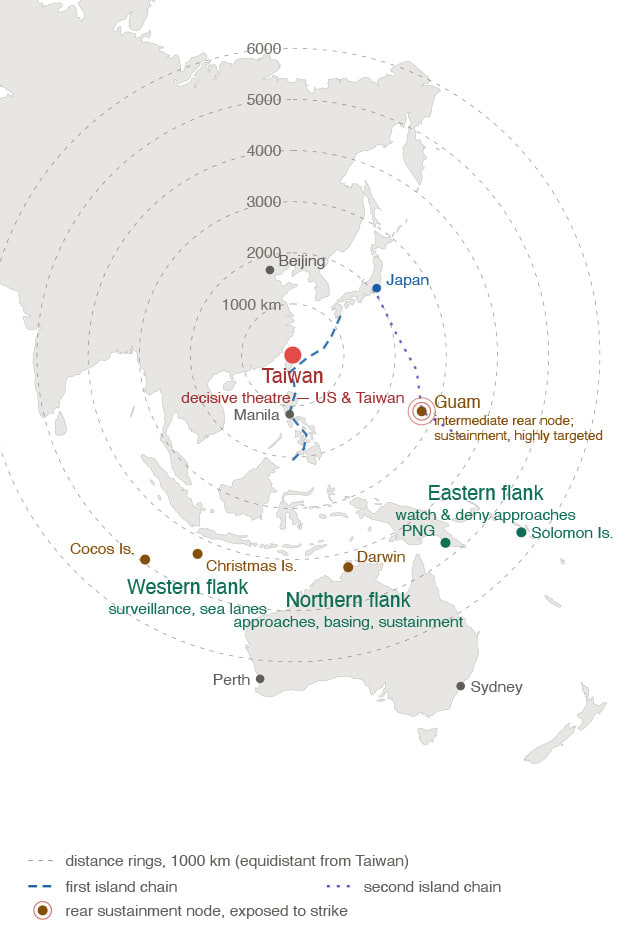
It offers territory from which coalition forces can be generated and sustained.
It offers logistics networks, training areas, intelligence support and industrial capacity.
Those advantages become more important, not less important, as a conflict lengthens.
The third advantage is deterrence.
Deterrence ultimately depends on credibility.
A military contribution that exceeds a country’s resources is less credible than one aligned with its geography, capabilities and interests.
Australia can credibly defend its approaches.
It can credibly protect regional sea lines of communication.
It can credibly host and sustain coalition forces.
These are all missions directly connected to Australia’s national interests and therefore more likely to be sustained throughout a prolonged crisis.
By defining roles in advance and exercising them regularly, allies reduce uncertainty about how the coalition would respond to aggression.
That clarity strengthens deterrence long before a conflict begins.
None of this means Australia should never contribute forces beyond its immediate region.
Submarines, long-range strike systems, cyber capabilities, intelligence support and other niche capabilities may all be employed further afield when circumstances require.
The distinction is between occasional contributions and defining the entire force around participation in the most distant and demanding tasks.
Australia should retain the freedom to make those decisions as circumstances evolve.
What it should not do is build its entire strategic concept around tasks that larger allies are inherently better positioned to perform.
The central lesson is straightforward.
Australia’s contribution to deterrence should be defined not by political aspiration but by military mass.
A focused force requires a focused strategy.
For Australia, that means concentrating on the tasks it can perform and the geography in which it can perform them most effectively.
In a Taiwan contingency, Australia’s greatest contribution may not be fighting in the decisive theatre. It may be ensuring that the coalition can continue fighting there at all.
John Harvey is a former Air Marshal in the Royal Australian Air Force and has a PhD in computer science from UNSW Canberra. His postings have included Chief Capability Development Group, F-35 project manager, director Military Strategy and director Air Power Studies Centre.
Want to see more stories from trusted news sources?
Make Defence Connect a preferred news source on Google.
Click here to add Defence Connect as a preferred news source.