

 iscover
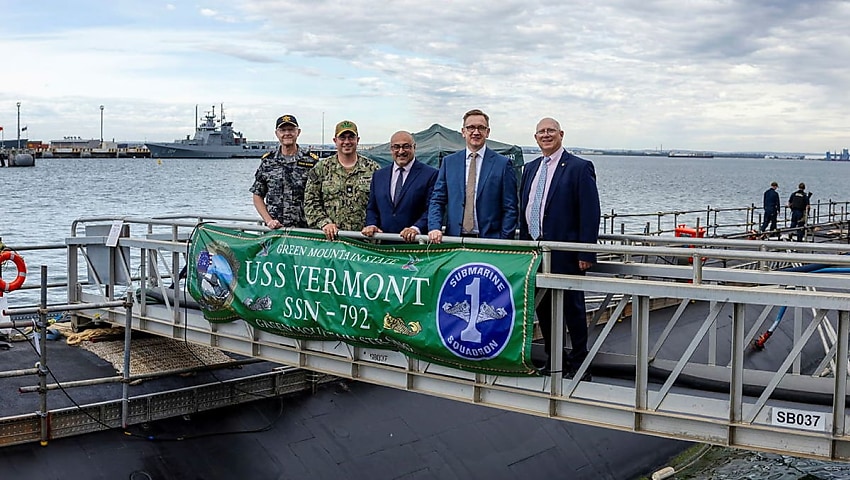
Opinion: Assistant Minister for Defence, Peter Khalil, argues that Australia’s fleet of nuclear-powered submarines is more than just a vital investment in Australia’s sovereignty and deterrence. It also strengthens our ability to contribute to a stable Indo-Pacific amid rising strategic uncertainty.
On a sunny day in Perth last year, I stood on a nuclear-powered submarine, the USS Vermont, which was berthed at HMAS Stirling in Western Australia. This was the third American, nuclear-powered Virginia Class submarine to visit in preparation for rotations in Australia under the AUKUS agreement.
The experience of standing on and touring one of the most complex machines ever created by humans reaffirmed that AUKUS is happening, and it’s happening now. For Australia, nuclear-powered submarines (Pillar 1 of AUKUS) are justifiable, vital, proportionate and unavoidable.
Australia is a middle-power democracy whose security and prosperity have been enhanced by a global rules-based order by which most countries abide.
However, the rules-based order that has served us so well over decades is today under severe strain. We have entered a more dangerous and unpredictable era, characterised by a more overt struggle among states where thresholds against the use of force and coercion are being eroded.
As a result, the work by Australia and like-minded partners to maintain and protect the global rules-based order has become a lot harder and more complicated.
The global order is in transition. Yet amid these changes – with the rules of trade, security frameworks and alliances all being renegotiated – there is also opportunity for Australia to harness our innate strengths and shape the region and the rules.
Australia, as a middle-power democracy, needs to continue investing in our capabilities, just as we must continue to strengthen our defence and economic partnerships to contribute to the stability of our region and protect the trade and security architecture that underpins our prosperity.

The 2026 National Defence Strategy directs our defence force to build greater long-term self-reliance and to assume increased responsibility for Australia’s national security. Investment in military power ensures that deterrence is credible and our adversaries understand that any benefits from using force against Australia will be outweighed by the costs.
The investment in AUKUS nuclear-powered submarines is an essential element of increasing our self-reliance. This, in turn, contributes to collective deterrence, which discourages other countries from using coercion or force to achieve their aims, and maintains a favourable regional balance of power.
Why do we do this? Because it protects our sovereignty – the capacity for Australia to determine its own circumstances and act of its own accord.
The Albanese government has continued to affirm the bipartisan political commitment to the AUKUS partnership. Some Australians, including prominent members of the commentariat and national security community, have raised various concerns with AUKUS Pillar 1. And these concerns deserve to be considered both by the government and by the Australian public.
The decision to acquire nuclear-powered submarines should not be beyond question or scrutiny, and its cost means real trade-offs in other capabilities and platforms. However, a clear-eyed assessment of the strategic realities we face and the capability options we possess to address them points to this being the best path forward for Australia. Indeed, that was the conclusion of the 2023 Defence Strategic Review.
Means and ends
The Virginia Class submarine is huge, up to 110 metres long, and able to remain underwater and undetected for as long as the humans on board have food available. It was remarkable to be aboard such an advanced piece of technology.
From the early 2030s, Australia will begin to own, operate and sustain its first nuclear-powered Virginia Class submarines. And over the next 20 years, Australia will construct and deliver, together with the United Kingdom, the nuclear-powered SSN-AUKUS submarine – crewed by Australians and under the command of the Royal Australian Navy.
Acquisition of nuclear-powered Virginia Class submarines, along with the continued operation of the conventionally powered Collins Class submarine, will ensure Australia does not have a submarine capability gap and continues to maintain and enhance its contribution to regional security into the 2030s.
Delivering this capability will be unlike anything else. It will be the single biggest leap in military capability and one of the biggest industrial endeavours in our history. It will also be one of the largest investments in the Australian Defence Force. It is imperative that the government clearly articulate the case for AUKUS and why this is an effective use of taxpayer money.
We are a country that is small on population and big on technological prowess, and nuclear-powered submarines emphasise our strengths and mitigate our weaknesses. The government is investing $71 billion–$96 billion over the decade in nuclear-powered submarines and related infrastructure, along with other capability spending. That covers a range of expenses, from commencing the construction of submarines and the required infrastructure and sustainment through to developing the workforce, regulations and safety.
Many critics of AUKUS have conflated the investment in defence with a desire for conflict. That is a fundamental misunderstanding of the purpose both of defence spending and of the need for Australia to increase its self-reliance. The Albanese government holds peace as the highest priority.
We invest in defence because it provides a credible contribution to deterrence and stability, which support peace and security. To paraphrase a Tolkien character, “We do not love the bright sword for its sharpness, nor the arrow for its swiftness, nor the warrior for his glory. We love only that which they defend.” And we defend an Australia that maintains its security and prosperity by contributing to the stability of our region.
This concept – of defending that which we cherish – is the basis for the social licence necessary for these defence investments. To justify this spending, we therefore need to look at what this capability can defend and how it will defend it.
Our global order is in transition
An accelerated strategic contest is underway in the Indo-Pacific. What is at stake are the post-World War II conditions that the global rules-based order produced, which have contributed to the most prosperous and peaceful period in human history. That period has been maintained through credible military deterrence, partnered with a strong rules-based order. But, as the 2026 National Defence Strategy articulated, this “global rules-based order is in transition … The end state is difficult to predict”.
Australia spent 34 per cent of our gross domestic product (GDP) on the military during World War II. While the cost of AUKUS Pillar 1 is significant, it pales in comparison to the costs of a war in our region.
Of course we seek a world in which we do not have to spend a significant amount of our resources on defence. But until that world becomes a reality, we must acquire the military capabilities that will deter adversaries and protect our national interest. The price of inaction would be far greater.
The United States is Australia’s closest ally, a relationship that is measured in decades and transcends political parties and administrations. Our security and intelligence partnership with the United States is a critical element of Australia’s national security and allows Australia to pursue capabilities and interests far beyond what we could achieve alone.
As the regional dynamics are evolving, the United States increasingly expects its allies to reduce reliance on it and invest more in our own defence capabilities.
As outlined in the 2026 National Defence Strategy, China’s growing national power and military build-up is central to the shifting security dynamics in the Indo-Pacific. With China, Australia will cooperate where we can, disagree where we must, manage our differences wisely and vigorously pursue our national interest. Intense competition between major powers – including the United States and China – will continue to feature in our strategic reality.
There are also factors beyond the Indo-Pacific that are contributing to shifting regional dynamics. In Ukraine, we have the first major European land war since World War II. Global defence spending has accelerated, with an estimated 2.5 per cent real increase in global defence spending from 2024 to 2025 (adjusted for inflation), reaching an annual total of US$2.6 trillion.
Since Russia’s full-scale invasion of Ukraine in 2022, one in every three dollars in Ukraine has been spent on defence. Not on health, not on infrastructure – which has been decimated by the war – and not on education.
In 1953, following the destruction of World War II and the necessary rebuilding, President Dwight D Eisenhower was considering a similar set of problems and was faced with the increasing military costs of the Cold War.
Eisenhower realised, as does the Albanese government, that underinvestment in defence often results in low deterrence, which only empowers autocrats and leads to more expensive conflicts later. He lamented: “The free world knows, out of the bitter wisdom of experience, that vigilance and sacrifice are the price of liberty.”
In our world of international ballistic missiles, hypersonic and cyber attacks – where capabilities can be deployed more quickly, more destructively and from further away – our strategic warning time is shortening considerably. And so our defence capabilities need to adapt.
Does Australia need nuclear-powered submarines?
In 1991, my dad gave me his 1977 Holden Torana SL/R 3300. I loved that car. By the time I got it, it had already done half a million kilometres but it still moved like the wind.
Its V6 engine made a beautiful sound and I thrashed it for a couple of years as a teenager and into my early twenties. It was a fantastic vehicle that served me well at the time and could have continued to serve me for years longer. Conventionally powered submarines are the Toranas of the sea. They are terrific and continue to remain a potent capability.
However, Australia’s strategic needs are evolving, and over the coming decades we will require a new, nuclear-powered platform. Conventionally powered submarines will continue as we transition to the nuclear-powered submarines.
Australia has benefited from the “tyranny of distance” in our defence planning ever since Federation. Being far away from potential adversaries has made it harder for the mainland to be directly threatened. Our defence forces have spent much of the last quarter century focused on low-intensity counterinsurgency operations in the Middle East.
Our current strategic environment, though, is increasingly threatened by coercive tactics, raising the prospect of conflict in an increasingly volatile region. Australia needs to be able to create doubt in the mind of any adversary and protect our sea lines of communication and economic connection to the world – at a greater speed than conventionally powered, diesel-electric submarines can provide.
Due to Australia’s location, our mainland would likely not be under threat of invasion and occupation in the event of a military contingency. Modern threats to Australia are predominantly long-range strike capabilities, cyber effects and the disruption of maritime trade.
Australia’s future submarines need to be able to operate in a contested environment across the Indo-Pacific, where the ADF does not have control over the sea and airspace, and potentially even in situations where our adversaries maintain sea and air dominance.
Nuclear-powered submarines have several features that make them better suited than conventionally powered submarines to Australia’s geographic and strategic conditions.
Stealth
There are various reasons for a submarine to operate at periscope depth, such as the need to observe the operating environment, to achieve satellite communications and, in the case of some conventionally powered submarines, to recharge batteries. It is the most dangerous time for a submarine. As surveillance capabilities improve, it is becoming increasingly difficult for submarines to remain undetected during “snorting”, particularly in conflict areas where adversaries contest or control the sea and/or airspace.
Conventionally powered submarines need to snort every few days when charging their batteries. Nuclear-powered submarines never have to snort. They only ever need to surface to take on food and stores for the crew, becoming indiscreet only once every 80 to 120 days.
As former Chief of Navy Vice Admiral (Ret’d) Michael Noonan has explained, the ability to operate a conventionally powered submarine undetected is expected to diminish from the late 2030s. Given that submarines are long-term investments, it is responsible to invest in a new technology while we use our existing fleet of conventionally powered submarines in the transition.
Speed and size
As with all battery systems, the speed at which conventionally powered submarines travel reduces their operational distance. Travelling faster means more frequent stops to recharge. Nuclear-powered submarines can travel at top speed for longer periods and do not need to surface, making it much more difficult for them to be tracked, even through chokepoints.
Conventionally powered submarines can have a dived speed of around 20 knots (37 kilometres per hour), whereas nuclear-powered submarines can travel at a dived speed above 30 knots (55 kilometres per hour), with an unlimited range.
Importantly, many large military surface vessels travel at around 30 knots, meaning that nuclear-powered submarines are more capable of pursuing and/or escaping from surface combatants than conventionally powered submarines. Some nuclear-powered submarines are double the size (measured by displacement) of conventionally powered submarines.
Because of their increased energy generation, nuclear-powered submarines can be larger and carry more sophisticated capabilities, including modern sensors and command systems.
This speed and size, alongside stealth, can create significant doubt in the mind of an adversary. Within five days of leaving port in Western Australia, a nuclear-powered submarine could have moved 2,500 nautical miles (4,630 kilometres) from Perth, with no indiscretion, making it incredibly difficult to identify its whereabouts and establishing a significant risk to an adversary from the Pacific to Indian oceans.
Our adversaries will know this and therefore will be less inclined to resort to conflict in the first place. They would need to spend increased resources searching for our submarines and protecting their naval assets, and they would be more reticent to deploy assets that could be held at risk anywhere in the Indo-Pacific.
Given the size of both our population and our navy, our ability to create uncertainty is an important asset as we seek to establish credible deterrence.
Cost
Another common argument against nuclear-powered submarines is that they are not cost-efficient. Given the scale and cost of this undertaking, the merits or otherwise of nuclear-powered submarines versus alternative options requires clear articulation. Not just a diesel-electric submarine capability, but also the number of drones, jets, High Mobility Artillery Rocket Systems (HIMARS) or other military equipment that could be purchased for the cost of nuclear-powered submarines.
The fact is, no number of drones, HIMARS jets or tanks could stop an adversary that cut our maritime supply chains during a conflict. Submarines are the most effective and survivable way to hold adversaries at risk far from Australia’s shores and to project maritime power in our region.
The acquisition of nuclear-powered submarines is a generational investment: it hands our children and grandchildren a nation that is more self-reliant, more resilient and anchored in Australian sovereignty.
Obsolescence
Some have argued that the Virginia Class nuclear-powered submarine is already an outdated platform. This fails to acknowledge that it is under continuous improvement. For example, the Virginia Payload Module, introduced in 2019, increased the number of torpedo-sized weapons the submarine can carry by 76 per cent, expanding its strike capability and allowing it to stay at sea longer without rearming.
Others have argued that improvements in surveillance and detection technology, such as LiDAR – a laser-based sensing technique – make long-term investment in submarines obsolete. But improvements in surveillance and detection capabilities are always racing against improvements in stealth and submersion technologies.
Finally, some have pointed to the increased use of drones and “collaborative combat vehicles” as reasons to not invest in large platforms – instead, they say, Australia should reorientate to a more dispersed and “attritable” ADF by investing in low-cost systems.
Australia is investing between $12 billion and $15 billion through to 2035–36 on autonomous and uncrewed systems such as the Ghost Shark (an uncrewed underwater vehicle) and the Ghost Bat (an uncrewed aircraft) and will continue to invest in and develop smaller inexpensive drones.
Collaborative combat vehicles work in tandem with human-piloted platforms such as the F-35A strike fighter and submarines. For example, the reach and endurance of undersea drones is significantly limited by their size; their best use case is to be carried by and deployed from a larger platform, such as a ship or submarine.
The size of some conventionally powered submarines means they are unable to carry large undersea drones and collaborative combat vehicles. Nuclear-powered submarines are therefore a better option for the future ADF.
Sovereignty
Our AUKUS partnership enhances our deterrence capabilities, makes us less vulnerable to coercion and thus is a significant contributor to national sovereignty. This is because high-end defence capability, such as nuclear submarines, augments Australia’s self-reliance, and this in turn reinforces the ability of Australians to determine our circumstances and shape our strategic environment.
As part of the AUKUS agreement, Australia will always retain command over our submarines, under the ADF’s chain of command and at the direction of the Australian government. This means Australian submarines will be commanded by Australian officers. This immediately rebuts the argument that purchasing nuclear-powered submarines from our closest military ally will somehow reduce our sovereignty and/or our ability to choose when or how we use these submarines.
Interoperability allows our equipment to work with that of our allies. It does not tie us to their operational command structures. No one has ever suggested – and nor is it the case – that the United States has the final decision on how we deploy our M1A2 Abrams tanks, even though they were bought from the Americans.
Whether operating as part of UN peacekeeping forces or as part of Coalition forces in the Middle East, Australia has always maintained our sovereignty while working alongside our allies to achieve shared goals.
Australia as a middle power
Nuclear-powered submarines will meet our medium- to long-term defence capability needs – and they play an integral role in Australia’s contribution to regional stability and security, within the framework of collective deterrence.
The submarine capability is part of the answer to the question: how can we manage competition without it devolving into conflict? A diverse and robust network of bilateral, regional and multilateral defence partnerships is essential to navigating a strategic environment characterised by fracture, rivalry and disorder. By treading the narrow path for middle powers, we must work together to maintain, strengthen and evolve the global rules-based order.
The current global rules-based order was broadly shaped by Western powers in the ashes of World War II, and there are legitimate arguments that the international institutions they created have failed to keep up with the changing world.
Yet some critics of the global rules-based order, including in the Liberal–National Coalition, take the position that anyone who still believes in it is living in a fantasy land. Do these critics believe in the law of the sea or the law of the jungle?
Do they believe in the protection of our shipping lanes? Do they support the rules that enable our trade, exports and imports to traverse international waters unhindered? The freedom of navigation on which our security and prosperity rely on is only possible when all the powers of the region abide by those laws.
Australia, in partnership with other middle powers, must play a role in shaping and evolving a rules-based order in the Indo-Pacific and globally, because collectively we all benefit.
Australia can contribute more military weight through the introduction of nuclear-powered submarines, but military capability can’t be our only response.
To continue to effectively contribute to our multilateral architecture and meet our strategic challenges, Australia’s statecraft must be a coordinated, whole-of-government and whole-of-nation approach. This holistic concept of National Defence (introduced in the 2024 National Defence Strategy) includes military capability.
But it goes beyond this, harnessing Australia’s unique strengths in the region, including our status as a middle power, our contributions to regional architectures and our partnerships in the region. The decisions the government makes on defence capabilities and how effective those capabilities will be are critical to the collective deterrence produced through our defence partnerships.
The Albanese government will continue to embrace middle-power diplomacy to engender Australia’s leadership in our region, reminiscent of our international activism after World War II. It is in Australia’s interests to protect our global rules-based order and ensure we have diverse and robust bilateral, regional and multilateral architecture and defence partnerships.
The government has moved at pace to deepen Australia’s diplomatic and defence partnerships with key partners in the Indo-Pacific, prioritising bilateral security agreements (such as those that Australia now has with various countries in the Pacific) and trilateral operational initiatives (such as joint military exercises between the United States, Japan and Australia).
In the long arc of human history, the modest gains of an international order forged out of the fire of the 20th century are worth salvaging, protecting and building upon.
Why should Australians care?
If contributing to a global rules-based order costs the Australian taxpayer billions of dollars, is it a good deal? Simply put, as we are an island nation with an export economy, our prosperity relies on a peaceful Indo-Pacific, with trading rules by which all countries abide because it is in their interests as well.
With the wars in Ukraine and Iran, Australians have seen firsthand the impact that faraway conflicts can have on our everyday lives. The war in Ukraine is estimated to have reduced global GDP by more than 1 per cent in 2022 and 2023, and energy prices have skyrocketed.
The war in Iran has also demonstrated how a regional conflict can have global economic implications. Smaller countries are particularly impacted: they tend to have less ability to endure economic hardships, such as fuel shortages, supply-chain disruptions or inflation spikes.
The rises in energy prices caused by both conflicts have increased the costs of every bit of transport and energy required to build a finished good and get it to market. It is in this increasingly interconnected and unpredictable world that we see how Australia’s sovereignty, security and prosperity are inextricably linked and interdependent. We need to demonstrate to other middle powers, and to our allies and partnerships, that we can bring sufficient military, economic and diplomatic heft to meaningfully contribute to regional stability.
New horizons
The purpose of defence is to safeguard Australia. Its raison d’être is to defend and protect Australia and our national interests – this is a unique responsibility of the federal government and has huge implications if we get it wrong.
The AUKUS agreement, including the nuclear-powered submarine capability, is critical to meeting Australia’s defence needs in our current strategic environment. These high-end defence capabilities position Australia to work together with our partners and allies to provide collective deterrence, ensuring regional and global stability.
The global rules-based order will not simply march along without input from us. We need to be prepared to shape our strategic environment and bilateral and multilateral partnerships, invest in defence to signal deterrence, and respond with credible military force where necessary.
The honourable Peter Khalil MP is the Australian Labor Member for Wills, serving as Assistant Minister for Defence and a former human rights lawyer and national security adviser with experience in government, law and international affairs.
This opinion piece was first published in Australian Foreign Affairs on Monday, 22 June 2026.
Want to see more stories from trusted news sources?
Make Defence Connect a preferred news source on Google.
Click here to add Defence Connect as a preferred news source.