

 iscover
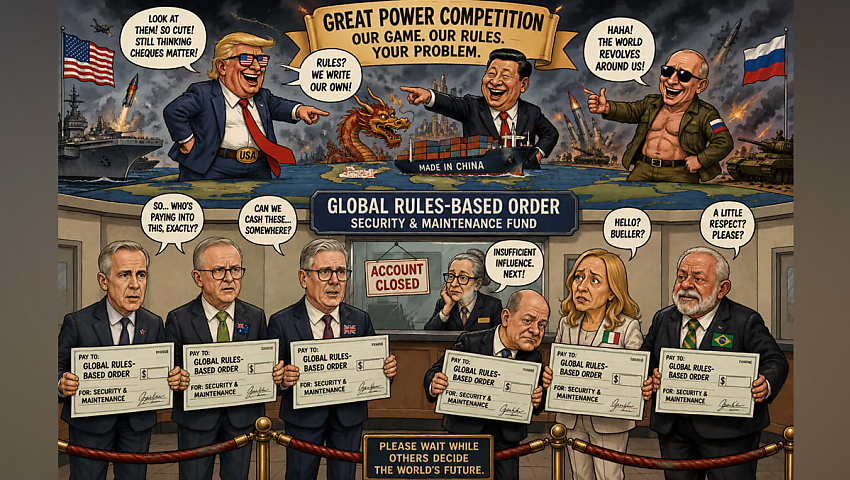
When Canadian Prime Minister Mark Carney declared to the World Economic Forum that “middle powers” collectively need to lift their game to act in the interest of the “global rules-based order”, it was met with applause, but the reality is far from praiseworthy.
Middle powers like Australia, Canada and, even to an extent, the United Kingdom have had, since the end of the Second World War, what can be most charitably described as an over-inflated sense of their position in the world.
Backed by the strategic umbrella and guarantees provided by the United States and the formalisation of the “global rules-based order” following the devastation of the war, it was easy for middle powers to act tough on the global stage where the “rules of the road” and international organs and procedures allowed them to do so.
However, since the end of the Cold War, those international norms and structures have started slowly fraying, at first. But it has become overwhelmingly apparent that in an ever-accelerating manner, the likes of Russia, China, India and even those nations considered foundational to the global order, like the United States, have slowly undermined and, in many ways, subverted the foundations of the international order.
For many middle powers, Australia included, this global “devolution” towards the historical norm of multipolarity and great power competition has come as quite a confronting and surprising shock to the system, particularly as the United States, since the early 2000s, has repeatedly sought to force the hand of its allies to “step up to the plate”.
The rise of Donald Trump and his, at least rhetorical, focus on “America First”, combined with his antagonism towards long-term allies and mercurial style of diplomacy, has only served to accelerate the shift and anxiety sweeping across middle powers and their populations, Australia included.
Bringing us conveniently to the speech provided by Canadian Prime Minister Mark Carney at the World Economic Forum’s annual meeting in Davos in January 2026, in which he said: “The middle powers must act together, because if we’re not at the table, we’re on the menu.
“But I’d also say that great powers, great powers can afford for now to go it alone. They have the market size, the military capacity and the leverage to dictate terms. Middle powers do not.”

Critically, he issued a timely but poignant warning, saying, “We know the old order is not coming back. We shouldn’t mourn it. Nostalgia is not a strategy, but we believe that from the fracture, we can build something bigger, better, stronger, more just. This is the task of the middle powers, the countries that have the most to lose from a world of fortresses and most to gain from genuine cooperation.”
But the reality is, as is often the case, underwhelming, with middle powers increasingly finding themselves caught between a rock and a hard place, one where they like to talk tough, but when it comes to delivering meaningful economic, political and strategic capability, they significantly lack.
Talk loudly and carry a little stick
In a sick twisting of former US President Teddy Roosevelt’s timeless advice for statesmen, “Speak softly but carry a big stick”, contemporary middle power leaders seem to have missed the memo and continue to expose their failings to an increasingly volatile and contested global environment.
Bringing me to a detailed analysis by Alexander Hynd, Max Broad and Minsun Hong for the Lowy Institute, titled Middle powers talk big – and act small, in which the trio argued that in light of an increasingly volatile and mercurial United States and an even more volatile international order, “middle powers are still going it alone”.
Recent events in the Middle East, specifically the seemingly never-ending opening and closing of the Strait of Hormuz, the downstream impact on global energy supplies and the haphazard regional expeditions of Prime Minister Anthony Albanese and Minister for Climate Change and Energy Chris Bowen to secure national energy supplies have only served to reinforce the collapse of the global rules-based order as nations began to look after themselves.
The trio from Lowy hinted at this, saying, “In Australia, the closure of the Strait of Hormuz sparked panic due to the country’s limited fuel reserves. Leaders responded with a flurry of bilateral dealmaking to secure fuel supply, travelling to Singapore, South Korea, Malaysia and Brunei, and hosting Japanese Prime Minister Sanae Takaichi in Canberra. Australia and Japan also agreed to work together in response to economic coercion, seemingly prompted by Beijing’s recent imposition of export restrictions on Tokyo.”
Going further, the trio were quick to highlight the nation’s glaring vulnerabilities and exposure to further coercion as typified by the Prime Minister’s request to Chinese Premier Li Qiang for Chinese assistance on securing vital jet fuel supplies, saying, “Prime Minister Anthony Albanese contacted China’s Premier Li Qiang. It meant that even at a moment of apparent middle-power cooperation, Australia needed to manage a point of great power leverage – coming after Australia’s energy insecurity was exposed because of a war led by its own great power ally.”
Yet all the while, Australia, along with its other middle-power compatriots, continue to bang on about the sanctity of the “global rules-based order”, seeking, in essence, to guilt trip the world’s great powers to play by a set of rules that they don’t believe work for them. At the same time, these middle power nations seek to build on the rhetoric of Prime Minister Carney, which Hynd, Broad and Hong highlighted, saying, “In the aftermath of Carney’s Davos speech, the chorus urging closer middle-power cooperation and coalition-building has grown loud. Australian Treasurer Jim Chalmers said the speech was ‘widely shared and discussed in our government’.”
They added: “Finnish President Alexander Stubb urged middle powers to ‘tilt the global order’ by supporting trade governance institutions such as the World Trade Organisation. But in practice, middle powers haven’t backed up their bark with bite.”
In doing so, these nations are seeking to leverage their aggregated weight, economically, politically and strategically in an effort to strong arm the world’s great powers into acting in certain ways, to abide by the post-Second World War rules of the road and maintain a status quo that many across the capitals of middle powers refuse to accept has died.
Hynd, Broad and Hong said: “In the long-term, maintaining economic openness, reinforcing existing rules, and ensuring that the great powers don’t have a free hand in setting new rules are worthy objectives. Working in middle-power coalitions may be part of that.
“But, even at a moment when the global economy is under strain, middle powers aren’t leading by example. They are largely falling back on bilateral dealmaking and bespoke unilateral tactics. Those arguing for grand middle-power coalitions are likely to be disappointed.”
One of the key challenges that constantly gets over looked and, indeed, Hynd, Broad and Hong themselves completely missed is that any effort by the world’s middle powers to marshal their own strength and aggregate weight is only as effective and, for that matter, impressive as the individual sums of its parts, and as it stands, most of the world’s middle powers are flabby, weak and in the language of the trio, lack any meaningful bite.
Or simply put, they speak loudly and carry a little stick.
Final thoughts
Australia’s strategic moment of truth isn’t approaching; it is already here. And Canberra is simply not keeping pace.
The post-Cold War order that underwrote decades of Australian prosperity – American primacy, economic integration, the comfortable fiction of the rules-based system – is fracturing in real time. The Indo-Pacific is no longer a regional backwater. It is the arena where economic dominance, military supremacy and technological leadership are being contested, right on Australia’s doorstep.
Government rhetoric has sharpened. Sovereignty. Self-reliance. Denial. National defence. The words are right. The reality is not. Capability acquisition crawls. Industrial policy remains fragmented. And too many institutions still operate on assumptions built for a far more forgiving world.
Australia cannot have it both ways. You cannot speak the language of strategic urgency while budgeting, planning and reforming at peacetime pace. A posture designed to straddle the old world and the new will succeed in either.
The answer is not isolation. Geography, economics and alliance obligations are features, not bugs or constraints, but only if Australia brings genuine sovereign capability to the table. Alliance dependence without industrial depth and independent capacity is not security. It is a liability dressed up as strategy.
Australia holds real advantages: strategic geography, vast natural resources, genuine research capacity and an unmatched position at the centre of the region that will define this century. The question is no longer whether those assets exist. It is whether the political will exists to mobilise them coherently, and to sustain that mobilisation across decades rather than manage it across election cycles.
The coming decade will not simply test Australia’s policy settings. It will test whether this country can build fast enough, decide boldly enough and commit deeply enough for the consequences to remain theoretical.
The opportunity is real. So is the cost of hesitation.
Get involved with the discussion and let us know your thoughts on Australia’s future role and position in the Indo-Pacific region and what you would like to see from Australia’s political leaders in terms of partisan and bipartisan agenda setting in the comments section below or get in touch at

Want to see more stories from trusted news sources?
Make Defence Connect a preferred news source on Google.
Click here to add Defence Connect as a preferred news source.