

 iscover
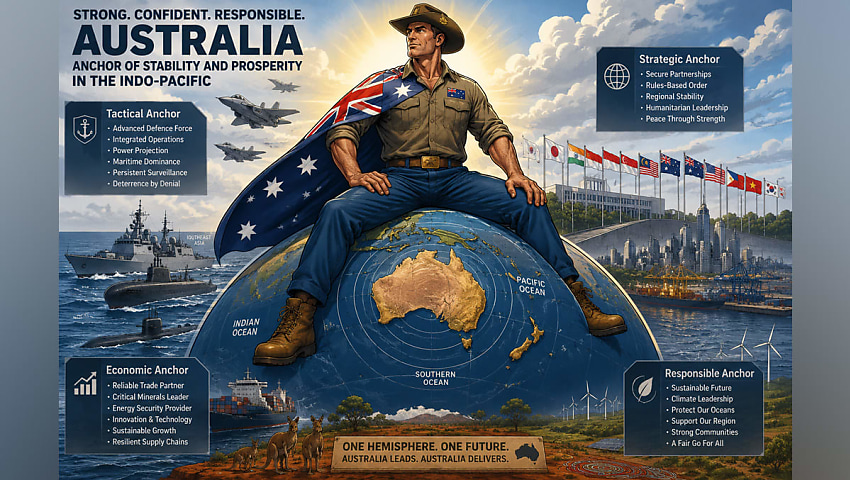
As great power competition returns, Australia faces a defining choice: remain a declining, middling middle power or embrace its potential as the strategic, political and economic anchor of the southern hemisphere.
Australia has a habit of talking itself into strategic sleep. Yet we are, by geography, one of the luckiest nations on earth, girt by sea, distant from the great fault lines, blessed with resources everyone else needs.
However, that unearned privilege and luck has curdled into a kind of civic complacency, a national assumption that history happens elsewhere and that our job is simply to watch it on the news.
Yet now, as the world order devolves into what can be charitably referred to as the “law of the jungle”, where the great powers do what they want and the middle and small powers must suffer what they can, the long meridian argument – as proposed by Australian geostrategic analyst Marc Ablong – should be the thing that finally breaks that spell because it reframes the one part of our geography we have spent a century ignoring, the Southern Ocean and the Antarctic continent beyond it as the anchor point of a hemispheric contest that is already under way, whether we have noticed it or not.
This is not an abstract academic exercise and, importantly, it sets the foundation for a broader reimagining of Australia’s role and responsibilities in the Indo-Pacific, one where we serve as an anchor nation, with all of the benefits that entails.
It is a live question about whether Australia intends to be a keystone in the emerging order of the Indo-Pacific and beyond, or whether we intend to remain what we have largely been since Federation: a wealthy, well-defended backwater that lets others do the hard strategic thinking on our behalf.
The choice is ours. But only if we choose it deliberately, and soon.
The malaise we need to name

Before getting to policy, it is worth naming the problem plainly, because policy prescriptions land nowhere without first shifting the mindset that has let the problem fester.
Australia’s strategic culture has, for two generations, been built on the assumption that someone else, first Britain, then the United States, would always be the guarantor of last resort, and that our task was simply to be a useful, undemanding junior partner.
That assumption has produced a political class allergic to hard trade-offs, a public discourse that treats defence spending as a subtraction from the “real” business of government rather than the precondition for all of it, and a bureaucratic culture that manages risk downward rather than building capability upward.
Geostrategic analyst Marc Ablong, in a detailed analysis on SubStack, titled, The Long Meridian: Australia and the contest for a hemisphere, has put his finger on exactly this dynamic, describing the way “the paper is real”, the claims, the treaty memberships, the maps with 42 per cent of a continent shaded in Australian colours, while “the presence is not”.
That gap between the paper claim and the physical fact of holding ground is, in miniature, the story of Australian strategic culture for the better part of a century.
That malaise is not unique to defence. It runs through our approach to Antarctica and the Southern Ocean with a particular sharpness, because there is no domestic constituency demanding we fix it. Nobody loses an election over the number of ice-rated hulls in the fleet.
Nobody marches on Parliament House over the state of our krill fishery enforcement. The cost of neglect is invisible until the day it isn’t, and by then, the bill has usually multiplied.
The long meridian argument is useful precisely because it converts an invisible problem into a visible one. It says: this is not a scattered set of research-station budget lines and treaty housekeeping. This is one axis of a live great-power contest, and we are sitting at the end of it that nobody else can hold for us.
The strategic opportunity hiding inside the challenge
The instinctive Australian response to a strategic challenge of this size is to treat it as a burden, another thing to fund, another thing to worry about, another argument for the next Defence Strategic Review to relitigate. That instinct is wrong, and it is worth being blunt about why.
A nation that can credibly hold the southern anchor of the long meridian is not merely defending territory nobody else wants. It is positioning itself as an indispensable partner to every power with an interest in the corridor staying open, the United States, Japan, India, Indonesia, and the smaller Pacific and Southern Ocean states who have even less capacity than we do to watch that end of the map.
Capability at the southern anchor is leverage everywhere else. A serious Antarctic and Southern Ocean posture is not a cost centre; it is a strategic asset that multiplies our relevance to partners who currently see us as useful mainly for basing and access in the north.
As Ablong framed the underlying logic, a power that can “anchor both its ends and sit astride the straits between them gains three things together: strategic depth, assured access to routes and resources, and the ability to raise the cost of everyone else’s trade without firing a shot”.
Australia’s task is to make sure it is one of the powers doing the anchoring at the southern end, not one of the powers whose costs get raised.
There is an economic opportunity braided through this as well, and it deserves more attention than it usually gets. The Southern Ocean’s krill and finfish stocks are, on the numbers, close to the last substantial underexploited protein reserve on the planet.
A world with more than a third of its assessed marine stocks already fished beyond sustainable limits is a world in which control of what remains becomes a genuine strategic commodity, not a marginal environmental line item.
Australia is positioned, by an accident of geography and a century-old treaty claim, to be the credible steward of that resource, but stewardship without presence is a fiction, and a fiction is not what a serious middle power should be selling to its own public.
The same logic runs through sovereign shipbuilding, ice-capable vessel design, polar logistics, cold-weather sustainment, and the surveillance and space-tracking infrastructure that a genuine southern presence would require.
None of this is exotic.
Norway, a nation of 5 million people, sustains a serious Arctic and North Atlantic maritime industrial base because it has decided that geography is destiny and built accordingly. There is no reason a nation of 27 million, sitting on the doorstep of the largest unclaimed strategic resource base left on the planet, should accept doing less.
The political challenge: Making the invisible visible
The hardest part of this task is not technical.
We know, broadly, what an ice-capable fleet, a resourced Southern Ocean patrol, and a properly staffed Antarctic Territory administration would look like.
The hardest part is political: convincing a government, an opposition, and an electorate that this is worth paying for before the crisis arrives rather than after.
Ablong is blunt about why this keeps being deferred: “The bill for readiness is always smaller than the bill for dependence, but it falls due earlier, which is why it is so easily deferred.”
That is the entire political economy of Australian strategic policy in one line – we do not underfund the southern anchor because the case is weak, we underfund it because the invoice for neglect never seems to arrive on this term of government.
That means treating the southern anchor argument not as a Defence portfolio issue alone but as a whole-of-government, whole-of-nation project, in the way AUKUS has, belatedly and imperfectly become one.
It means Foreign Affairs treating the 2048 Madrid Protocol review point as a live diplomatic deadline rather than a footnote. It means Home Affairs treating Southern Ocean fisheries enforcement as border protection, not a discretionary add-on.
It means Industry and Science treating polar shipbuilding and cold-weather platform design as sovereign capability, not niche procurement.
And it means the political leadership of this country being willing to explain to voters, in plain language, why 42 per cent of a continent we barely visit is actually one of the more consequential pieces of real estate we hold.
Next steps
None of the above matters unless it is translated into a program of work with dates, budgets and accountable ministers attached. The following is not exhaustive, but it is the minimum credible starting point.
First, fold the southern approaches into formal strategic doctrine.
The National Defence Strategy currently reads the region latitudinally, the sea-air gap, the archipelago, the first and second island chains. That framing needs to be explicitly extended to treat the Southern Ocean and Antarctic approaches as part of the same strategic geography, not a separate and lesser file managed out of a different department.
Doctrine drives budget, and budget drives capability. Get the doctrine right and the rest follows with far less friction.
Second, fund a genuine ice-capable maritime capability.
A single icebreaker servicing an entire continental claim is not a capability, it is a liability wearing the uniform of one. Australia needs more than one polar-capable vessel, and needs at least a portion of the surface fleet, patrol and offshore combatant classes in particular built or refitted to operate credibly in Southern Ocean sea states.
This is a multi-decade shipbuilding commitment, not a press release.
Third, restore a dedicated, armed Southern Ocean patrol. The Viarsa 1 pursuit in 2003 proved that sustained enforcement works, illegal toothfishing in the Heard and McDonald Islands zone collapsed once we treated the exclusive economic zone as something worth defending rather than administering. That capability has since atrophied into general border work. It needs to be rebuilt as a standing, resourced function, not an occasional deployment.
Fourth, build the surveillance picture we currently do not have. We cannot defend, regulate or even understand activity in a maritime space we do not watch. Southern Ocean maritime domain awareness, satellite, aerial and subsurface need the same seriousness currently (finally) being applied to the northern approaches.
Fifth, give the Australian Antarctic Territory actual governing capacity. A law that formally applies but cannot be enforced is not sovereignty, it is paperwork. Australia should be examining what a permanent, appropriately resourced administrative, quarantine and law enforcement presence on the continent would look like, rather than relying on the assumption that nobody will ever test it.
Sixth, begin the diplomatic groundwork for 2048 now. The Madrid Protocol review point is more than two decades away, which in government-time terms means it is already overdue for planning. Coalition-building with like-minded Antarctic Treaty parties and a clear-eyed Australian negotiating position should be under active development well before that clock runs out, not assembled in a panic in the years immediately prior.
Ablong’s own test for seriousness is simple and hard to argue with: “a claim to 42 per cent of a continent is either backed or surrendered”. There is no comfortable middle setting where we keep the map shaded in and the ledger unfunded indefinitely. Sooner or later, someone tests the claim and by then, it is too late to discover we never meant it.
Snapping out of it
Australia’s defining strategic weakness has never really been geography, resources or alliances. It has been temperament, a settled national habit of assuming that the worst will not happen here, and that if it does, someone larger and more capable will handle it.
That temperament served a small, distant, resource-rich country reasonably well for a long time. It will not serve a nation sitting at the southern anchor of a contested hemispheric corridor, where presence at the poles is starting to matter as much as presence in the archipelago, and where a rival power is already building the ships, the stations and the satellite infrastructure to make the argument for us if we will not make it ourselves.
The long meridian is not a metaphor. It is a description of where the strategic weight of the next generation is actually going to sit, running from the melting Arctic to the ice we claim and barely visit in the south. Three of the four plausible futures on that axis are bad for Australia.
The one livable future 0 an armed, contested but genuinely multipolar balance – is also the only one we can help bring into being, and only if we behave like a country that intends to hold its own end of the ladder rather than one hoping nobody ever tests the grip.
As Ablong pointedly reminds us, luck is not a policy. It has never been.
The question in front of Australia now is whether we treat the southern anchor as the opportunity it plainly is, or whether we wait for someone else to answer that question for us, on terms we will not have chosen, and at a cost considerably higher than the one on the table today.
Get involved with the discussion and let us know your thoughts on Australia’s future role and position in the Indo-Pacific region and what you would like to see from Australia’s political leaders in terms of partisan and bipartisan agenda setting in the comments section below or get in touch at

Stephen Kuper
Steve has an extensive career across government, defence industry and advocacy, having previously worked for cabinet ministers at both Federal and State levels.
Want to see more stories from trusted news sources?
Make Defence Connect a preferred news source on Google.
Click here to add Defence Connect as a preferred news source.