

 iscover
With China seeming to have “locked down” hegemony in Eurasia, its focus will inevitably turn to the wider Indo-Pacific. For Australia’s former ambassador to Beijing, increased Chinese power projection isn’t necessarily cause for alarm, but rather is simply the “new normal”.
There is a quote attributed to French general and emperor Napolean Bonaparte in which it is alleged that he said: “China is a sleeping giant; let him sleep, for when he wakes, he will shake the world”, hinting at the new reality both Australia and the world find themselves now facing.
Far from the destitute, developing and third-world nation of the early years post-Mao Zedong’s revolution, China has emerged as one of the world’s great economic, political and increasingly military powers with the ambitions and designs to match.
For Australia, the rise of China over the past four decades has been transformative, in both positive and negative ways. Beijing’s voracious demand for raw materials, agricultural produce and energy, combined with the explosion in the services economy plus Australian and global demands for low-cost consumer goods from clothes and electronics to cars, saw the growth of Beijing’s industrial base and the hollowing out of Australia’s.
Meanwhile, operating in parallel to the economic and industrial growth of Beijing was the growing might and reach of China’s political influence across both the Indo-Pacific region and the globe where successive Chinese leaders have actively leveraged and often manipulated multilateral institutions and leaders across the globe, capitalising on Chinese diasporas to influence the domestic politics of potential adversaries and allies alike.
Further to this, Beijing was also embarking on the largest peacetime military modernisation and build-up since the interwar years of the 1920s and 1930s with one clear objective in mind: establish the Middle Kingdom as the world’s pre-eminent and central economic, political and strategic power, upending the post-Second World War “global rules-based order” in the process.
For many Australians, it wasn’t until the fallout during the COVID-19 pandemic, following an Australian-launched push for an inquiry into the origins of the pandemic, which saw Australian agricultural produce targeted by a series of trade sanctions by China that the mask had, at least in part, began to slip.
This new reality has prompted successive Australian governments to begin a rapid but belated investment in our defence capabilities, from new armoured vehicles and long-range fires to nuclear-powered submarines and the strengthening of our multilateral relationships across the region.

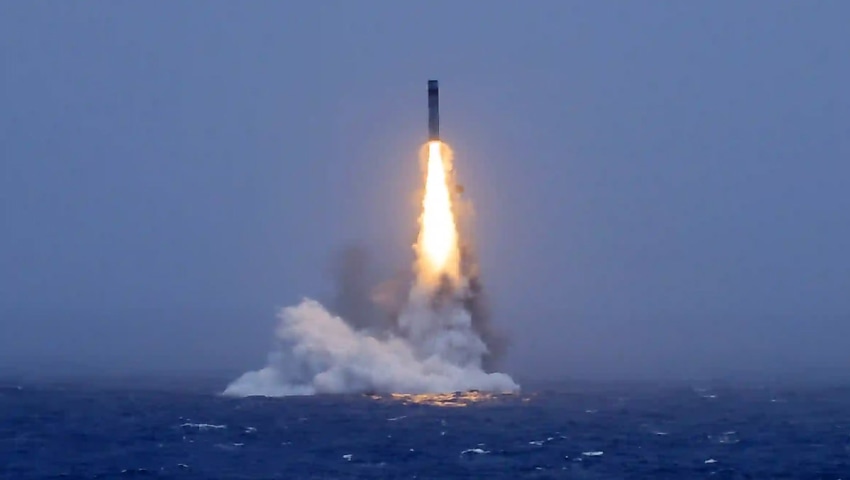
These efforts have drawn the ire of Beijing, with the most recent example, the successful test-firing of a nuclear-capable submarine-launched ballistic missile (SLBM) from a ballistic missile submarine in the Western Pacific during Prime Minister Anthony Albanese’s most recent trip to the South Pacific, which ultimately saw the missile splash down somewhere in the region.
This development has, for all intents and purposes, served to fire the starter gun on the regional countdown to potential conflict and has only served to reinforce a growing degree of public anxiety, particularly following the circumnavigation of Australia by a People’s Liberation Army Navy (PLAN) taskforce during the 2025 federal election campaign.
However, not everyone is convinced that Beijing’s actions and ambitions are necessarily all bad for Australia. Leading the charge is former Australian ambassador to China from 2007–11 Geoff Raby in a piece for The Australian Financial Review, titled Stop panicking and accept a rising China is here to stay, in which he said: “Having achieved pre-eminence in Eurasia, Beijing is now free to project power globally, which is what it is doing. Australia can expect more of this to come.”
In doing so, Raby has set the scene for what will no doubt become an increasingly prominent part of Australia’s broader political discourse: how to navigate a region and indeed a global environment where our largest trading and economic partner has become a direct threat to security, sovereignty and the established order in our region.
A tale of two nations
Raby began his analysis by comparing and contrasting the disparate responses of Australia and Japan following similar provocative incidents involving the intrusion of Chinese military assets in economic exclusion zones, territorial waters and airspace, something that has, until recently, been an uncommon occurrence for Australia.
In contrast, Japan, by virtue of its geographic proximity to China and the Korean Peninsula, has long grappled with the increasing reach and capability of the People’s Liberation Army, the ever-elusive threat of North Korea and Russia’s continued presence as a Pacific power, no matter how one attempts to frame it.
For Raby, the hysteria, which reached an all too temporary fever pitch during the 2025 election campaign and more recently during the immediate aftermath of the SLBM launch, starkly contrasts with the response of Japan, a nation which has, through a form of perverse exposure therapy, overcome the hysterical response and instead responded as a mature nation and people.
“This week, it is particularly apposite as we hear from both sides of politics, apoplectic with protests, indignation, and victimhood over China’s single missile test launch that landed somewhere in the vastness of the Pacific Ocean.
“This is the same storm of protest unleashed last year when three People’s Liberation Army Navy vessels were spotted by a commercial aircraft pilot bobbing around in the wide expanse of the Tasman Sea, and, on another occasion, a purported Matthew Flinders-like circumnavigation. And has been repeated over again, whether because of close encounters between aircraft or naval vessels in the South China Sea, or elsewhere.
“Contrast the near-hysteria in Australia with Japan, which must deal with regular Chinese and Russian sea and air incursions, and the occasional North Korean missile tests,” Raby said.
However, it is worth stating that this comparison is, at best, unfair, given Japan’s long (but admittedly recent) history of dealing with such incursions and provocations in close proximity to the Japanese mainland. Contrasting it with Australia, a nation which has long celebrated the “tyranny of distance” and our geographic isolation from the world’s great geopolitical flashpoints; it is all rather shocking.
Regardless, it provides important precedent and understanding for how a like-minded nation, in this case Japan, responds with and deals with such provocations: cool, calm and collected.
However, for Raby, if Australia’s protests are to have any credibility, “it would help if we had made similar protests over weapons testing by our friends and allies” as opposed to having any means of guaranteeing our own economic, diplomatic, political and strategic prosperity and security independent of allied support or top cover.
Rather, it seems Raby is quite content in assessing China’s behaviour and its actions as legitimate by virtue of Beijing’s position as a great power, saying, “China is just behaving like any other great power ... China is playing catch-up. Russia and the US have a rough parity of more than 5,000 warheads each, while China has just over 600, so it is reasonable to expect Beijing will want to close the gap.”
Adjusting to the ‘new normal’
However, Raby makes one important and valid point: “The questions then are what we can do about it, and if it is time for a rethink of how Australia has dealt with China’s inexorable ascendancy.”
As part of this, Raby called on Australia to think long and hard about blindly following the US strategy of containment and competition with Beijing, particularly as American economic, political and military might continue to decline in relative terms not only compared to that of China, but more broadly in the multipolar world.
Raby said: “Australia’s strategy since the mid-2010s, when the US shifted its stance towards China from strategic engagement to competition and containment, has been to push back against Beijing ... This seemed a good idea at the time, while the Trump 1.0 and Biden administrations pursued a policy of maintaining US primacy over China. It looks markedly different today under Trump 2.0. And now with Iran added to the list of failed overseas interventions, whether the US will or has the capacity to confront China is seriously in doubt.”
At the core of Raby’s analysis is the need for Australia’s policymakers and public to accept an uncomfortable reality, one that has been blatantly obvious to anyone with eyes since at least the early to mid-2010s, if not earlier, as America and its partners, including Australia, were distracted by costly conflicts in the Middle East and central Asia.
All the while, Beijing was subtly and, in some cases, not so subtly expanding its reach, increasing its influence and building out its industrial and military capabilities and capacity to directly challenge the primacy of the United States and the post-Second World War economic, political and strategic order, which ironically enough is responsible for its own rise.
Raby detailed the required shift in Australian thinking, saying, “Although Australian political figures never tire of dark warnings about living in the ‘most dangerous of times’, without ever saying what the threat is, its nature and consequences, or how imminent it might be, it would be more constructive to simply acknowledge the complexity of the global situation.”
“Critical acknowledgement of what has worked and what hasn’t would be a good starting point. While much of Australia’s efforts have achieved little, commendably, once Canberra became serious about the Pacific, some potentially valuable results, such as this week’s agreement with Fiji, have been scored. China has noticed,” Raby added.
Importantly, Canberra must be prepared for Beijing to make any number of next moves, both malign and benign and within the region and closer to home. How we respond to these actions and how we prepare ourselves to face the worst possible outcome is now the utmost priority.
After all, we all pay into our home and contents insurance annually with little in the way of grudge; a nation’s resilience, prosperity and security is just that at a larger scale.
Final thoughts
Australia’s biggest vulnerability isn’t our geography, our resources or our alliances – it’s our complacency. We’ve coasted on a comfortable national myth: that the worst won’t happen here and if it does, a bigger mate will sort it out.
That she’ll be right attitude worked when we were a quiet, distant outpost. It won’t cut it now.
We sit at the southern anchor of a hot, contested corridor. Here, presence, resilience and capability matters just as much as presence on the global stage.
Right now, a rival power is building the economic, political, strategic and diplomatic capacity to upend the established regional and global order, something that will have a disproportionate impact on Australia and its position in the world, preparing for the worst possible outcome is now not a precautionary option, it is an inescapable necessity.
The only viable future, a tough, contested but stable balance, demands that we act like a nation ready to pull its own weight, rather than one praying no one calls our bluff.
Luck isn’t a strategy. It never was.
The choice for Australia is stark: step up and secure our region and our interests today or wait for someone else to decide our fate for us, on their terms and at a cost we can’t afford.
Get involved with the discussion and let us know your thoughts on Australia’s future role and position in the Indo-Pacific region and what you would like to see from Australia’s political leaders in terms of partisan and bipartisan agenda setting in the comments section below or get in touch at

Want to see more stories from trusted news sources?
Make Defence Connect a preferred news source on Google.
Click here to add Defence Connect as a preferred news source.