

 iscover
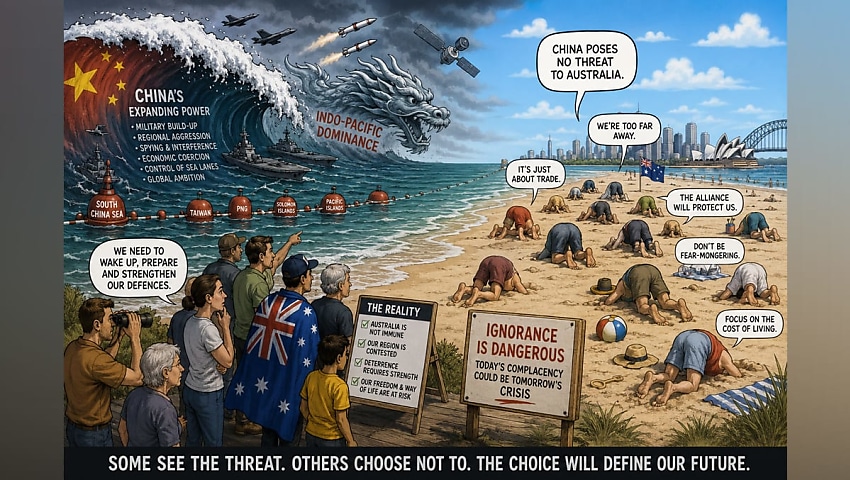
Just weeks following the successful test launch of nuclear-capable ballistic missile in our region, new polling has revealed a growing number of Australians are unfazed by China’s threat, the risk of conflict in our region and, by extension, the risks to Australia.
In 1984, Soviet defector and former KGB operative Yuri Bezmenov gave an interview to American filmmaker and author G Edward Griffin, in which he detailed the way in which the KGB had sowed the seeds of defeat in the American and, by extension, the broader Western public consciousness.
Bezmenov detailed the process of “demoralisation” by means of what he described as “a slow process which we call either ideological subversion, active measures or psychological warfare”.
Going further, Bezmenov would explain the objective of this process, telling Griffin: “What it basically means is: to change the perception of reality of every American to such an extent that despite of the abundance of information, no one is able to come to sensible conclusions in the interest of defending themselves, their families, their community and their country.”
Now as Beijing ramps up its coercive activity across the Indo-Pacific, new Newspoll data reported by The Australian’s Geoff Chambers reveals a country increasingly divided on whether the threat is real – a divide with serious implications for AUKUS, alliance management and Australia’s strategic posture.
For much of the past decade, Australia’s assessment of the China threat has been one of the few areas of genuine bipartisan and indeed, broad public, consensus. That consensus is now fracturing, and the fracture lines run directly through the electorate’s political and educational divides.
This special Newspoll conducted last week, surveying 1,238 voters, has found that overall concern about Beijing’s threat to Australia’s national security has fallen sharply since the peak of the relationship’s deterioration in 2021.
Where 75 per cent of voters believed China posed a significant threat at the height of the Morrison government’s trade war with Beijing, that figure has now dropped to 60 per cent, with 31 per cent actively rejecting the proposition and a further 9 per cent undecided.

And while the topline shift is notable enough, what is more consequential is where that shift has occurred.
Fractured consensus – divided by politics and education
The polling shows a clear and widening gap between conservative-leaning, older and non-tertiary-educated Australians on one side and Labor, Greens and university-educated voters on the other.
Roughly three-quarters of One Nation and Coalition supporters continue to regard China as a significant security threat, alongside 61 per cent of women and 68 per cent of older Australians. Non-tertiary-educated voters and those with TAFE and vocational qualifications track closely behind at above 60 per cent.
By contrast, 43 per cent of Labor supporters, 48 per cent of Greens supporters and 41 per cent of university-educated voters now say China does not present a significant threat.
That is a dramatic movement from 2021, when 73 per cent of Labor voters and 57 per cent of Greens supporters shared the majority view that Beijing represented a serious risk, figures that were themselves unremarkable at the time precisely because concern about China crossed the political spectrum.
What has changed is not the underlying strategic picture – if anything, that picture has deteriorated – but the political framing voters are receiving and the priorities competing for their attention.
Beijing’s behaviour has gotten worse
The irony of the softening in threat perception is that it has occurred against a backdrop of steadily escalating Chinese military and grey-zone activity directed at Australia and its regional partners.
The most striking recent example came earlier this month, when a Chinese nuclear-powered submarine fired a long-range ballistic missile carrying a dummy warhead into the South Pacific, a launch that travelled more than 7,000 kilometres before landing between Tuvalu and Nauru, roughly 1,000km north-east of the Solomon Islands.
The timing was pointed: the test coincided with Prime Minister Anthony Albanese’s visits to Fiji and the Solomon Islands to progress bilateral security arrangements, a sequence that reads less as coincidence than as a calibrated signal from Beijing about who it believes should set the terms of Pacific security engagement.
That incident sits alongside a pattern of increasingly assertive People’s Liberation Army (PLA) behaviour that has become almost routine background noise in the bilateral relationship: Chinese warships conducting live-fire drills in the Tasman Sea and circumnavigating the Australian continent ahead of the last federal election; a PLA-AF Su-35 releasing flares in the path of an RAAF P-8A Poseidon on lawful surveillance operations; similar flare incidents targeting an Australian navy helicopter; and the 2023 sonar-pulse incident in the East China Sea that injured Australian Defence Force clearance divers.
Beyond the military domain, Chinese-linked cyber intrusions against critical infrastructure and sustained espionage and foreign interference operations have continued largely unabated.
None of this suggests a relationship trending towards stability. It suggests a relationship in which Canberra has chosen de-escalatory public messaging even as Beijing’s operational posture has hardened, and the polling indicates that messaging strategy is shaping public perception more than the underlying activity is.
Why the shift?
Several converging factors help explain the divergence. The Albanese government has deliberately avoided the kind of public confrontation with Beijing that characterised the Morrison years, prioritising the stabilisation of trade relations and the removal of Chinese tariffs on Australian exports.
That approach has delivered real economic dividends but it has also meant fewer high-profile moments that crystallise the threat in the public consciousness compared with 2020–21, when Beijing’s coercive trade measures and diplomatic broadsides were front-page news on a near-weekly basis.
Domestic economic pressures, cost of living and housing affordability have simultaneously absorbed a greater share of public attention, while global developments, particularly Donald Trump’s return to the White House and his disruptive approach to trade and alliance management, alongside the conflicts in Ukraine and the Middle East, have crowded out sustained focus on the Indo-Pacific.
There is also a plausible electoral logic at play. Both major parties are acutely aware of the consequences of the 2022 and 2025 elections, in which the Coalition lost several Sydney and Melbourne seats with significant Chinese–Australian communities.
That awareness has visibly shaped how both Labor and Liberal strategists calibrate their language directing criticism specifically at the Chinese Communist Party and the People’s Liberation Army rather than China or Chinese–Australians more broadly, a distinction with real communications value but one that may also, over time, blunt the public’s sense of urgency about the state actor actually driving the behaviour.
The AUKUS pressure point
The timing of the polling is not incidental. It lands in the same week as the ALP National Conference in Adelaide, where the Albanese government has been working to manage a Labor Left push against AUKUS.
A softening public appetite for confronting China head-on gives momentum to voices within the party sceptical of the trilateral submarine partnership, even as the government publicly maintains its commitment to the pathway.
This is where the polling divide moves from an interesting demographic curiosity to a genuine strategic policy risk. AUKUS was conceived and sold, in significant part, on the basis of a shared public understanding of the deteriorating strategic environment.
If a growing bloc of Labor and Greens-aligned, university-educated voters no longer accept the premise that China presents a serious threat, the political cover for sustaining a multi-decade, multibillion-dollar submarine program and the broader force posture that accompany it shift, it becomes correspondingly harder to sustain across successive electoral cycles.
What comes next
The second half of 2026 will place considerable pressure on Canberra’s current posture. A scheduled visit by Chinese Premier Li Qiang; the installation of a new Chinese ambassador expected to be veteran diplomat Liu Jinsong, a figure associated with the more combative “wolf warrior” school of Chinese diplomacy; and the Pacific Islands Forum summit in Palau will all unfold alongside China’s hosting of the APEC summit in Shenzhen in mid-November and the US-hosted G20 in Miami in December.
Each of these events carries the potential to reset or further destabilise the public narrative. A return to more overtly assertive Chinese diplomacy under a new ambassador would likely sharpen threat perception again, much as it did after 2020.
Conversely, a smooth Li Qiang visit focused on trade normalisation could further entrench the current, more sanguine public mood particularly among the demographic cohorts already trending that way.
The strategic risk of a divided public
The core danger in this emerging split is not that reasonable people can disagree on the calibration of the China threat, that debate is legitimate and healthy in any democracy.
The danger is that a bifurcated public understanding of the strategic environment makes it materially harder to sustain the kind of long-term, resourced, cross-partisan national security commitments that credible deterrence actually requires, AUKUS chief among them, but also broader defence spending trajectories, industrial mobilisation and Pacific security architecture.
Beijing does not require public consensus in Australia to continue building capability, testing missiles into the South Pacific or normalising coercive grey-zone activity against Australian assets. It only requires that Australian political and public will remain divided enough, for long enough, that the difficult and expensive decisions get deferred, diluted or reversed at the ballot box.
The Newspoll numbers should be read less as a verdict on whether the China threat is real and the operational evidence of the past 18 months speaks for itself and more as a warning about the fragility of the domestic political consensus required to respond to it.
Apathy, whatever its causes, is not a strategy. And on current polling trends, a meaningful and growing share of the electorate appears to be drifting towards exactly that.
Final thoughts
All of this conveniently brings me back to the warnings of Soviet defector Yuri Bezmenov’s four-stage model of ideological subversion: demoralisation, destabilisation, crisis and normalisation.
Demoralisation, he argued, was the slowest and most decisive stage, a generational effort to erode a target society’s confidence in its own institutions, values and threat perception so thoroughly that the population becomes unable to recognise a genuine adversary even when the evidence is placed directly in front of it.
Crucially, he warned that this stage is not reversed by better information; by the time facts are presented, the target audience has already lost the framework to process them rationally.
Whether or not one accepts every element of Bezmenov’s Cold War framework, the diagnostic value for Australia today is hard to ignore. The Newspoll findings show a widening bloc of educated, politically engaged voters discounting a threat that is escalating by every operational measure: submarine-launched missile tests, cyber intrusions, dangerous air and naval incidents, injured ADF divers.
That is not a failure of evidence. It is a failure of framework.
The lesson for Australia is not paranoia, but discipline: sustained, honest civic and strategic education that treats threat perception as national infrastructure, not a partisan talking point.
Demoralisation is defeated by clarity repeated consistently over years, not by a single missile test or news cycle.
If Canberra wants durable public support for AUKUS and the broader force posture shift now underway, it cannot outsource that work to the news cycle alone, it must be built deliberately, or the drift Bezmenov described will keep setting the pace.
Get involved with the discussion and let us know your thoughts on Australia’s future role and position in the Indo-Pacific region and what you would like to see from Australia’s political leaders in terms of partisan and bipartisan agenda setting in the comments section below or get in touch at

Stephen Kuper
Steve has an extensive career across government, defence industry and advocacy, having previously worked for cabinet ministers at both Federal and State levels.
Want to see more stories from trusted news sources?
Make Defence Connect a preferred news source on Google.
Click here to add Defence Connect as a preferred news source.