

 iscover
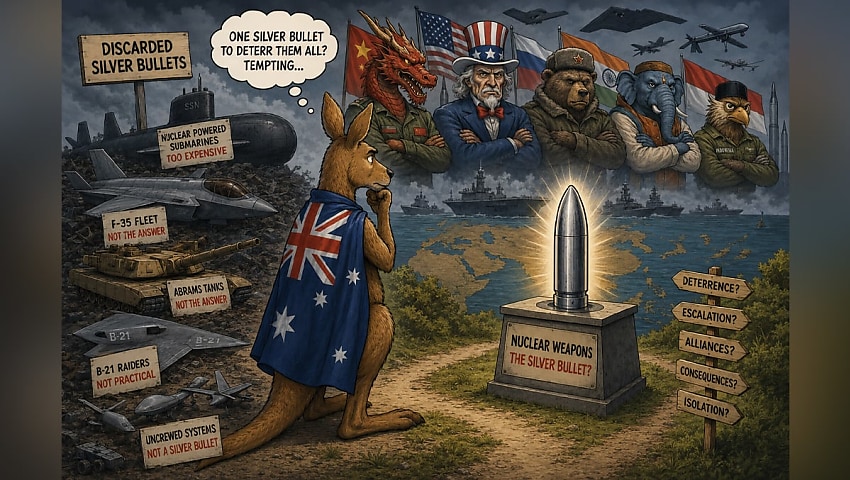
From submarines and stealth bombers to nuclear weapons, Australia keeps chasing silver bullets. Real, sustainable security, prosperity and stability mean confronting regional threats beyond China and the true cost of going nuclear.
In October 1953, a Royal Air Force Valiant crew and a small contingent of Australian personnel watched a fireball rise over the red plain at Emu Field, South Australia, the first of what would become a dozen British atomic tests conducted on Australian soil with the consent of an Australian government.
It was, at the time, presented as proof of alliance value: the mother country’s bomb, tested in the empty vastness of the outback, in exchange for a seat near the top table of the nuclear age. Seventy years on, the country and the communities beneath that fireball are still being counted, tested and compensated.
The “empty” plain was never empty. And the seat at the top table never quite arrived, Australia chose, in the end, not to build a bomb of its own, betting instead on the promise of an American umbrella.
That history feels newly relevant. Australians are, once again, being asked, implicitly, through polling rather than any government white paper, whether the old bet still holds.
The instinct when the answer feels uncertain is to reach for the thing the last generation set aside: an independent deterrent, procured this time not under a colonial testing regime but as a sovereign, 21st century-capability. It is an old anxiety wearing new language.
And it is worth pausing on Emu Field before wading into the current debate, because the question Australia is really being asked has very little to do with warhead yields or delivery systems and everything to do with what kind of country it wants to be trusted as by its own citizens, by its region and by itself.
A quiet but consequential shift has appeared in the 2026 Lowy Institute Poll. Opposition to Australia acquiring nuclear weapons has softened by five points since 2022 – not a mandate, not a majority, but a signal worth taking seriously.

As Art Cotterell argued in a recent piece for The Interpreter, titled Going nuclear: The true costs Australia would face, that softening tracks almost exactly with Australians reporting they feel less safe about world events, less trusting of the United States acting responsibly, and less confident in the current US president “to do the right thing regarding world affairs”.
This is not a considered policy shift. It is a symptom of anxiety, and anxiety makes for poor strategic policy.
That distinction matters enormously because it cuts to the heart of a pattern Australia has repeated with almost every new capability debate of the past two decades: when the strategic picture darkens, the instinct is to reach for a single transformative acquisition – a “silver bullet” – rather than to do the harder, less satisfying work of building a coherent, layered, sustainable national security architecture.
Nuclear weapons are the ultimate expression of that instinct, and precisely because the stakes are so high, they deserve to be examined with more rigour than the poll-driven commentary cycle usually allows.
Nothing is set in stone
It is easy to forget, amid decades of non-proliferation orthodoxy, that Australia’s status as a non-nuclear-weapon state was a choice, not a given.
During the negotiation of the Treaty on the Non-Proliferation of Nuclear Weapons (NPT), Australia sat among more than a dozen so-called “near-nuclear countries”.
Cold War-era officials and scientists genuinely explored options for acquiring or developing an independent nuclear capability, and the debate over ratifying the NPT in 1973 turned, in large part, on whether Canberra could rely with confidence on the US nuclear umbrella rather than build its own deterrent.
Australia answered that question in the affirmative and then went further than most middle powers in institutionalising the choice. It concluded a Comprehensive Safeguards Agreement with the International Atomic Energy Agency (IAEA) in 1974, played a leading role negotiating the additional protocol that strengthened verification after the exposure of undeclared programs in Iraq and North Korea, and became, in 1997, the first state to bring that protocol into force.
It was a central architect of the Treaty of Rarotonga, establishing the South Pacific Nuclear Free Zone in 1986, and ratified the Comprehensive Nuclear-Test-Ban Treaty in 1998, hosting International Monitoring System infrastructure on Australian soil ever since.
This history is not incidental colour. It is the scaffolding that underpins Australia’s uranium export industry, its bilateral nuclear cooperation agreements requiring partner consent for enrichment and reprocessing and, critically, the entire non-proliferation architecture that AUKUS depends on to distinguish nuclear-powered submarines from nuclear-armed ones.
Walking away from the NPT would not be a simple policy reversal. It would require invoking the treaty’s withdrawal clause, giving formal notice to the UN Security Council and treaty parties, and declaring that “extraordinary events” had jeopardised Australia’s “supreme interests”, a declaration with immediate and cascading consequences for the safeguards regime that underwrites both AUKUS and the broader civil nuclear sector Australia is simultaneously trying to build.
That is a genuinely serious threshold. It should be treated accordingly.
A region shifting on more axes than one
Where the nuclear weapons debate too often goes wrong is in flattening a genuinely complex regional threat picture into a single variable: China.
China’s military modernisation, its assertiveness in the South China Sea and its expanding nuclear arsenal are real and consequential developments, and they deserve serious analytical attention. But treating China as the sole driver of Australia’s strategic anxiety does the public a disservice, because it obscures just how broad and how structurally different the challenges actually are.
The global arms control architecture is fraying on multiple fronts simultaneously, and not just because of Beijing. Existing nuclear-weapon states are modernising and, in some cases, expanding their arsenals, according to recent SIPRI Yearbook assessments.
The last three NPT Review Conferences have failed to reach consensus outcomes – a marker of genuine institutional strain, not a single-actor problem. The IAEA continues to warn that it cannot fully verify Iran’s inventories of declared nuclear material, including highly enriched uranium, an entirely separate proliferation risk with its own timeline and dynamics.
North Korea remains an unresolved, unpredictable nuclear-armed state on Australia’s strategic periphery. And an extended deterrence itself is the credibility of the US nuclear umbrella that Australia bet its entire non-proliferation posture on in 1973, which is being questioned, not because of any single adversary’s behaviour but because of shifting American domestic politics and alliance management under successive administrations.
This is the deeper problem with the “nuclear weapons as ultimate insurance policy” framing that has crept into commentary: it assumes a single point of failure (US extended deterrence) and a single point of solution (an independent Australian arsenal), when the actual environment is one of diffuse, overlapping and only partially correlated risks.
A serious national security conversation has to hold multiple threats in view at once – grey-zone coercion, cyber and critical infrastructure vulnerability, supply chain fragility, climate-driven instability across the Pacific, and conventional force structure gaps – without collapsing them all into a proxy argument about one country and one capability.
Avoiding the silver bullet trap
Australian defence debate has a recurring vulnerability: the tendency to treat each new major capability as if it will singlehandedly resolve the country’s strategic predicament.
Submarines, long-range strike, space capabilities, and now nuclear weapons in fringe commentary, each has, in turn, been discussed in terms that imply that acquisition itself constitutes strategy. It doesn’t.
Capability without doctrine, without integration into a broader force structure, without the industrial base and workforce to sustain it, and without a clear-eyed theory of how it deters or defeats a specific set of threats is expensive theatre.
Nuclear weapons would be the most extreme version of this trap and Cotterell’s framing of “premium” is the right one: the cost is not merely fiscal, though the fiscal cost of an indigenous weapons program, enrichment infrastructure, warhead design and testing, delivery systems, command and control, and the personnel and security architecture to manage all of it would be immense and would compete directly with conventional force structure modernisation at a moment when the Australian Defence Force already has well-documented capability gaps.
It is the legal, diplomatic and moral cost that is harder to price but arguably more damaging.
Withdrawing from the NPT would not happen in isolation. It would trigger scrutiny of Australia’s safeguards compliance under its Comprehensive Safeguards Agreement, with the IAEA Board of Governors empowered to make a finding of non-compliance and refer the matter to the UN Security Council – precisely the mechanism used against Iran.
It would jeopardise the bilateral nuclear cooperation agreements that underpin Australia’s uranium export industry and the AUKUS submarine program itself whose entire non-proliferation legitimacy rests on the distinction between nuclear propulsion and nuclear armament.
It would unwind three decades of Australian leadership on the additional protocol, the Treaty of Rarotonga and the Comprehensive Nuclear-Test-Ban Treaty, leadership that gives Canberra real diplomatic standing in the Indo-Pacific and in multilateral forums that matters far beyond the weapons question itself.
And it would reopen a history many Australians would rather not confront directly: the legacy of British nuclear testing at Maralinga, Emu Field and the Montebello Islands, conducted with Australian government permission, which caused displacement and dispossession for affected First Nations communities alongside radioactive contamination of people and country harms that are still the subject of truth-telling processes today, and that also affected the Defence personnel involved in the tests.
Pacific nations carry their own intergenerational memory of nuclear harm from decades of US, UK and French testing, memory that was central to why the Treaty of Rarotonga exists in the first place.
Any Australian government contemplating nuclear armament would be doing so in a region where the moral and historical weight of nuclear weapons is not an abstraction; it is lived experience for neighbours whose trust Australia depends on for a great deal of its regional strategy, from Pacific security partnerships to labour mobility schemes to climate cooperation.
None of this means the strategic anxiety driving the Lowy Poll shift is illegitimate. It is entirely rational to feel less certain about the reliability of the American security guarantee than a decade ago and entirely rational to want reassurance.
But an “ultimate insurance policy” framing obscures the fact that insurance policies still need to be affordable, still need to actually cover the risks in question, and still need to be weighed against everything else a household or a nation has to fund.
Judged against that standard, a nuclear weapons program is a policy that would consume enormous fiscal, diplomatic and industrial bandwidth to address, a narrow slice of Australia’s actual threat exposure, while actively degrading the broader alliance, industrial and regional relationships that address the rest of it.
A much needed ‘talk’
The value of Cotterell’s intervention is less in closing down the nuclear weapons debate than in insisting it be conducted honestly with the legal mechanics, the historical legacy and the diplomatic costs on the table alongside the deterrence logic. That same standard of honesty needs to be applied more broadly to how Australia talks about its national security.
The China-centric framing that dominates so much public commentary is not wrong so much as radically incomplete. A mature conversation would ask Australians to hold in view a genuinely plural threat picture: an erratic and unpredictable North Korea; a fraying global non-proliferation and arms control architecture that constrains everyone’s options, including Australia’s; the question of whether and how far US-extended deterrence can be relied upon under future administrations of either party; the accumulating vulnerability of undersea cables, satellites and critical infrastructure to grey-zone disruption; and the genuine, non-hypothetical instability that climate change is already generating across the Pacific, a region where Australia’s credibility depends far more on being a trusted, non-nuclear partner than on any deterrent posture.
It would also require political and civil society leaders to resist the temptation to let a single poll number, however striking, substitute for policy development.
A five-point softening in opposition to nuclear weapons, occurring in lockstep with declining trust in Washington, is a warning sign about the fragility of public confidence in Australia’s existing security arrangements, not a public appetite for the extraordinary legal, financial and diplomatic rupture that actual nuclear armament would represent.
Treating it as the latter risks legitimising a minority preference, fuelled by fear rather than analysis, into something resembling a policy option.
Australia’s real strategic task is unglamorous by comparison: sustained investment in conventional force structure and the industrial base to sustain it, deeper and more diversified regional partnerships that don’t hinge entirely on Washington, serious attention to the grey-zone and infrastructure vulnerabilities that don’t make for dramatic headlines, and continued leadership in the non-proliferation architecture that has given Australia disproportionate diplomatic weight for 50 years.
None of that carries the rhetorical power of “ultimate insurance policy”. All of it is more likely to actually keep the country safe. The premium on a nuclear silver bullet, as Cotterell made clear, would be enormous and it is the public, not just the policymakers, who deserve to understand exactly what that premium buys and what it would cost.
Get involved with the discussion and let us know your thoughts on Australia’s future role and position in the Indo-Pacific region and what you would like to see from Australia’s political leaders in terms of partisan and bipartisan agenda setting in the comments section below or get in touch at

Want to see more stories from trusted news sources?
Make Defence Connect a preferred news source on Google.
Click here to add Defence Connect as a preferred news source.