

 iscover
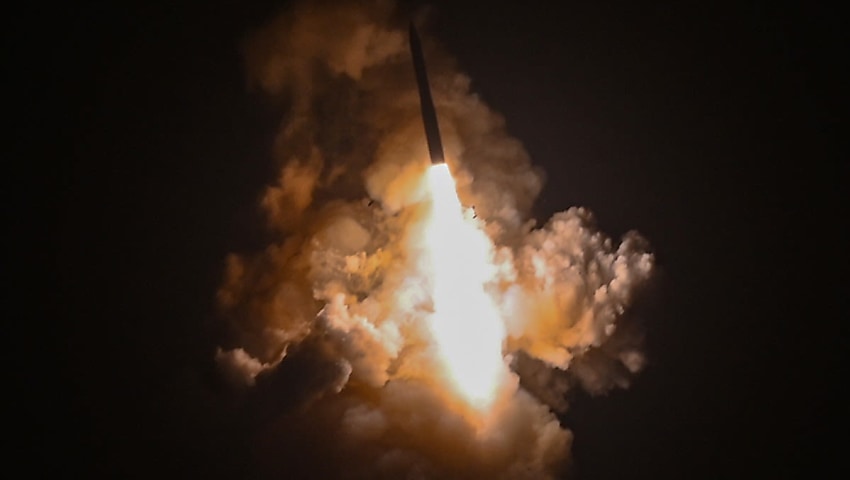
Australia has joined a plethora of international nations calling for all countries to provide advance notification of intercontinental ballistic missile, submarine-launched ballistic missile and space-launched vehicle launches.
The international effort calls on all relevant countries to commit to participate in arrangements for providing advance notification of launches of intercontinental ballistic missiles (ICBM), submarine-launched ballistic missiles (SLBM) and space-launched vehicles (SLV) to affected states. One hundred and forty-five countries participated in one such mechanism, the Hague Code of Conduct Against Ballistic Missile Proliferation.
The statement is likely directed as a result of recent unnotified ICBM and SLBM testing in the Indo-Pacific by the People’s Republic of China.
“Recent missile testing activity in the Pacific area did not follow the standard practices adopted by most states to notify and deconflict ICBM, SLBM and SLV launches,” the joint statement said.
“Conducting nuclear-capable ballistic missile tests without sufficient advance notice and detail is dangerous and disrupts the peace and security of relevant nations in proximity to these tests.
“It increases the risk of miscalculation, undermines global stability and security, and is incompatible with the responsibilities that come with possessing long-range missile capabilities.
“We call on all countries, particularly nuclear-weapon states, that launch ICBMs, SLBMs and SLVs to provide notification of such launches no less than 24 hours in advance.
“Notifications should include such information as the generic class of the ballistic missile or SLV, the planned launch notification window, the launch area, and the planned direction. Countries should also provide clear notices for airmen and mariners consistent with international standards to reduce risk, including in expected impact or landing areas.

“Regularised, transparent notification arrangements do not constrain any nation’s military development or operational needs. Instead, they reduce the risk of miscalculation, build confidence and reflect a shared commitment to security.
“We remain committed to working with all countries to strengthen the implementation of and expand notification frameworks and to hold accountable any state whose actions fall short of its responsibilities.”
Other participating governments include the United States, Albania, Austria, Belgium, Bulgaria, Canada, Croatia, Czechia, Denmark, Estonia, Finland, France, Germany, Greece, Hungary, Iceland, Italy, Japan, Latvia, Lithuania, Luxembourg, the Republic of the Marshall Islands, Montenegro, the Kingdom of the Netherlands, New Zealand, North Macedonia, Norway, Palau, the Philippines, Poland, Portugal, the Republic of Korea, Romania, Slovakia, Slovenia, Spain, Sweden, Türkiye, Ukraine, and the United Kingdom of Great Britain and Northern Ireland.

Want to see more stories from trusted news sources?
Make Defence Connect a preferred news source on Google.
Click here to add Defence Connect as a preferred news source.