

 iscover
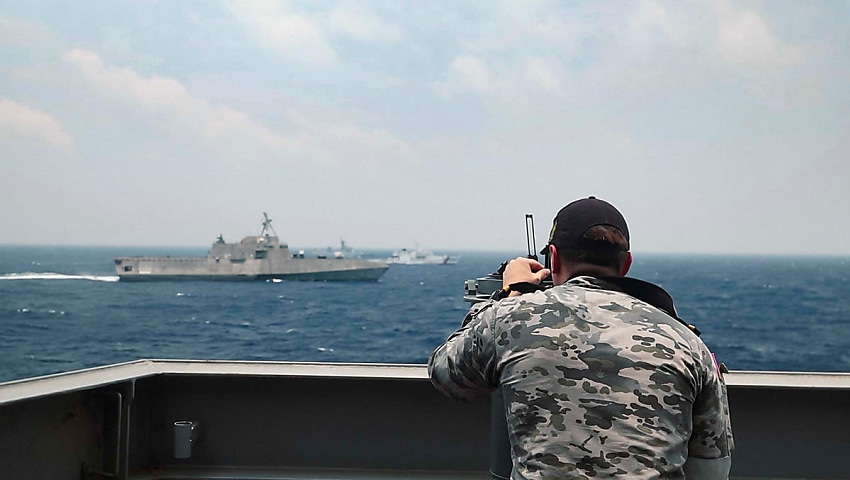
The Royal Australian Navy has joined Philippine and US forces for a maritime cooperative activity in the Philippines’ exclusive economic zone, as Australia maintains a near-continuous regional naval presence across the Indo-Pacific.
Australia, the Philippines and the United States have conducted a joint Maritime Cooperative Activity (MCA) in the Philippines’ exclusive economic zone, reinforcing their ability to operate together in support of regional security and freedom of navigation.
Held from 19 to 25 August, the activity brought together Royal Australian Navy, Philippine Navy, Philippine Air Force, Philippine Coast Guard and US Navy assets.
Australia contributed the Supply Class auxiliary oiler replenishment ship HMAS Supply, embarked with an MH-60R Seahawk helicopter, supported by a Royal Australian Air Force P-8A Poseidon maritime patrol aircraft. The Philippines deployed frigate BRP Diego Silang, an AW109 helicopter, FA-50PH and A-29B aircraft and Coast Guard vessel BRP Teresa Magbanua, while the United States contributed the Independence Class littoral combat ship USS Santa Barbara and a US Navy P-8A.
The activity demonstrated the three countries’ ability to coordinate maritime and air assets while reinforcing their commitment to international law, including freedom of navigation and overflight under the United Nations Convention on the Law of the Sea.
The operation also comes as the Australian Defence Force expands its use of regional presence deployments to maintain a near-continuous maritime presence across the Indo-Pacific.
Three Royal Australian Navy ships were conducting concurrent regional presence deployments in August. HMAS Perth supported the US Navy’s USS George Washington Carrier Strike Group during its transit of the South China Sea, while HMAS Sydney participated in Exercise Pacific Dragon 26 following its involvement in RIMPAC. HMAS Supply has meanwhile been supporting the US 7th Fleet logistics network.
Australia’s regional presence program has also included deployments by HMAS Toowoomba and HMAS Warramunga, with Australian ships conducting exercises, maritime security activities and port visits with partners including Indonesia, Japan, South Korea, India, Vietnam and the Philippines.

The tempo highlighted Canberra’s growing emphasis on persistent engagement rather than episodic exercises, using deployed ships to build interoperability while maintaining a visible Australian presence across key maritime approaches.
For Australia, the Philippines and United States, the latest MCA provided another opportunity to develop practical cooperation in a strategically important maritime region while demonstrating the ability of regional partners to coordinate forces in support of a free, open and rules-based Indo-Pacific.
The activity also reinforced Australia’s broader strategy of combining forward naval presence, multinational exercises and defence diplomacy to strengthen relationships and collective readiness across the region.

Want to see more stories from trusted news sources?
Make Defence Connect a preferred news source on Google.
Click here to add Defence Connect as a preferred news source.