

 iscover
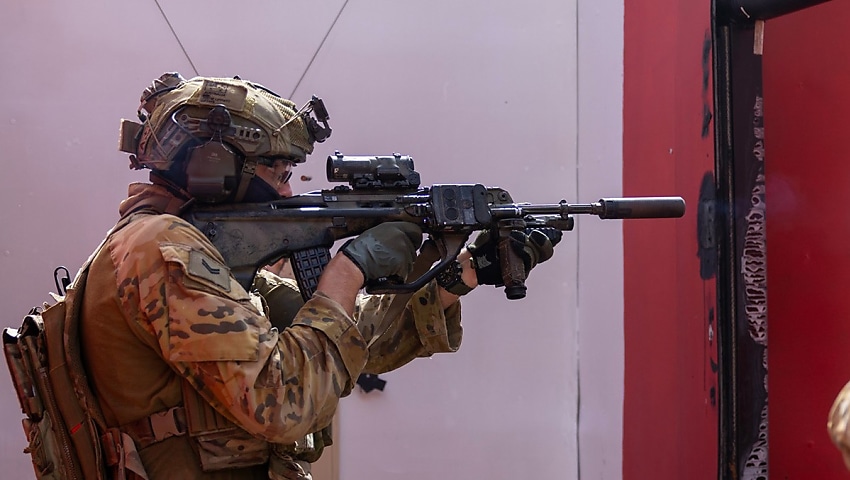
Firearm suppressors will become part of the standard Australian Defence Force equipment within five years, Australian firearms manufacturer Wedgetail Industries has said.
The Australian manufacturer of small arms, suppressors and accessories was recently featured in the ninth edition of the Australian Defence Export Catalogue, released last month and produces reduced blowback suppressors designed specifically for military small arms and AR-type rifles.
In particular, it offers a series of Ninox Suppressors for signature reduction, durability, reduced back pressure and minimal point-of-impact shift.
Wedgetail Industries director Alex Knott, speaking exclusively with Defence Connect, said knowledge about the medical benefits of using suppressors on firearms has become overwhelming in recent years.
“Our view from the information we're getting from overseas and also domestically is that essentially we’re moving to suppress every small arm in use with what we call Green Army (regular army, excluding special forces),” Knott said.
“The special forces guys are already using suppressors and have been doing so for the last 20 years or more, and our understanding is that the regular army is going to follow suit or is following suit in limited numbers.
“The main reason to use a suppressor is [to avoid] position disclosure in a battlefield-type situation, but the other main one is in training. It’s an environment where your personnel are subject to tens of thousands of gunshots in a training scenario, and that leads to hearing damage as a result.
“So, our understanding is it’s a benefit to the long-term health of the soldiers, it limits liability or claims for hearing loss damage in the future.

“There’s a shockwave from a gunshot that goes not only in your ears, but it goes through your mouth and up your nose as well. And there's a concussion wave that goes through a pressure wave that moves through your skull, so all of that adds up to increase the risk of brain damage … suppressors are really, really essential to begin to minimise the effects … which means you can shoot more often as a result.
“It should be no different to being given a pair of safety goggles, gloves and hearing protection… It’s one of the tools that you need to do your job, the suppressor is part of that kit.
“… I think with small arms, they will be issued and in service with suppressors within the next five years [in the ADF], but time will tell.”
A suppressor muzzle device, when fitted to the end of a firearm barrel, aims to suppress the blast and resulting gunshot sound from a firearm when discharged by controlling propellant gas release.
Global interest in firearms suppressors has dramatically risen in recent years with the US Army and US Marine Corps signalling that suppressor systems are under consideration for its new Next Generation Squad Weapon (NGSW) program to enhance communication, reduce hearing damage, and improve situational awareness in combat.
It’s understood that the ADF has already down-selected suppressors in 2017 and conducted a limited trial with as many as 1000 units across EF88 service rifles with the Army.
In addition, concerns have previously been raised about the effects of blast wave exposure on ADF personnel, and the Australian Department of Veterans' Affairs has confirmed that hearing loss and tinnitus are both common conditions experienced by former ADF members.
From a commercial perspective, Knott said there could even be benefits found outside of the military in Australia for hearing protection equipment, such as suppressors.
“We've worked long and hard to develop really good suppressive technology in Australia, and we've got some world-leading technology here,” he said.
“But you have to be a professional shooter in Australia to have a suppressor. They’re still not allowed in Queensland, Western Australia and Tasmania, which is ridiculous … imagine driving your car to Queensland and you have to cut the muffler off the car because Queensland doesn't want mufflers, it’s just ridiculous.
“In Northern Europe and the United Kingdom, suppressor ownership is really seen as mandatory for hunting. Just because of the noise that is comfortable for people around you, they don’t want dogs and neighbouring properties hearing gunshots.
“Hearing damage occurs to anybody shooting a firearm that's unsuppressed. So, we'd like to see all shooters across all markets have access to suppressors regardless of their occupation. Because the physics is physics, right?”

Want to see more stories from trusted news sources?
Make Defence Connect a preferred news source on Google.
Click here to add Defence Connect as a preferred news source.