

 iscover
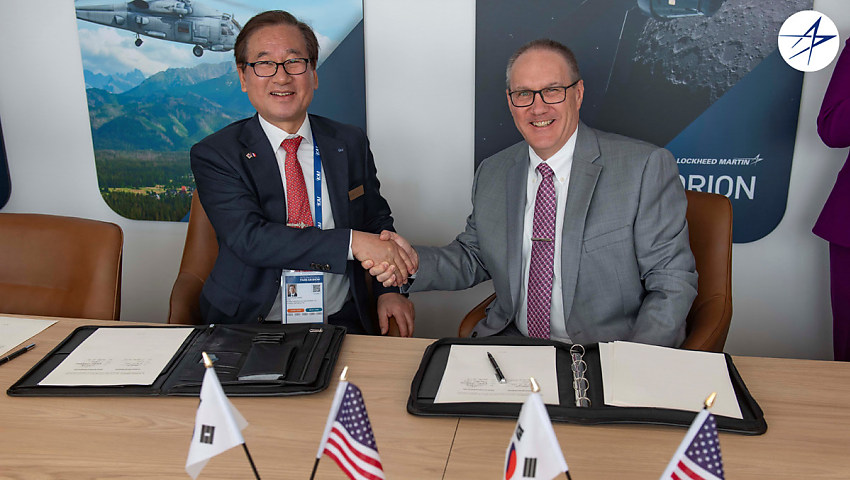
Lockheed Martin and Korea Aerospace Industries have signed a new memorandum of understanding at the Paris Air Show 2025, formalising an expansion of their long-standing partnership to cover a broader range of advanced defence and aerospace technologies.
The MOU, signed by Lockheed Martin chief operating officer Frank St John and Korea Aerospace Industries (KAI) president and CEO Kang Goo-young, signals a significant step forward in the companies’ collaboration.
The agreement will extend their cooperation beyond existing air systems to now include rotorcraft manufacturing, next-generation platforms, space systems, crewed-uncrewed teaming, uncrewed aerial vehicles, training systems and sustainment solutions.
This expanded partnership builds on a relationship that began more than three decades ago with the licensed production of the F-16 fighter and has since grown to include co-development of the T-50 supersonic trainer, FA-50 light attack aircraft, KF-21 multirole fighter and integrated logistics support programs.
“The extension of our collaboration with KAI reflects our commitment to advancing global security by partnering with allies to develop, manufacture and sustain 21st century deterrence solutions,” St John said.
“By combining the best of American and Korean skills, technologies and expertise, we aim to build industrial capacity, sustain high-skilled jobs and generate mutual economic benefits.”
Kang emphasised the deepening of the companies’ industrial and technological partnership. “Our enduring cooperation with Lockheed Martin over the past 30 years has been characterised by joint development, technical exchange and shared industrial goals,” he said. “This new phase will strengthen our presence in the global aircraft and fighter markets, including the United States and its allies.”
“We are already collaborating successfully on several key programs and look forward to advancing next-generation capabilities in rotorcraft, autonomous systems and uncrewed platforms,” Kang added.

“These technologies will expand the capability sets available to our defence customers while creating opportunities for local industry involvement.”
The companies are already pursuing expanded export opportunities for the T-50 and FA-50, including the US Navy’s Undergraduate Jet Training System competition.
Lockheed Martin has played a major role in supporting South Korea’s defence and aerospace priorities for over 30 years. Its contributions extend beyond military platforms to include civil aerospace advancements such as modernised air traffic control, telecommunications systems and space capabilities.
Want to see more stories from trusted news sources?
Make Defence Connect a preferred news source on Google.
Click here to add Defence Connect as a preferred news source.