

 iscover
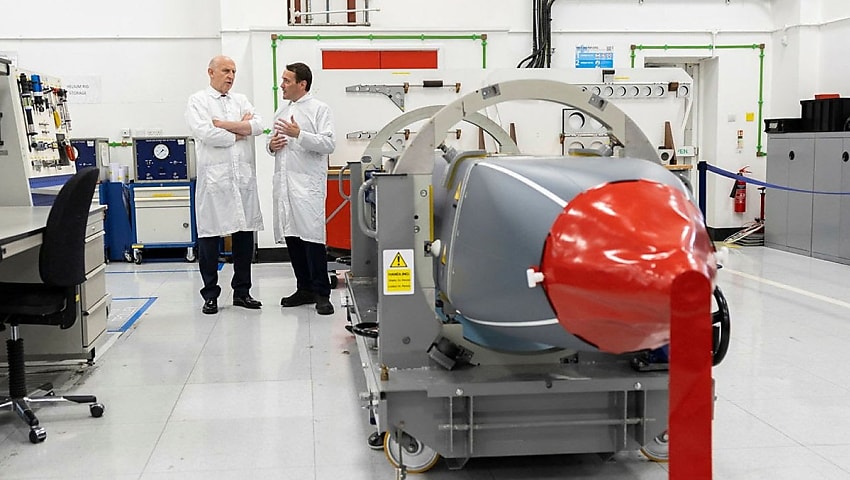
A landmark report by the UK government’s Defence and Economic Growth Taskforce has outlined a series of bold recommendations to harness increased defence spending for national prosperity, including the rollout of regionally tailored defence growth deals and targeted investment in dual-use technologies.
The proposals aim to ensure working people across the country benefit from the United Kingdom’s historic commitment to lift defence spending to 2.6 per cent of gross domestic product (GDP) by 2027.
In a major boost for British industry, defence technology firm Helsing has announced it will establish the UK’s first Resilience Factory, an advanced manufacturing facility specialising in artificial intelligence (AI)-powered autonomous submarines.
The site, to be located in Plymouth, is set to become a national centre of excellence for marine autonomy, creating high-value jobs across the south-west and the broader UK defence technology supply chain.
Helsing will double the size of its UK operations as part of an accelerated £350 million (AU$727.6 million) investment under its Trinity House initiative, delivering cutting-edge capabilities to allied navies and helping to safeguard undersea critical infrastructure.
The announcement was welcomed by UK Chancellor Rachel Reeves and Defence Secretary John Healey, who will jointly launch the taskforce’s report later today at a Ministry of Defence roundtable.
“A new era of threats demands a new era for defence and security,” said Reeves.
“That’s why we’ve prioritised increasing defence spending to 2.6 per cent of GDP by April 2027. With the taskforce’s recommendations and Helsing’s announcement, we are not only strengthening our national security but also unlocking the economic potential of the defence sector – benefiting working people and advancing our Plan for Change.”

The taskforce’s central recommendation is the creation of a “Team UK” approach – a whole-of-nation strategy to build global competitiveness by reforming defence procurement, boosting innovation and unlocking private capital. The strategy aligns closely with the UK’s Strategic Defence Review, which repositions defence as a pillar of long-term national resilience and economic renewal.
Other key recommendations include:
- Prioritising dual-use technologies that serve both civilian and military applications.
- Reforming contracting processes to increase agility and value for money.
- Driving regional economic growth through bespoke defence growth deals.
- Deepening collaboration between government, industry and the finance sector.
The report comes as new figures show that defence spending now supports 151,000 jobs across the UK – a 14,000-job increase over the previous year. Notably, the south-west region is poised to benefit from Helsing’s investment, positioning Plymouth as a hub for maritime innovation.
Helsing UK managing director Ned Baker said the company is backing the government’s ambitions both strategically and economically, saying, “We are investing in both by opening the UK’s first Resilience Factory and accelerating our £350 million commitment. We believe in the government’s direction on advanced technological solutions and are confident this will attract further private investment to equip our Armed Forces and stimulate economic growth.”
Defence Secretary John Healey echoed the sentiment, framing the shift as a modernisation of Britain’s defence-industrial base, saying, “In a new era for defence, we are building a new partnership with the UK’s world-class defence industry – large and small – and with innovators and investors.
“Through our Defence Industrial Strategy, we will equip the Armed Forces for the future and make defence an engine of national growth, unlocking investment, reforming procurement and championing innovation.”
The government has already begun implementing several of the report’s key recommendations:
- Establishing a Defence SME hub to support new entrants into the market.
- Launching work on a Defence Exports Office within the Ministry of Defence.
- Committing to develop defence growth deals across the UK as part of the next spending review.
Remaining recommendations will now be considered by the cross-Whitehall Defence Growth Board and the Defence Industrial Joint Council, with further updates expected as part of the upcoming Defence Industrial Strategy launch.
The taskforce represents an unprecedented collaboration between government, finance and industry, co-chaired by the Chancellor and Defence Secretary. It was convened by the Confederation of British Industry, with strategic support from global consultancy Oliver Wyman, and includes 20 major organisations across the defence and advanced manufacturing sectors.
The UK’s increasing defence investment mirrors broader global trends, including in Australia, where similar focus is being placed on defence as a driver of economic transformation. The UK’s commitment to advanced technologies, regional defence hubs and workforce development shares similarities with Australia’s own efforts under the Defence Strategic Review and Advanced Strategic Capabilities Accelerator initiatives.
Australia’s defence planners may closely watch the UK’s push to pair sovereign capability development with regional economic growth, especially as Australia progresses its own programs in undersea warfare, defence AI and defence industry expansion across states and territories.
Want to see more stories from trusted news sources?
Make Defence Connect a preferred news source on Google.
Click here to add Defence Connect as a preferred news source.