

 iscover
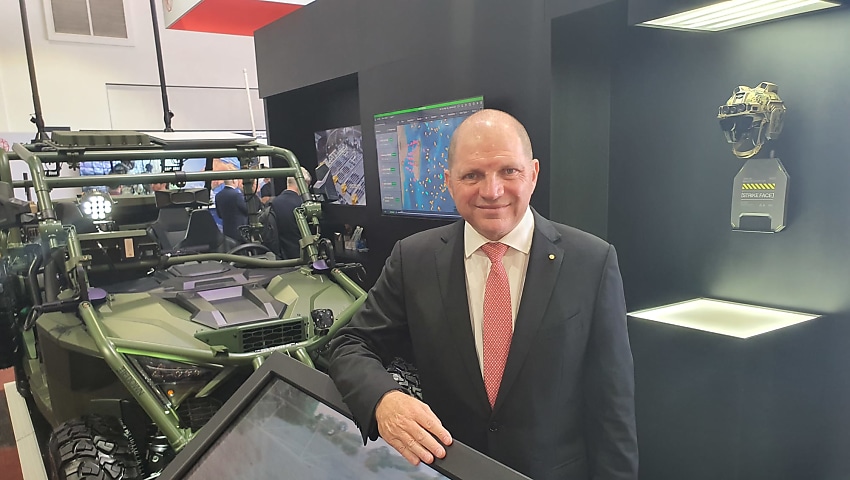
Anduril Australia has debuted its new EagleEye helmet system at the annual Military Communications and Information Systems Conference in Canberra this week.
The augmented vision system combines hearing protection with the traditional kinetic protection of a combat helmet as well as augmented vision and integration of Anduril’s Lattice AI. The system can provide a compass, waypoint marking, tracking of objects (such as support drones, teammates and enemies) as well as other augmented vision benefits in an almost “sci-fi” style heads-up display system.
EagleEye’s heads-up display reportedly provides the operator with an enhanced view of the landscape in front of them by overlaying digitised screens to the real-world view, operable in both day and night. The tech can further streamline soldier networks by enhancing communication across the battlefield and in restricted environments, as well as tasking unmanned aerial vehicles from mobile positions. It further has rear and flank view sensors to provide optimum awareness.
“EagleEye capability is our integrated soldier-worn revolution, that’s the way we think of it. It fuses a literally unlimited number of sensors – whether they are satellites, whether they are drones, whether they are ground sensors, whether they are other soldiers – into a common worldview through our lattice operating system. And then what that enables is the soldier to make decisions based upon lattice and AI recommendations or to seamlessly use autonomous systems to have an effect,” Anduril Australia executive chairman David Goodrich said.
“The current ecosystem for a soldier so completely taxes their mind space because they have a radio on their back, a GPS in their pouch, potentially some night vision goggles on their head, and they have to somehow manage all of those systems, each one of them having their own power source, their own display, their own operating manual, and they are completely unintegrated.
“The EagleEye system has all of those capabilities, and more, fully integrated into an AI-driven lattice operating picture.
“The glasses enables Lattice to display all of the situational awareness that the soldier is embedded in. Those sourced from ground sensors, from drones overhead, from satellite sensors and also other soldiers because the soldier itself is also now a sensor. It eliminates the uncertainty of his environment. It provides him with options as to what he can do in terms of putting an effect on an adversary, but it can also provide him with information as to what is the safest pathway out of harm’s way, which the soldier currently just does not have.
“What our Lattice AI system does is it filters out the noise of all of the potential information that could be provided to a particular soldier and distils it down using AI to only the information that that soldier needs at that particular point in time.

“The soldier will be gathering a lot of information via wearing the EagleEye that will be absorbed into Lattice and could be used by another soldier or another unit in another location … It’s a pull system, not a push system so it’s not an overloaded human experience. It’s only the information that that soldier wants.
“In the next couple of years, there will be tens of thousands of these units in the field with customers all around the world, including the United States and potentially even here in Australia.”
At the conference, the launch of the EagleEye is also supported by a rear plate armour insert combined from a battery, onboard computer and traditional armour plate. The insert allows power use to a soldier’s other body-worn equipment as well as protection against kinetic weapons.
“This is both a solid state non-flammable ceramic battery and also a ballistic plate. It’s not a lithium-ion battery, so it can absorb a bullet hitting it. This would probably be the back plate of a soldier. The front plate would be traditional armour,” Goodrich said.
“It eliminates every single one of these systems having their own battery, their own cable, their own display. And so this is an entire family of systems which is going to revolutionise the soldier-borne battle space.
“The creativity that we’re bringing to this entire ecosystem of trying to make the soldier less burdened by weight of technology.”
Anduril is forging ahead with the technology in the US and presenting EagleEye in Australia despite no official Defence contracts requesting the technology.
“We have demonstrated and brought EagleEye to Australia before and we’ve shown what we’re doing with our international customers to the Australian Army, and the Australian Army are interested.
“This will be a product that will be off the shelf and available in a mass production pricing model in the next 18 months or so.”

Want to see more stories from trusted news sources?
Make Defence Connect a preferred news source on Google.
Click here to add Defence Connect as a preferred news source.