

 iscover
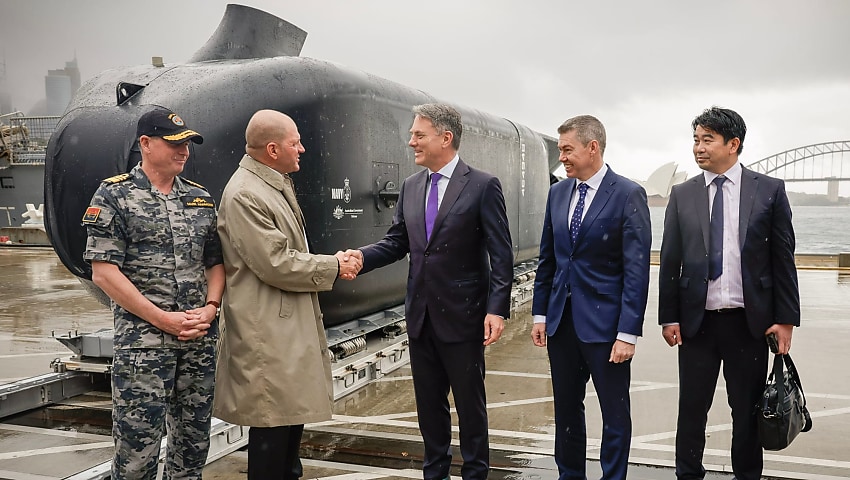
Production capacity is modern military deterrence and Australia must arm itself with “factories as weapons”, according to recent comments from the leadership of Anduril Australia.
Anduril Australia executive chairman David Goodrich made the comments to a recent joint standing committee on foreign affairs, defence and trade held on 25 November this year.
Goodrich extensively detailed the company’s success in working with the Department of Defence to opens its first Australian manufacturing facility in Sydney and successfully complete its first production model for the Ghost Shark modular, extra-large, underwater vehicles.
Ghost Shark platforms will be delivered to the Royal Australian Navy, with the first handed over in January next year. Commercial models will be exported internationally.
“From my almost 40 years of experience running private companies in Australia and around the world, I think that industry is willing to lean in to invest the capital that is required to deliver defence innovation and at scale manufacturing capabilities if (the Department of) Defence’s procurement and contracting systems are agile, streamlined and commercially sensible,” Goodrich said.
“Given the current and critical geopolitical uncertainties that we face in this region and around the world, production capacity is deterrence and the factory is the new weapon that we need as a nation.
“Defence does need to, and I think, recognises the need to modernise its acquisition framework. Procurement and contracting processes that have designed historically for large, long lead time cost plus programs for capabilities like frigates and submarines are simply not suited to fast-moving software-based technologies, such as autonomous systems that use artificial intelligence, machine learning and computer vision which need to be updated continuously to meet the changing threats.
“There is no such thing anymore as a one-size fits-all approach to defence contracting. A new procurement model is needed and it’s one that supports the speed to capability, iterative capability development and continuous technology insertion supported by shared investment, aligned incentives between government and industry.

“If companies take risk and they deliver successfully, they must be rewarded with substantial contracts that allow investors in those companies to earn a market-based return on the risk that they have taken.
“If Australia is to deter a great-power aggression in the coming decade, we have to move beyond the risk aversion that is baked into legislative instruments like the PGPA Act, Commonwealth Procurement rules, and the threat of an ANAO audit, which leads to an allergic reaction to sole source contracts.
“The reality is that tendering is expensive for industry and it isn’t the only way to ensure that value for money, necessary value for money, is achieved or does it always encourage innovation.
“We need to move towards a more balanced approach between these traditional and appropriate contracting models for large programs and sensible risk-taking where innovation, co-investment, speed to capability and sovereignty are acknowledged as part of that process and rewarded for taking risk.
“We need to invest in capabilities where we can produce them in Australia because in the time of a conflict, a global conflict, our supply chains will be disrupted. We’ve seen what that looked like in a pandemic. A global conflict will make a pandemic look like a picnic. So, we need to be prepared to be able to produce a range of capabilities in our country.
“We obviously can’t produce everything in our country. So, there’s a set of strategies that that we need to employ which is partly about long lead buys and a supply chain-driven investment.
“I’m thinking of things like long-range weapons. I’m thinking of things like fuel supply.
“But then there are factories that we can build … The factories of today are a deterrent for a country potentially deciding to try to take on Australia if they know that we have the ability to produce capabilities on mass at scale very, very economically.
“They may decide not today. And a conflict deterred is a conflict that is potentially one that may not happen.
“(Australia needs) to invest into industrial capability that would allow us to build vast quantities of weapons, vast quantities of capabilities that could be used in an ongoing sense because a war will not be over in what modern warfare thinking has lulled us into a false sense of security and thinking that it won’t be over in a couple of weeks. We’ve seen what’s happened in Europe. Any conflict that starts is going to be a war of production, not necessarily a war where the most exquisite, the stealthiest capability will prevail.”
The Anduril Australia executive also put forward several recommendations to the committee meeting regarding the future progression of the Australian defence industry.
“Firstly, we recommend that there needs to be a strengthening and an enlivening of collaborative trust-based partnerships with industry where industry shows that they deserve this,” he said.
“Secondly, we need to focus on delivering shared operational outcomes rather than using rigid, slow, overdetail and over-documented specifications which are often out of context before they are even issued.
“Thirdly, we need to encourage industry co-investment models that make industry genuinely accountable and incentivised to invest their own capital by guaranteeing that they will be awarded a commercially viable and a commercial scale contract if they succeed.
“Now, there are two sides to that coin. The other side of the coin is that if we don’t succeed, we should suffer the pain and financial loss associated with that process. So we are rewarded if we do succeed. If we do not succeed, we should not be bailed out by the taxpayer.
“And finally, we need to plan. Government needs to plan for at scale production and budget fully for the program of record that would follow a successful prototyping phase to ensure a smooth transition between the prototyping phase and the at scale production commencement to avoid the risk of slipping into that well-described category or component of a company’s nightmare, which is the valley of death between those two phases.”

Want to see more stories from trusted news sources?
Make Defence Connect a preferred news source on Google.
Click here to add Defence Connect as a preferred news source.