

 iscover

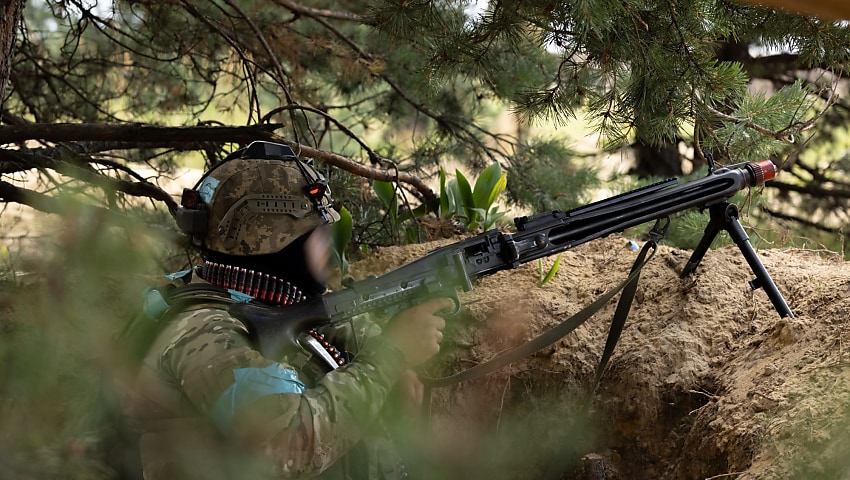
Stay informed, build a track record and plan for lengthy integration as you pitch defence products into the international and Ukrainian market, advises HighCom’s Geoff Knox.
HighCom’s executive chairman and group chief executive officer discussed breaking out of the Australian box into international export markets, in particular into Ukraine, while speaking exclusively with Defence Connect earlier this year.
HighCom primarily offers ballistic protection gear, such as soft and hard armour plates, vehicular armour as well as uncrewed systems, sensors and integrated defence tech.
The company displayed drone, counter-drone systems including Sharpshooter, ultra-light, buoyant and female form factor plates at Land Forces International Land Defence Exposition 2026 earlier this year in Perth.
“We (originally) developed the technology for the lightweight armour in Adelaide. The challenge with the Aussie marketplace is it’s not that large and that technology has got huge reach. So, we moved it from Adelaide to the biggest market available in the world, a concentrated market, which is the US market,” according to Knox.
“And we also bought the HighCom business to house it in fundamentally. So that was the focus of that particular part of it. But we left behind the HighCom Technology part in Australia, based out of Canberra, once again servicing ADF’s needs going forward.
“For anything you buy you’ve got to have track record… The Australian market is small and it’s periodic. Unless you’ve got a bigger business arrangement around that, which is a bigger global customer base, you can end up in some pretty big troughs here where it’s hard to manage through.
“Having a global business, we can actually smooth out the peaks and troughs. We can continue to focus on technology here in the sustainable but having a bigger global reach for the rest of the business to offset anything that might happen here.”

Making The Leap To The US Market
The Australian company XTEK Limited agreed to acquire US-based HighCom Armor Solutions in 2019, before rebranding itself as HighCom Limited in 2023.
“My forbearers in doing that (shift to the US) had basically realised the market was there. And they then realised what it was going to take to package up the technology and ship it across to the US,” he said.
“So, in this case, not a lot of physical components went over there. They were made in the US to the Aussie design. Obviously, you had to localise the standards that it was designed to and the pressure vessel standards, etc. had to change. And then the control systems are all the same.
“So the project of doing that is relatively linear. The thing that I think the enterprise misunderstood at the time is how long it would take to get it working and commissioned over there in the US in its new environment.
“And literally it was June, July this year that we finally got it fully commissioned and running properly and delivering. That took a lot longer than the team before me expected it to.
“My background in major project development and delivery would always said that was going to be at least a two-to-three year project. They were assuming six to nine months. That was just a lack of experience on their behalf.”
Supplying Armour Products Into Ukraine
HighCom reportedly began supplying body armour into Ukraine from around March and April 2022. By August 2025, it had reportedly supplied more than 160,000 armour plates into the country.
“There’s a project called Interflex which basically people supply to. So, it’s a general supply to get general products, not just armour into the Ukraine. We have sold the vast share of that into the Ukraine,” he said.
“Interflex has since changed, the program doesn’t exist in that form anymore, it’s changing… So it was basically supplied from the US, shipped across and then put into the Ukraine.
“We got there because we were in the US, so we’re in the biggest market, it’s got the biggest reach, it’s got the biggest budget, so that allowed us to do that for the armour part of the business.
“For technology, what we do here is already global. So it says that makes it easy for us. We are not developing new products now in Australia for Australian use. We’re sourcing the best products from around the world to bring to use here, which is a different risk model. It’s a much lower risk model.”
Armour Trends Out of Ukraine
Knox indicated that major trends emerged from the armour supply into Ukraine, including observations about development cycle and armour trends.
“I think what we’re witnessing in the Ukraine is just this fast development cycle, this prototyping,” he said.
“They’re very good at putting ‘Beta’ to work and if it does succeed then they turn it into Alpha and then they mass produce.”
“There’s two things going on in the armour market (at the moment from Ukraine). One is…lighter, thinner plates… We can go further if we have to (thinner), but then you’ve got to work out can the human take the load if it hits. So that becomes a limit point.
“The other one is if you look at the injuries happening in the Ukraine, the bulk of the injuries are from near force blast. So, in other words, it’s not being shot anymore. It’s having a blast from a drone going off nearby.
“That’s a different set of protections that you need to do that. And once again, we look at that and we’re looking at what is it we can do to address those needs? Because that’s the evolving battlefield, particularly in the Ukraine anyway… the vast majority of injuries are from a blasts nearby from Ukraine.
“I think it’s beholden on the industry to keep them (the Australian Defence Force) informed (about this). They’re already well networked anyway. Let’s not underestimate the amount of time they spend out there listening. They’re intently involved in listening (about these new threats).”
Further Changes In The Body Armour Market
“Firstly, the weight, you’ve got to get the weight under control. You can’t continue to load the fighting person up with more and more gear and more and more batteries,” he said.
“Two is the ergonomics on the carrier. If you look at the current systems, they plug square rectangular boxes on the system and now you’ve got bulky gear out in front, which is not good. So, there’s some ergonomic work to happen, which we think is important.
“And then the batteries, there’s a number of groups saying they’re going to integrate the batteries in the armour. It doesn’t make a lot of sense to us because as soon as you do that, you get shot, you get hit on the armour, you just destroy your battery.
“Why would you do that? We think it’s going to be a modular system. that attaches to the armour and we’re working on that. We’ve got various technologies we’re exploring right now for that reason.
“But I would warn that battery tech is a fraught industry. I happened to look after GD mining for a number of years and I inherited a battery technology in that process and they’re tricky to get to market in a commercial way. So we’re looking once again to work with battery partners that have the technical skills to design to suit our users.”
The above interview was conducted by Defence Connect with HighCom’s Geoff Knox at Land Forces International Land Defence Exposition 2026 earlier this year in Perth.

Want to see more stories from trusted news sources?
Make Defence Connect a preferred news source on Google.
Click here to add Defence Connect as a preferred news source.