

 iscover
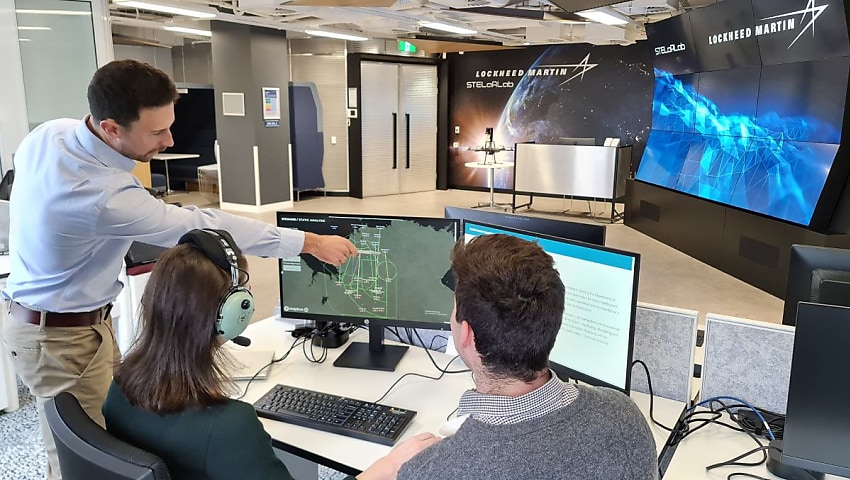
The prime has leveraged a virtual network to test the ADF’s integrated air and missile defence capability.
Lockheed Martin Australia’s (LMA) research and development team, STELaRLab, has conducted an integrated air and missile defence (IAMD) decision support experiment using a live, virtual, constructive (LVC) training system.
The test was conducted in collaboration with the Royal Australian Air Force (RAAF) and the Defence Science Technology Group (DSTG).
The experiments, which took place over several weeks, involved exploring systems leveraging artificial intelligence (AI) to support rapid decision making at tactical levels of command and control across multiple domains.
Five STELaRLab scientists were tasked with testing and evaluating advanced resource allocation decision support systems incorporated into a next generation battle management testbed.
Air battle managers (ABMs) supported the exercise, providing realistic mission needs, including mission planning, execution and a debrief.
“Over the past five years, STELaRLab has developed a suite of decision support AI systems to support RAAF’s air battle management operators make faster data driven decisions to remain ahead of future threats,” STELaRLab director Dr Tony Lindsay said.
“During this collaboration, we were able to demonstrate the art-of-the possible by putting dynamic decision support algorithms to the test in an LVC environment and demonstrate cutting-edge sovereign innovations that enhance Australia’s future integrated air and missile defence capabilities.”

According to LMA, IAMD AI technologies demonstrated the benefits of providing tasking and tactical recommendations, preparing ABMs for complex scenarios.
“Being deployed with Defence and having the benefit of deep operational experience providing context and feedback was invaluable, as it allowed our STELaRLab scientists to gain critical insights in real time,” Lockheed Martin Australia’s Kevin McDonald, research engineering manager and the IAMD research leader, STELaRLab, said.
“You get to see first-hand how the AI systems perform, what improvements are needed, which in turn allows our scientists to incorporate the feedback quickly and adjust the AI systems to better align with our customer’s mission.
“Working directly with the end user and receiving feedback in real time means we can develop new innovations, and transition-ready innovations, more rapidly.”
LMA’s STELaRLab team is expected to continue work to evolve IAMD decision support capabilities, aimed at ensuring the ADF is equipped to address future threats in the battlespace.
[Related: Lockheed Martin Australia, University of Newcastle launch STEM partnership]

Want to see more stories from trusted news sources?
Make Defence Connect a preferred news source on Google.
Click here to add Defence Connect as a preferred news source.