

 iscover
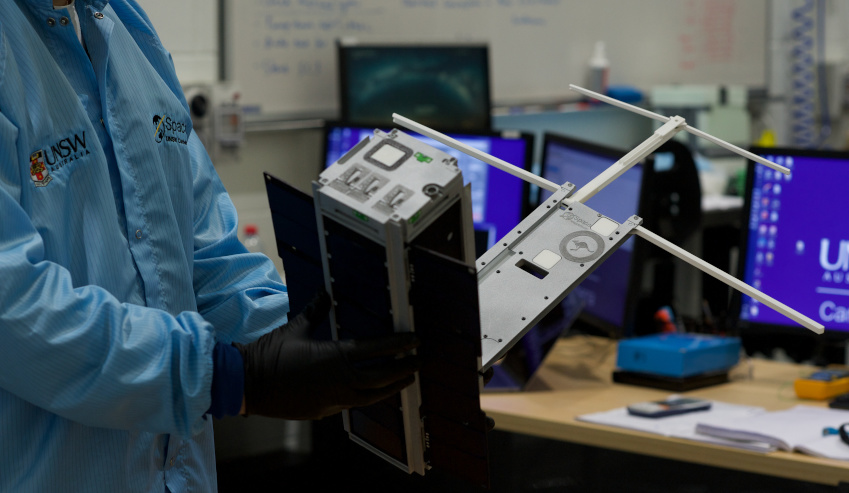
The Australian Defence Force Academy (ADFA) and Royal Australian Air Force (RAAF) have partnered with a leading Australian university to deliver a three-year space research and development program.
Announcing the news of the University of New South Wales Canberra (UNSW Canberra) partnership with the ADFA and RAAF at the International Astronautical Conference, Minister for Defence Industry Christopher Pyne confirmed the government was investing $9.96 million, in a move the minister said would support the growth of Australian space technologies and investigate ways to enhance Defence space capability.
"The program is designed to enhance the ability of UNSW Canberra to deliver world-class space education to Defence personnel, as well as inform the future direction of Defence space capability," the minister said.
"Through the program’s delivery, UNSW Canberra will partner with Australian industry to develop elements of a space flight mission.
"Research outputs are anticipated to provide UNSW Canberra with commercialisation opportunities, which in turn could provide opportunities to stimulate Australian space industry."
Engineers and scientists from UNSW Canberra Space will design and build three Cubesat spacecraft for two space missions, to be launched into low Earth orbit. The first will lift-off in early 2018, followed by the second in 2019. Cubesats come in a standardised form that fits into “piggy back” dispensers on most commercial rocket launch services and are made up of units that are 10 centimetres cubed.
Director of UNSW Canberra Space, Professor Russell Boyce said the Cubesats will be used for maritime surveillance.
"These spacecraft are able to gather remote sensing information with radios and cameras, and are the sort of innovative space capability that can help meet many ground-based needs in ways that make sense for Australia,” Professor Boyce said.

“Because they have re-programmable software defined radios on board, we can change their purpose on the fly during the mission, which greatly improves the spacecraft’s functional capabilities for multiple use by Defence."
Minister Pyne said the program would also help to achieve a secure, resilient Australia by supporting the protection of Australia's space systems from debris and anti-satellite weapons.
"Partnerships such as this are an integral element of our Defence Force," Minister Pyne said.
"The expansion of space research and development into a regional academic institution provides Defence with an opportunity to build, sustain and create momentum to develop our space professionals."

Want to see more stories from trusted news sources?
Make Defence Connect a preferred news source on Google.
Click here to add Defence Connect as a preferred news source.