

 iscover
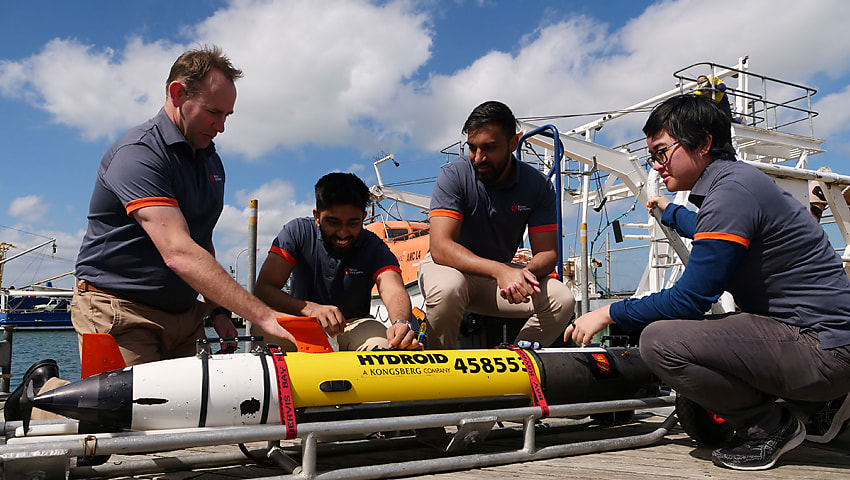
Nova Systems has developed state-of-the-art artificial intelligence (AI) technology designed to analyse sonar imagery from autonomous underwater vehicles and detect previously unseen threats, marking a significant advancement in maritime defence capabilities.
Defence industry stakeholders were given an exclusive preview of the cutting-edge tool as part of Nova Systems’ Test and Evaluation (T&E) Advanced Practitioners Course, delivered in partnership with the Australian Maritime College in Tasmania.
Developed in-house by Nova Systems’ team of expert engineers, the AI-driven system processes sonar imagery collected by autonomous underwater vehicles, identifying and alerting operators to the presence of unknown objects or potential threats.
Nova Systems CEO Dean Rosenfield highlighted how the initiative aligns with Australia’s Sovereign Defence Industrial Priorities under the Defence Industry Development Strategy (DIDS) and supports AUKUS Pillar Two objectives in underwater autonomy.
“Nova Systems has been the leading provider of T&E for 25 years and no one understands the Australian T&E environment better than us,” Rosenfield said.
“As an industry leader, we have a responsibility to stay at the forefront of T&E innovation and best practice. Our investment in AI, synthetics, modelling and simulation aims to accelerate capability development and enhance defence preparedness.”
The DIDS has identified T&E, certification, and systems assurance as one of seven critical Sovereign Defence Industrial Priorities, highlighting a growing shortfall of skilled T&E practitioners – projected to exceed 1,000 by 2030.
Recognising this need, Nova Systems has invested heavily in training initiatives to bolster Australia’s T&E workforce, ensuring defence personnel and industry specialists are equipped with the expertise to deliver world-leading capability. This includes advanced training in digital mission engineering, synthetic environments and assurance methodologies for AI-driven defence technologies.

The advanced T&E course will continue in May, with a focus on testing uncrewed aerial systems, validating modelling and simulation techniques, and applying assurance methods for AI-enabled systems. Australian academic experts have contributed specialised tutorials to support the program, reinforcing Australia’s leadership in defence technology innovation.
Want to see more stories from trusted news sources?
Make Defence Connect a preferred news source on Google.
Click here to add Defence Connect as a preferred news source.