

 iscover
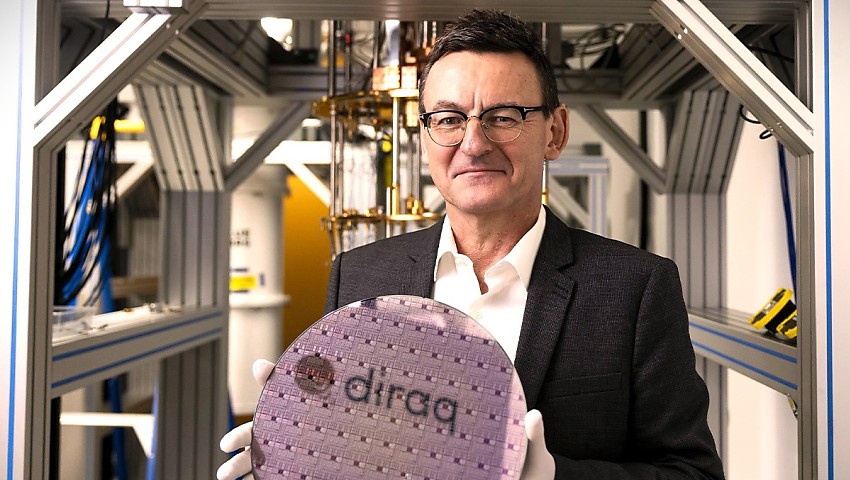
Sydney-based quantum processor company Diraq has been awarded a Stage A contract with the Defense Advanced Research Projects Agency (DARPA) to work on its recently announced Quantum Benchmarking Initiative.
In a bid to fast-track the development of commercially viable quantum computing, the US government is spearheading a new initiative to assess whether an industrially useful quantum computer can be built far more rapidly than previously anticipated.
Dubbed the Quantum Benchmarking Initiative (QBI) Stage A program, the project aims to verify and validate a range of quantum computing methodologies – including the approach championed by Australian-headquartered Diraq.
The company is leveraging silicon spin qubits fabricated using the CMOS manufacturing techniques that underpin today’s computer chips. The initial due diligence will focus on Diraq’s quantum hardware and its strategy to achieve utility-scale operation by 2033 – ensuring that the system’s computational benefits outweigh its construction and operating costs.
The DARPA-led QBI program will scrutinise various proposed system designs and configurations, testing the resilience of each quantum technology concept. The ultimate goal is to pave the way towards constructing the world’s first utility-scale, fault-tolerant quantum computer.
Joe Altepeter, DARPA QBI program manager, said, “We selected these companies for Stage A following a review of their written abstracts and daylong oral presentations before a team of US quantum experts to determine whether their proposed concepts might be able to reach industrial utility.”
Diraq, which recently expanded its operations to the US, is on an upward growth trajectory. The firm is at the forefront of a novel technology aimed at rapidly realising utility-scale quantum operations through silicon quantum dot spin qubits monolithically integrated with classical CMOS electronics.
Andrew Dzurak, chief executive officer and founder of Diraq, said, “Our focus is to design, build and deploy the world’s first truly utility-scale quantum computer. We are honoured to be selected by DARPA and the US government for this emphasis on full-scale, fault-tolerant quantum computing. It’s an exciting opportunity to demonstrate our CMOS quantum dot qubit approach.”

Dzurak continued, “We are harnessing exceptional technical capabilities and extensive experience from our consortium of global partners. With our combined expertise, we believe we can swiftly deliver a commercially viable quantum system that considers capex, equipment footprint, scalability, sustainability and operating costs.”
Diraq is leading a consortium comprising top companies from Australia, the UK and the US, all united in accelerating innovation in qubit fabrication and control systems.
In Australia, Diraq will collaborate with former Microsoft experts – Professor David Reilly and Dr Thomas Ohki – who now operate under the banner of Emergence Quantum. The team will offer specialised expertise in system architecture design, classical cryo-CMOS electronics, and qubit readout and control.
Ohki, co-founder of Emergence Quantum, remarked, “Working on DARPA programs significantly raises the bar, and we are delighted to continue our participation in such pioneering projects alongside Diraq.”
Quantum computers are poised to dramatically speed up discoveries in science and technology, tackling complex challenges from designing new materials for clean energy to accelerating drug discovery and optimising supply chains. Achieving these milestones, however, will depend on the development of advanced techniques such as quantum error correction (QEC).
Riverlane – recognised globally for its QEC technology – is set to bolster Diraq with cutting-edge QEC software and hardware solutions to secure reliable, real-time error correction. Steve Brierley, CEO and founder of Riverlane, said, “Quantum error correction is vital for scaling quantum computing from hundreds of reliable operations to the billions required for commercial applications. We are thrilled to support Diraq and its partners by providing our advanced QEC solutions, which will be instrumental in realising the industrial potential of quantum computing.”
Central to Diraq’s approach is the utilisation of high-volume production capabilities available at advanced semiconductor foundries. These facilities can manufacture silicon quantum chips at scale and integrate them with classical processors housed in compact cryogenic refrigerators.
In addition to its QBI consortium partnerships, Diraq maintains collaborative ties with US chip manufacturing leader Global Foundries and Europe’s Imec – both renowned for their expertise in advanced semiconductor manufacturing and packaging.
Ted Letavic, corporate fellow and senior vice president at Global Foundries, said, “Creating value through transformational technologies is core to our business. We are excited to support Diraq and their partners in the DARPA QBI program. This groundbreaking work will accelerate the transition from the lab to full-scale production for silicon-based quantum and cryo-CMOS control chips using our innovative 22FDX FD-SOI platform.”
Altepeter added, “We’ve built and are expanding our world-class IV&V team of US quantum experts, leveraging federal and state test facilities to separate hype from reality in quantum computing. Our team is eager to scrutinise the commercial concepts, designs, R&D plans, and prototype hardware – all with the goal of helping the US government identify and support efforts that are genuinely advancing toward transformative, fault-tolerant quantum computing.”
The QBI consortium, led by Diraq, sees this initiative as a strategic investment in developing a resilient and commercially sustainable quantum computing technology ecosystem – one that could redefine the future of computing on a global scale.
Want to see more stories from trusted news sources?
Make Defence Connect a preferred news source on Google.
Click here to add Defence Connect as a preferred news source.