

 iscover
The war in Ukraine has rewritten the rules for what near-peer conflict might look like, and those rules are still being written. Here are some of the key takeaways after three years of bitter fighting.
From the prevalence and impact of drones on combat operations to the importance of coordinated long-range fires, the fighting in Ukraine has acted as a wake-up call for militaries around the world, forcing governments to rethink defence strategies and spending priorities.
However, as the fighting continues, lessons continue to be learned as tactics and hardware evolve to meet the demands of a slow-moving, attritional conflict.
A new paper released earlier this year by the Royal United Services Institute, or RUSI, took a deep dive into the tactical and strategic developments of the war’s third year, and some of the trends are well worth contemplating, especially from a local, Australian perspective. Ukraine has a population only a third larger than Australia’s and is facing an adversary with a far larger population and industrial base.
If Australia does ever find itself in a regional conflict, we’re likely to face some similar problems. That said, the geography of the region and Australia’s position in it offers some unique challenges alongside some similarly unique benefits.
Air defence
Throughout the conflict, Russia has targeted Ukrainian infrastructure and civilian population centres behind the front lines. This tactic continues now, and while the damage from long-range drone and cruise missile strikes is relatively light, it does pose a challenge for Ukrainian defenders and their allies.
“The AFRF are also continuing to conduct widespread and regular long-range strikes on Ukrainian training bases, airfields and critical national infrastructure,” RUSI researchers Dr Jack Watling and Nick Reynolds said in their paper, Tactical Developments During the Third Year of the Russo–Ukrainian War.

“This campaign involves a combination of daily strikes using Geran-2 and Gerbera UAVs and periodic ballistic and cruise missile salvos. The campaign inflicts persistent damage but is highly unlikely to prove decisive this winter. Its greatest military impact is fixing Ukrainian air defence across the country and depleting Ukrainian and NATO air defence interceptor stockpiles.”
Given Australia’s far greater size, a similar campaign could be just as effective at fixing and degrading vital air defence assets.
On the front lines, this threat from the air presents a similar dilemma, with question being, as RUSI asked, “should the [Armed Forces of Ukraine] hold and invest in static defensive positions to reduce attrition from FPVs and drone-enabled artillery, or retain mobility to avoid destruction from glide bomb strikes, which have the explosive yield to demolish or bury even well-prepared fortifications?”
Force regeneration
Both sides face significant challenges in terms of unit replenishment but in very different ways. Russia is losing troops far faster due to attritional tactics and the use of poorly trained assault troops to gain tactical advantage for follow-on assault units.
“Russia is anticipated to reduce its recruitment targets for 2025, but is still expected to recruit more personnel than it loses over this period,” RUSI said.
“Russian forces were often suffering more than 200 personnel killed per day during 2024, with over 1,200 casualties per day towards the end of the year. A significant proportion of wounded are returned to service.”
Ukraine, on the other hand, has a far smaller population and is endeavouring to keep its young people away from the fighting. That, combined with front-line casualties, is a true cause for concern.
“In many sectors, the greatest challenge for the AFU is the shortage of combat troops. Although Ukraine is suffering heavy casualties, it does have reserves of manpower that can address this challenge,” RUSI said.
“The biggest problems in achieving this, aside from equipment and armaments shortages, are training, personnel management and morale among troops who have been engaged in heavy fighting for three years and perceive a deteriorating tactical situation.”
In any prolonged conflict, Australia’s armed forces are likely to face a similar challenge. With recruitment already a struggle for the ADF, some means to inspire more Australians to sign up, either for full- or part-time service, is an absolute necessity if the country ever finds itself in any form of prolonged conflict.
Low-tech doesn’t mean low-impact
In a world increasingly dominated by high-tech combat systems, Russia is nonetheless managing to eke out great service from many of its older armaments, many of which date well back to the Soviet era. Perhaps not by choice, but by adding relatively simple guidance packages on munitions that are essentially approaching 70 years of service, Russia has been able to utilise stocks of old bombs as stand-off glide munitions.
“These are predominantly the FAB-500 and FAB-1500 aerial bomb, along with limited numbers of similar munitions of different yields,” RUSI said.
“While these were initially considered individually dangerous but not game changing, or even a sign of Russian desperation, their mass-producibility rapidly proved a key advantage. Due to the strength of Russia’s integrated air defence systems, the VKS has been able to launch glide bombs across the front line with the crewed launch aircraft remaining at a safe distance of between 30 and 90 kilometres, depending on the size and thus the glide efficiency of the bomb.”
The lesson here is twofold. The first is that with some ingenuity, even outdated systems can have a battlefield impact when the conditions are right. But this also illustrates the need to at least contest the airspace, even if outright control may be impossible.
Combined arms matter even for UAV operations
Combined arms is far from a new concept, but adapting that philosophy to the modern, hyper-observable battlefield reinforces the need for rapid doctrinal adaptation.
“Ukrainian officers on multiple axes and from multiple brigades – two of which had exceptionally high rates of efficiency with FPVs – repeatedly reiterated that they needed artillery,” RUSI said.
“They emphasised that UAVs alone were inadequate and that they were most effective when used in combination with artillery. For example, artillery was effective at suppressing or displacing EW and air defences or suppressing infantry protecting key targets from bomber UAVs. Artillery was also able to defend the front in poor weather and was generally more responsive. Combined UAV and artillery operations often maximised the destruction achieved with, for example, an FPV immobilising a vehicle and artillery killing dismounts as they emerged.”
Drones are clearly one of the key game changers on the battlefield, but they cannot be operated in a vacuum. Coordination with all arms is vital to achieve the most effective battlefield outcomes.
The shovel still rules
Despite the prevalence of satellites, drones of all stripes, precision munitions, and EW and cyber warfare, the power of the shovel still holds sway all along the front lines in Ukraine. Despite some initial success with high-speed manoeuvre, Ukrainian soldiers – and their Russian opponents – now find themselves digging bunkers and trench lines, by hand, with gusto.
“Due to the fires threat, excavation equipment is rarely brought closer than 7 kilometres to the front, meaning that most defensive positions must be prepared by hand,” RUSI said.
“For infantry soldiers manually moving large volumes of soil with picks and shovels, the work is arduous and time-consuming. This has resulted in ground combat units often struggling to build adequate defensive structures.”
Both sides use their engineering teams and equipment to build pre-prepared positions in the rear of the line of contact, but where it matters most, hand-dug defences are all soldiers can rely on. This suggests that a modicum of engineering training would be of use to all combatants.
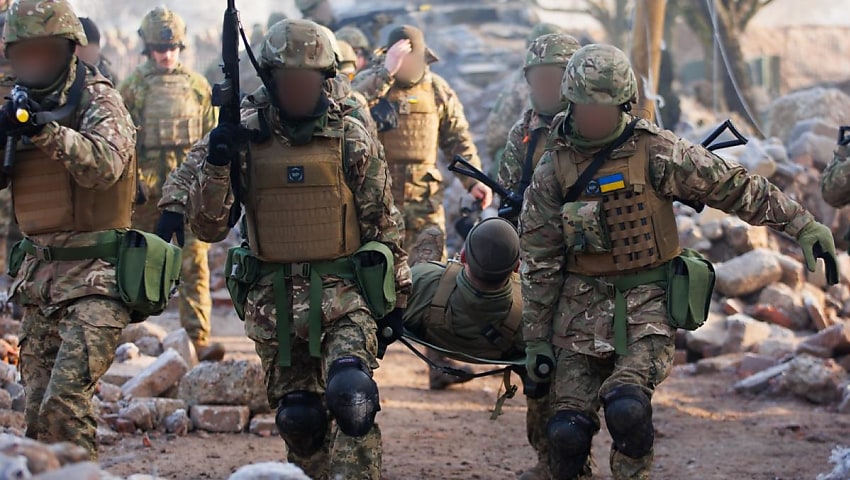
Combat medicine is a challenge
Providing adequate medical support to front-line combatants has been a challenge for centuries, and the fighting in Ukraine is no different.
In this case, however, while modern combat medicine is capable to performing miracles – all you need do is look at the survival rates of American soldiers operating in places like Iraq and Afghanistan – applying that same level of care in a near-peer environment, one that is constantly surveilled and prone to long range fires and drone attacks, is something else again.
This is exacerbated by the necessity of scattering front-line forces to avoid mass casualty events from those same long-range fires.
“First, with a force density of sections covering up to 200 m of front, and individual battalions distributed through 7 km of depth, it is not viable to have medics persistently present on the fighting positions,” RUSI said.
“Second, the distance between fighting positions, and the extent to which the intervening space is covered by precision fires from FPVs, makes it prohibitively dangerous for medics to reach wounded personnel.”
In much the same way that every modern infantry soldier needs to be their own engineering support, they also need to have the skills and equipment necessary to treat both themselves and their comrades while either waiting to be evacuated – an area where wheeled or tracked drones are proving to be an attractive proposition.
Learnings for NATO and allies
The paper ends with recommendations for NATO nations, but these recommendations are valid for any of NATO’s allies, including Australia.
The first is concerning the nature of the peace that must eventually be won, and here the authors insist that support for Ukraine should continue and that any truly sustainable peace must be one where Russia is deterred from any further military adventures. Ukraine must also be allowed to grow its economy without being “coercively suppressed by Russian threats”.
More broadly, however, RUSI has several recommendations for NATO forces.
Airpower matters, and even though Russia’s VKS has hardly covered itself in glory, it has been able to maintain an advantage that has allowed it to shape the aerial battlespace in its favour. Long-range air-to-air munitions are a key element that NATO should focus on, as well as keeping the cost of stand-off strike weapons as low as possible while maintaining stockpiles of both.
“The ability to expand the duration and complexity of long-range strike capabilities is also highly desirable,” RUSI said.
“This means that investing in the production of jet engines, rocket motors and guidance and navigation units in Europe to initially provide to Ukraine’s long-range strike program would subsequently leave Europe with the industrial capabilities to sustain large-scale strike operations against Russian logistics and infrastructure in the event of war.”
Strategies and technologies to counter unmanned aerial systems are also vital, and doctrine and equipment must adapt to a battlefield saturated with drone systems. Remote weapon stations are a key enabler in this area, alongside providing hardware that meets the needs of combatants.
RUSI considers this “an all-arms concern”.
“For infantry, for example, counter-drone nets and other simple stocks should be available alongside traditional stores like corrugated-iron or timber that can be used for augmentations to fortifications,” RUSI said.
The industrial capacity to produce IFVs and APCs needs to be expanded to meet the demands of the modern, highly observable battlefield. Mechanisation of units needs to increase, as does the sustainability of those units. Logistics units, particularly close support units, require increased training with armoured vehicles to improve and secure the supply of vital materiel to front-line combat units.
Similarly, UAV resupply needs to be a consideration, as well as caching and containerisation.
Unsurprisingly, stand-off firepower should be viewed as a priority, and while wire-guided strike drones are an essential development, RUSI believes that investments in drones should not come at the expense of traditional tube artillery. What is actually somewhat surprising is that RUSI also believes NATO countries should rethink their treaty positions on the use of cluster munitions to deploy both anti-personnel and anti-tank mines.
“Without these, they risk lacking both the required lethality to fight effectively and the ability to reduce enemy mobility sufficiently to allow that lethality to be brought to bear,” RUSI said.
“Explosive counter mobility capabilities may be achievable in a manner that is consistent with existing treaty obligations, due to technological advances, though some alterations to treaties to reflect technological advances may also be worth exploring.”
Again, stockpiling specialist munitions and ensuring industry can replace battlefield artillery losses is essential.
The greatest area that needs to be addressed is medical doctrine. Experimentation is required to manage the casualties this form of fighting incurs, from evacuation to targeting medical assets by enemy fires. Adequate medical measures are needed to ensure troop morale, and expectations of what can realistically be achieved must be managed.
“As the character of the threat continues to evolve, it is important that NATO militaries ensure that they are adapting to meet the challenges of tomorrow, rather than perfecting the execution of past doctrine,” RUSI said.
While Australia enjoys many advantages in its own defence – most notably the lack of a land border with any potential aggressor – the need for a doctrinal rethink is clear, and some cases are already underway. Australian investment in uncrewed systems is accelerating alongside the creation of sovereign industrial capabilities.
However, the lessons that NATO needs to take to heart are no less important for our own government and the defence force it is attempting to shape to meet the demands of a modern battlefield.
Want to see more stories from trusted news sources?
Make Defence Connect a preferred news source on Google.
Click here to add Defence Connect as a preferred news source.