

 iscover
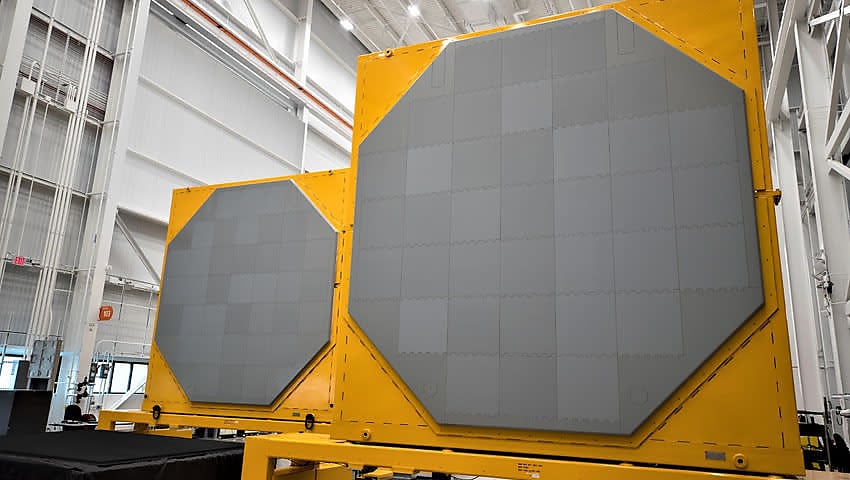
Raytheon has been awarded a US$646 million (approximately AU$975 million) contract by the US Navy to continue production of the cutting-edge AN/SPY-6(V) family of radars.
This marks the fourth production option exercised under a broader March 2022 contract, which is worth up to US$3 billion (AU$4.62 billion) over five years and includes hardware production and sustainment.
The latest contract will see the delivery of four additional SPY-6 radar systems, increasing the total number of units procured to 42.
Barbara Borgonovi, president of naval power at Raytheon, said, “SPY-6 enables the US Navy to see further than they’ve ever seen before, providing sailors with more time to respond to detected threats.”
Behind that capability lies one of the most ambitious radar programs in modern naval history. The SPY-6 family, developed under the Navy’s Air and Missile Defense Radar program, is built around the concept of radar modular assemblies – each one a self-contained radar “building block”. These can be combined to scale the system up or down depending on the ship type and its mission, enabling customisation without redesigning the core technology.
“This latest contract builds on decades of Raytheon’s expertise in developing modular, scalable and highly maintainable radar technologies,” Borgonovi added.
The primary variant, SPY-6(V)1, is set to become the standard radar on Flight III Arleigh Burke Class destroyers, replacing the ageing SPY-1D(V) with significantly improved sensitivity and resolution. Other versions, including SPY-6(V)2 and (V)3, are destined for amphibious assault ships and aircraft carriers, while the smaller SPY-6(V)4 will support frigates and future surface combatants.
The result is a flexible radar architecture capable of handling multiple missions simultaneously, capable of tracking aircraft, cruise missiles, drones, ballistic missiles and surface vessels in one integrated picture, all while withstanding complex electronic warfare environments. For the US Navy, SPY-6 represents not just an upgrade, but a transformational shift in how ships perceive and respond to their surroundings.

Central to the program’s delivery is Raytheon’s Radar Development Facility in Andover, Massachusetts. The 30,000-square foot plant is one of the most sophisticated of its kind, operating around the clock to support a wide range of US and allied radar programs. With high levels of automation and vertical integration, the site enables efficient development, testing and production of these complex systems at scale.
Most of the work under this latest contract will be carried out in Andover, with completion expected by 2028. It is a continuation of the US Navy’s drive to modernise its surface fleet with technologies that are not only powerful, but also easier to maintain and upgrade throughout their service lives.
Want to see more stories from trusted news sources?
Make Defence Connect a preferred news source on Google.
Click here to add Defence Connect as a preferred news source.