

 iscover
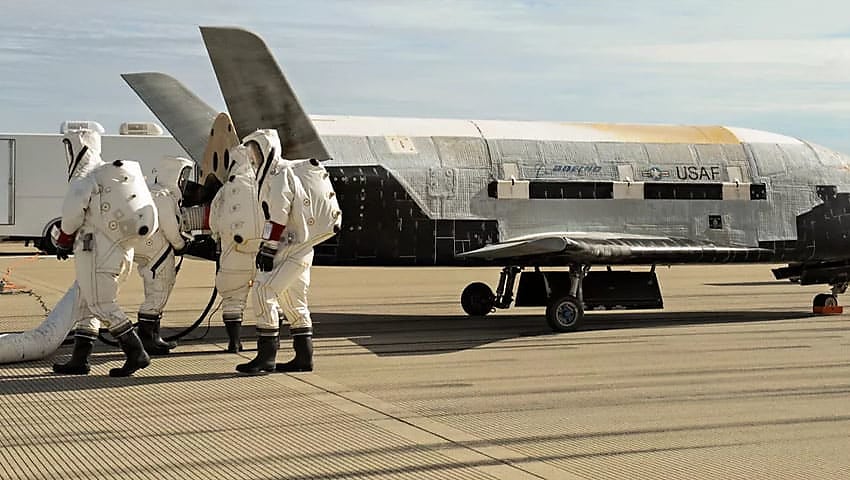
The Boeing-built X-37B Orbital Test Vehicle (OTV) is preparing to lift off on its eighth mission (OTV-8) from Florida’s Space Coast, with launch scheduled no earlier than 21 August.
The mission marks another major milestone for the experimental spaceplane, coming just months after the successful return of OTV-7. Boeing and the United States Space Force are once again teaming up to push the boundaries of space experimentation, with OTV-8 set to carry cutting-edge technologies that could reshape future defence and communications architectures.
“With each successive flight, the X-37B has demonstrated adaptability and flexibility by hosting diverse experiments and pioneering new orbital regimes,” said Michelle Parker, vice president of Boeing space mission systems. “This mission continues that legacy by fielding cutting-edge technologies that advance our nation’s space capability and improve the resilience of future architectures.”
For the second time in its operational history, the spaceplane will fly with an external service module, significantly boosting its experimental payload capacity. Mission partners include the Air Force Research Laboratory and the Defense Innovation Unit, both of which are keen to test new systems in space.
Among the key experiments aboard OTV-8 is a demonstration of high-bandwidth inter-satellite laser communications a major step forward for how future space networks will relay data.
“OTV-8’s laser communications demonstration will mark an important step in the US Space Force’s ability to leverage commercial space networks as part of proliferated, diversified and redundant space architectures,” said US Space Force Chief of Space Operations, General B Chance Saltzman. “It strengthens the resilience, reliability, adaptability and speed of our satellite communications.”
The mission will also host a groundbreaking quantum inertial sensor, the most advanced of its kind to be tested in orbit. Designed to enable precise positioning, navigation and timing in GPS-denied environments, the sensor is seen as a critical enabler for future missions in deep space and the increasingly strategic cis-lunar domain.
“OTV-8’s quantum inertial sensor demonstration is a welcome step forward for the operational resilience of Guardians in space,” said Colonel Ramsey Hom, Commander of Space Delta 9. “Whether navigating beyond Earth orbit or operating in GPS-denied environments, quantum sensing allows for precise navigation when GPS isn’t an option.”

The X-37B – often described as a fusion between a satellite and a reusable spaceplane – has already spent over 4,200 days in orbit since its first launch in April 2010. Operated by the US Space Force and built by Boeing, the uncrewed vehicle is prepped for flight at Boeing’s Kennedy Space Center facility in Florida.
Its longevity, reusability and versatility make the X-37B a key asset in shaping the future of space operations. With global interest in space rapidly growing and competition intensifying, missions like OTV-8 are helping to push the envelope both in terms of technology and strategic advantage.
Want to see more stories from trusted news sources?
Make Defence Connect a preferred news source on Google.
Click here to add Defence Connect as a preferred news source.