

 iscover
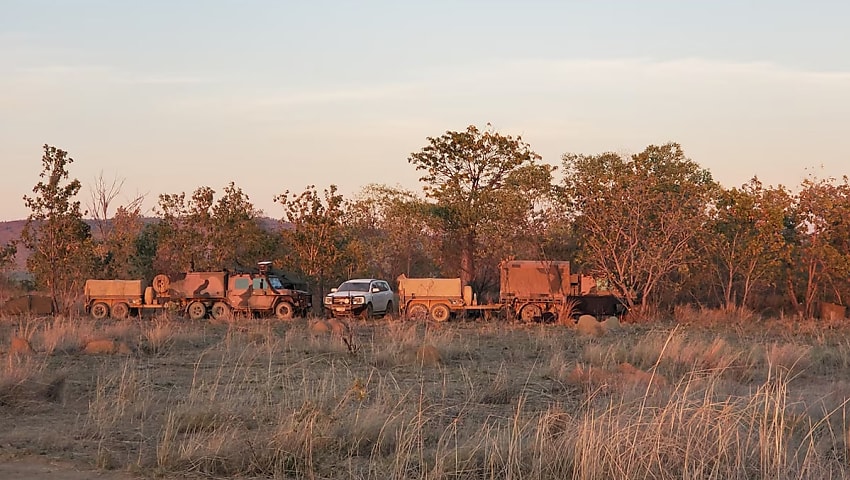
In the remote expanse of Australia’s Top End, far from the buzz of jet engines and bustling airbases, the US and Royal Australian air forces are overseeing a quiet revolution in the future of integrated air warfare.
Amid the dust and scrub of a remote northern airfield, Australian and American air force personnel are demonstrating that command and control (C2) no longer needs to be tied to massive, vulnerable infrastructure or airborne platforms. Now it can be deployed from the ground mobile, agile and mission-ready.
This effort is part of Exercise Talisman Sabre 2025, Australia’s premier joint military exercise, and more specifically under Talon Shield, a US Air Force-led activity focused on integrating deployable command and control elements in contested environments.
Central to the operation is a small, highly specialised team made up of Australia’s 114 Mobile Control and Reporting Unit and the US 552nd Air Control Wing, working together in real time to coordinate air operations across the battlespace.
Using the RAAF’s deployable Bandicoot system – a rapidly deployable, ground-based C2 node – alongside the US Air Force’s experimental Tactical Operations Center-Light, the coalition team is pioneering new ways to command complex air campaigns from austere environments.
These systems allow ground-based controllers to manage aircraft movements, respond to emerging threats and deliver real-time effects across thousands of kilometres.
US Air Force Major Kathryn Martin, the mission’s lead officer working alongside the RAAF from Edinburgh, South Australia, said, “Interoperability at this level isn’t just about technology – it’s about trust, shared processes and being able to operate side by side. This is about proving we can work together seamlessly, even in tough, unpredictable environments.”
The collaboration has seen US air battle managers and weapons controllers embedded directly within Australian teams, performing critical tasks such as threat tracking, aircraft refuelling coordination and missile defence responses.

Lieutenant Kaitlin Volk and Technical Sergeant Peyton Shaffer from the US Air Force’s 752nd Operations Support Squadron were stationed at Bandicoot Node 1, serving and operating alongside seven RAAF colleagues.
LT Volk said, “The lessons we’re learning here will help shape how our forces work together not just in the Indo-Pacific, but globally. This is a rare opportunity to test and refine future systems in a live operational setting."
Meanwhile, from the Australian perspective, the joint environment is building deep operator-level relationships, exemplified by Flight Lieutenant Joshua White, a RAAF air battle manager who detailed the lessons and experience gained, saying, “We often work with Americans during exercises overseas, but having them here, embedded with our team in Australia, really changes the dynamic. It’s been fantastic for interoperability and building genuine working relationships.”
The importance of these efforts is not theoretical, the combined Australian–US team is helping link airborne surveillance platforms like the RC-135 Rivet Joint, Global Hawk drones, and E-7A Wedgetail to ground control systems.
This kind of integration shortens the sensor-to-shooter loop, meaning threats can be identified, tracked and acted upon more quickly – a crucial edge in a fast-moving Indo-Pacific battlespace where hypersonic weapons are increasingly a likely challenge.
RAAF Flight Lieutenant Daniel Hand added, “At the end of the day, it’s about knowing the people you’ll be working with in a real-world situation. We’re not just learning systems; we’re learning each other.”
The exercise, which ran flying operations from 7 to 25 July, focused on distributed and resilient command and control, ensuring that if traditional systems are degraded or denied, coalition forces can still operate, coordinate and strike effectively.
Colonel Kendrick Carroll, Commander of the 552nd Air Control Wing, added, “Exercises like this one give our airmen real-world experience in high-stakes, high-complexity operations. They’re seeing firsthand what it means to work with allies in a live, demanding environment – and they’re thriving.”
Talisman Sabre has long been a testing ground for joint Australian–US operations, but this year’s ground-based C2 integration marks a step change in how future air campaigns could be fought.
In an era where speed, resilience and adaptability are critical, having agile command elements on the ground able to move quickly and operate independently offer a decisive advantage. As regional tensions grow and the pace of potential conflict accelerates, exercises like this are not just about readiness, they’re about shaping how the alliance will fight in the future.
Want to see more stories from trusted news sources?
Make Defence Connect a preferred news source on Google.
Click here to add Defence Connect as a preferred news source.