

 iscover
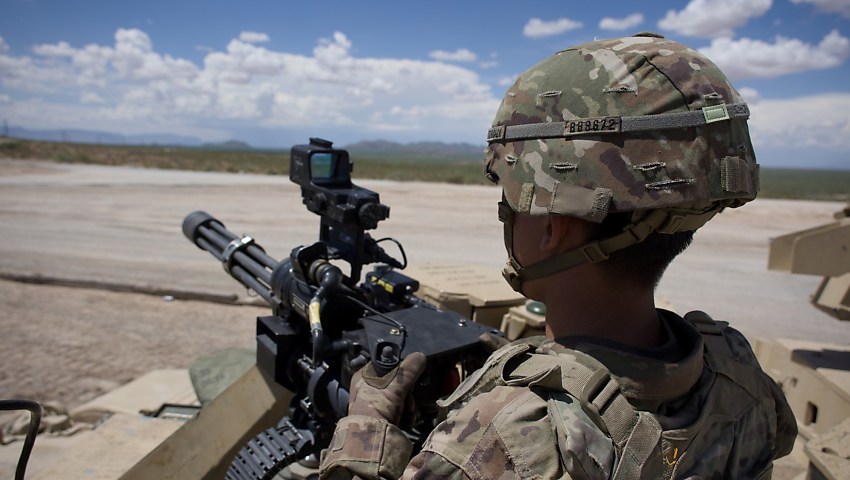
Allied forces could soon be fighting airborne explosive drones with vehicle-mounted miniguns, as the US Army flirts with the “close-quarters” defensive weapon system.
The US Army has recently conducted live-fire testing of M134 miniguns mounted on M1 Abrams main battle tanks at Fort Bliss in Texas in late July this year.
During the testing, tank crews from the US Army’s 1st Armored Brigade Combat Team (1st Armored Division) utilised a roof-mounted and elevation-capable minigun, manually controlled through the commander’s hatch of the tank.
“This cutting-edge integration of high-volume rotary firepower with heavy armour amplifies the brigade’s combat versatility, giving Ready First the tactical edge in close-quarters and complex terrain,” according to a statement published by the 1st Armored Division.
“As the brigade continues to evolve, innovations like this ensure dominance on tomorrow’s battlefield.”
M1A2 Abrams SEPv3 main battle tanks, operated by the US Army and Australian Defence Force, are currently equipped with a remotely operated weapon system, co-axis mounted machinegun and 120mm main cannon.
The firepower upgrade of a manually operated or remote turret 7.62mm M134 minigun would likely replace the current configuration of top-mounted defensive weaponry using a 12.7mm machinegun (Australian Defence Force) or .50 calibre machinegun (US Army).
It’s conceivable that such a weapon system could be used as a basic land version of the common Close-In Weapon System operated aboard naval warships, that rapid firing defensive system is used to create a wall of projectiles to intercept and destroy incoming missiles and other threats in a fixed last-ditch perimeter around the ship.

In their traditional role, miniguns have been used for their suppressive, overwhelming amount of firepower. They have previously been mounted on several US military vehicles, such as AH-1 Cobra attack helicopters, UH-1 Iroquois utility helicopters, US Army Humvees, Light Armored Vehicle – Air Defense (25mm GAU cannon) and the M163 Vulcan Air Defense System (20mm M163 rotary cannon).
In lock-step with the US military, the Australian Defence Force has recently ramped up testing of six-barrel electrically driven rotary guns, with the Australian Army 1st Armoured Regiment testing a M134D minigun mounted on an optionally crewed combat vehicle in August last year.
M113 optionally crewed combat vehicles, remotely operated platforms and an optionally crewed combat vehicle fitted with a remotely controlled minigun were evaluated during a Land Autonomous Systems and teaming demonstration at Puckapunyal military area in Victoria, during September of that year. The demonstration also included an Australian Army Hawkei vehicle fitted with a 30mm remote weapon station, OWL-B loitering munitions and unmanned aerial vehicles.
In addition, the Australian Army’s Combat Experimentation Group recently trialled the use of headset-operated M23D minigun remote weapon stations on M113 armoured personnel carrier during Exercise Talisman Sabre in July this year.
During the trial, B Squadron from 1AR travelled from Adelaide to Townsville to test the modular robotic vehicle (MRV) with remote weapon stations and first-person view drones (FPVD) for the first time in a combat field environment.
The MRV currently uses an M113 armoured personnel carrier as a “test bed”, with 50-calibre machineguns or M23D minigun remote weapon stations attached. The technology allows soldiers to control the vehicle and weapon station using a remote control from up to 1,000 metres away. Similarly, FPVDs are operated using a headset and hand controller.
Members of the regiment also deployed to Shoalwater Bay Training Area during Exercise Talisman Sabre to test uncrewed ground vehicles and hyper teaming drones.
Final thoughts
The benefits of rotary weapon technology, such as the M134 minigun, could provide a much-needed defensive advantage for the modern armour divisions of Western nations at a time when they are under attack from the proliferation of highly mobile, explosive uncrewed aerial vehicles (as seen in the conflict between Ukraine and Russia).
Conversely, it has been speculated that rotary weapon systems can lead to potentially larger maintenance requirements (both in time and more complex parts), potentially heavier use of ammunition and substantial use of onboard batteries (because they are electrically driven) in lengthy firefights, compared to traditional vehicle-mounted machineguns.
Despite these potential downsides, it’s significant that both the Australian Army and the US Army are pushing ahead with experimentation of minigun technology and strategy at the same time and in the same field of armoured warfare.

Want to see more stories from trusted news sources?
Make Defence Connect a preferred news source on Google.
Click here to add Defence Connect as a preferred news source.