

 iscover
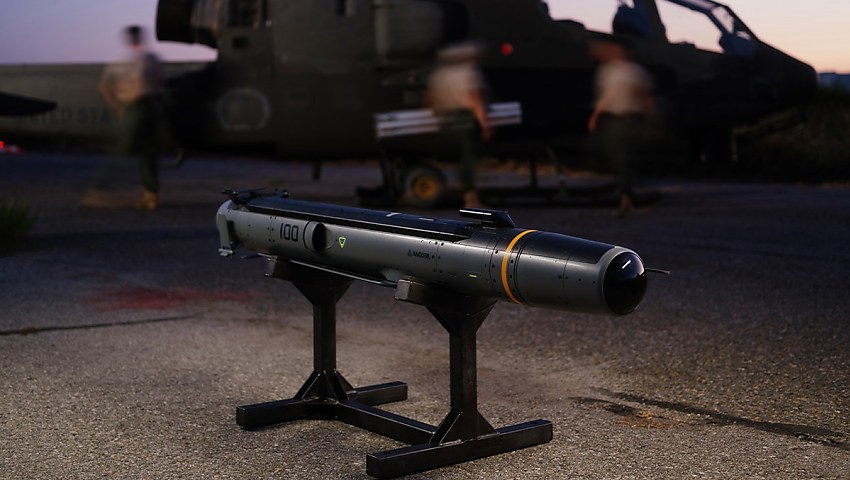
American defence firebrand Anduril says an affordable, mass-producible cruise missile family could plug a growing shortfall in long-range precision fires for the US and its allies, after a recent successful surface launch test of a Barracuda-500 prototype.
In a statement, Anduril stated it has been quietly advancing the Barracuda family of autonomous air vehicles and cruise missiles, with the surface-launched Barracuda-500 successfully completing its first test earlier this year at a US test range.
The trial demonstrated the viability of a launcher and booster kit for surface-launched concepts of operations, the firm said.
The company’s statement said, “The US and our allies are facing a critical gap in long-range precision fires capability. Existing solutions are too expensive, too exquisite and too hard to produce. To deter our adversaries, we need an affordable, mass-producible way to project power at distance – and we need it now.”
The Barracuda family was designed and developed to meet that precise requirement: quantities measured in the thousands rather than hundreds, with platforms that are more producible, flexible and cost-effective than current options.
The developer pointed to earlier demonstrations, including pallet launches for a US Air Force Enterprise Test Vehicle project and lug launches for a US Army high-speed manoeuvrable missile program, as part of the effort to mature the system.
Crucial to the surface-launch approach is a modular booster kit that bolts onto the tail of the Barracuda-500 rather than a full-platform redesign, reflecting the emphasis on scalability, and critically, time-to-capability.
The company said the simple solid rocket motor-powered booster is being built to accept a range of motors from US or allied suppliers, a move, the company said, that will ease supply-chain constraints if quantities scale up, with the statement saying, “Modularity and flexibility are essential characteristics of the Barracuda family of systems.

“Developing our surface-launched Barracuda-500 required relatively minimal changes to the baseline Barracuda platform. We did not conduct a full redesign of the platform to unlock surface launch – the solid rocket motor-powered booster that launches it airborne is a simple kit that attaches to the tail of Barracuda-500,” Anduril’s statement articulated further.
The company added that more than 90 per cent of parts are common across Barracuda-500 variants, enabling the same production lines and technicians to manufacture multiple versions. The company is targeting production rates in the high single-thousands per year by the end of next year, regardless of variant or launch mode.
The developer also emphasised practical integration with existing fielded launch systems. Rather than demanding new infrastructure, the surface-launched Barracuda-500 is being designed to work with launchers already in service, systems such as the High Mobility Artillery Rocket System, Harpoon and Patriot, with the added operational flexibility of having the platform transportable in commercial shipping containers.
Anduril’s statement added, “We’re building that booster kit to be compatible with a range of motors that could be produced by US suppliers or an allied nation’s own industrial base, addressing critical supply chain bottlenecks that could otherwise obstruct large-scale production and rapid fielding.”
The intent, the company said, is to deliver “multi-domain massed effects” without large-scale changes to doctrine, training or logistics.
The firm described the latest test as one step in a broader, internally funded push to mature surface-launched capability ahead of a potential product offering to the services.
“There is much more to come,” the statement said, adding that continued self-funded investment would be used to bring the capability to market for American and allied warfighters.
Want to see more stories from trusted news sources?
Make Defence Connect a preferred news source on Google.
Click here to add Defence Connect as a preferred news source.