

 iscover

Australia’s defence strategy demands mobility, reach, and 24/7 situational awareness. The Gray Eagle Short Takeoff and Landing (STOL) system provides the force-multiplying capability to achieve it.
Australia’s Defence Strategic Review (DSR) 2024 charted a bold course for the Australian Army, demanding a shift in thinking about reach, survivability, and tempo in the nation’s northern approaches. The review outlines a vision of mobile, forward-deployed operations supported by persistent sensing and targeting, long-range fires, resilient communications, and agile logistics. It calls for capabilities that can endure, manoeuvre, fight, and survive across the vast maritime and archipelagic terrain to Australia’s north.
Central to this transformation is the need for littoral manoeuvre, long-range strike, and the integration of advanced airborne systems such as the AH-64E Apache attack helicopter and a new generation of uncrewed aircraft. Yet one critical capability remains absent: a robust, long-range, expeditionary remotely piloted aircraft system (RPAS) capable of connecting and enhancing these concepts in the joint battlespace.
That missing piece exists in the Gray Eagle® STOL system — a combat-proven, networked, and highly versatile uncrewed aircraft from General Atomics Aeronautical Systems, Inc. (GA-ASI) that was designed to excel in those environments where future conflicts are most likely to unfold.
Addressing the DSR Imperatives
The Gray Eagle STOL is uniquely suited to meet the imperatives laid out in the DSR. It combines the range and endurance of a large-class RPAS with the flexibility to operate from short, unprepared surfaces — or even from the decks of Landing Helicopter Dock (LHD) and Landing Platform Dock (LPD) warships. This combination of endurance, mobility, lethality, and a small operational footprint allows the Army to maintain persistent intelligence, surveillance, target acquisition, reconnaissance, and electronic warfare (ISTAREW) coverage in environments that challenge conventional systems or smaller uncrewed aerial systems (UAS).
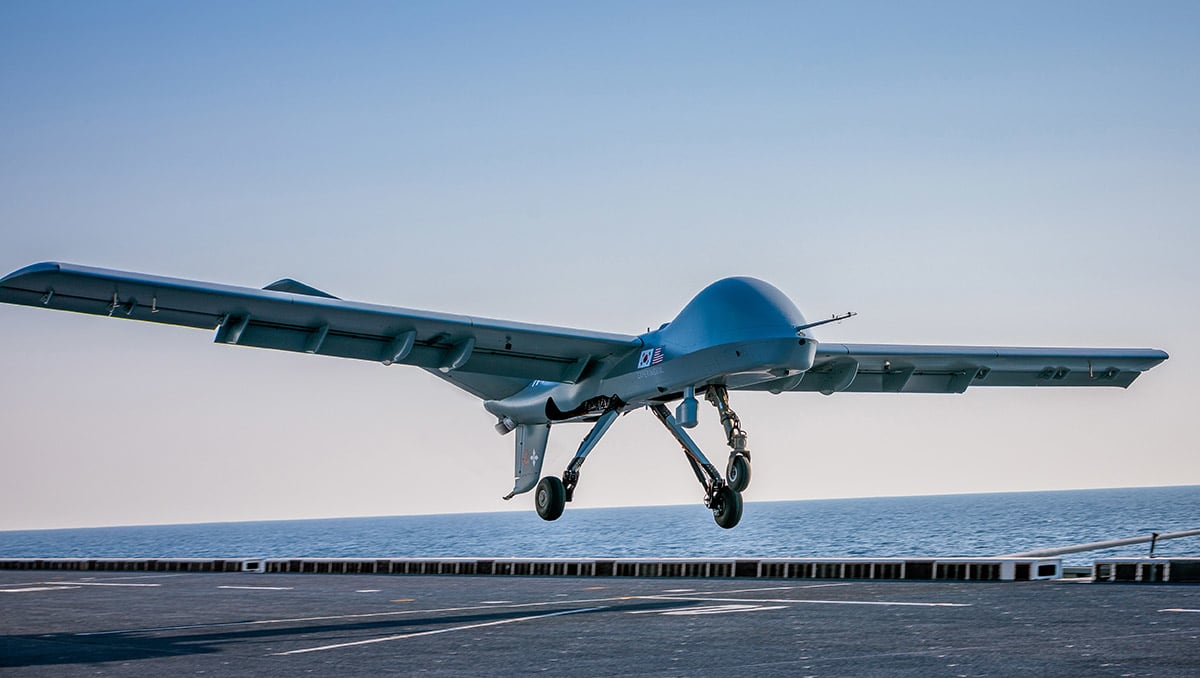
Derived from the U.S. Army’s Gray Eagle Extended Range — a platform with more than one million operational flight hours — the STOL variant retains its advanced sensing, communications, and strike architecture. However, it adds a redesigned wing and undercarriage, enabling safe operation from short or semi-prepared surfaces with minimal support.
Gray Eagle STOL’s automation and low personnel requirements mean that a small, deployed detachment can sustain 24-hour operations with a fraction of the workforce and logistical footprint required by traditional crewed aircraft. Whether launched from a forward island strip, road, field, or amphibious deck, the Gray Eagle STOL can be mission-ready within hours and redeployed just as quickly — precisely the adaptability demanded by a future expeditionary army.
Teaming With Apache
The arrival of the AH-64E Apache attack helicopter represents a generational leap in the Army’s battlefield aviation capability. However, like all crewed platforms, the Apache’s effectiveness and survivability depend on the quality and reach of the information it receives. The Gray Eagle STOL is the ideal teammate for the Apache, enabling seamless crewed-uncrewed teaming through shared data links. This allows for the real-time exchange of video, sensor data, and targeting information, enhancing situational awareness and battlefield effectiveness.
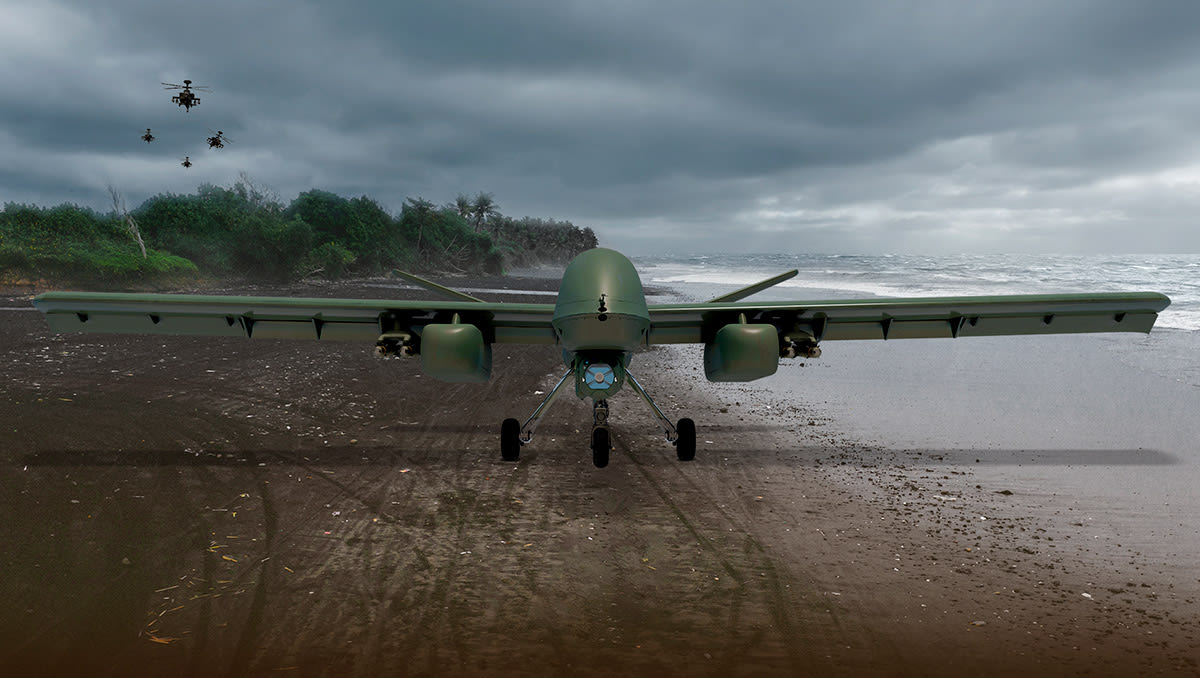
While smaller UAS can perform similar data-sharing functions, the Gray Eagle STOL offers the range, endurance, and ruggedisation necessary to operate across Australia’s expansive northern operating areas. Moreover, it can launch air-launched effects (ALE), including those built by GA-ASI or others — like the Altius-600 or Switchblade 600 — from standoff distances.
These ALEs provide wide-area reconnaissance or decoy support, allowing the Apache to remain concealed for decisive strikes. This division of responsibility enhances the survivability of both systems while protecting Australia’s significant investment in its attack helicopter fleet.
Enabling Long-Range Strike
As the Australian Defence Force (ADF) introduces advanced systems such as the Precision Strike Missile (PrSM), it must also field sensors and networks capable of finding, fixing, and tracking moving adversaries across the region. The Gray Eagle STOL delivers precisely this capability.
Its modular payload architecture supports multi-mode radar for land and maritime search and imaging, communications intelligence (COMINT) and electronic intelligence (ELINT) sensors for signals detection, and advanced electro-optical and infrared systems. These tools provide precision geolocation and targeting in all weather conditions, day or night, at ranges spanning hundreds of kilometres.
While smaller UAS can contribute to local situational awareness, they lack the endurance, payload, and robustness required for cross-region targeting or persistent cueing of long-range strike assets. The Gray Eagle STOL bridges this gap, linking surveillance to strike in a single resilient loop.
Future operations in Australia’s near region will depend on mobility and sustainment across archipelagic terrain. The Gray Eagle STOL’s combination of payload capacity and austere operational capability makes it a natural enabler for littoral manoeuvre and contested logistics. With a payload capacity of up to 1,000 pounds (450 kilograms) in two wing pods, it can deliver ammunition, medical supplies, or critical parts to forward locations without risking crewed aircraft.
Strengthening Regional Cooperation
Australia is not alone in pursuing expeditionary uncrewed systems. Several Indo-Pacific allies are evaluating or adopting Gray Eagle STOL to meet similar needs for persistent ISR, strike, and logistics from dispersed bases. This alignment presents an opportunity for Australia to serve as a regional manufacturing and sustainment hub, supporting allied fleets while strengthening sovereign industry capabilities.
As ADF cooperation with partners deepens under frameworks like AUKUS, shared use of interoperable platforms such as Gray Eagle STOL will multiply collective effects and streamline logistics across joint and coalition operations.
The Australian Army is already well advanced in modernising its aviation and fires capabilities. But to translate these investments into an operational advantage, it must network them through a persistent, expeditionary, and resilient uncrewed system. Gray Eagle STOL is that system.

