

 iscover
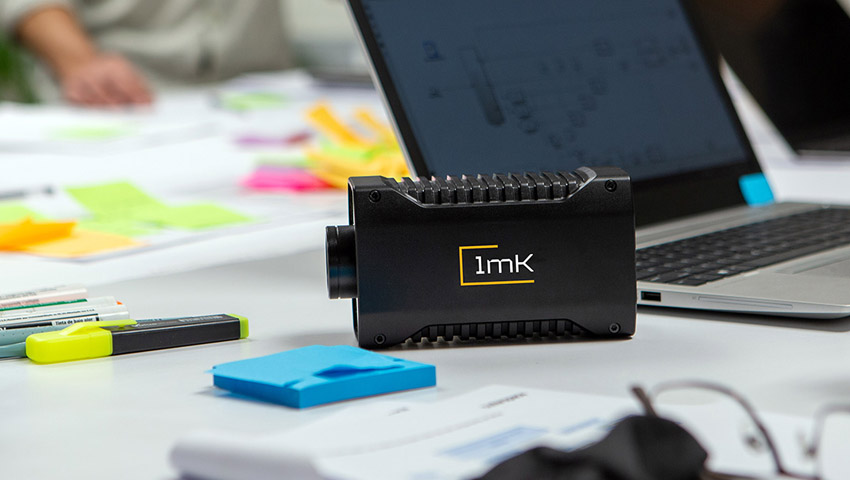
A Victoria-based SME is gearing up for the commercial launch of its new imaging technology, developed with support from the Department of Defence.
Leveraging a grant from the federal government’s Advanced Manufacturing Growth Centre (AMGC), 1 MILLIKELVIN, a subsidiary of LRM Technologies, has developed MiTE (Microbolometer Thermoelastic Evaluation) — an imaging technology designed to identify and measure minute changes in temperature in solid objects.
MiTE can be used to image complex aircraft structures undergoing fatigue testing, and generate highly accurate and detailed full field stress maps.
The system leverages small infrared cameras and sophisticated real-time image and data processing to capture high-resolution close-up images of the object and identify critical stress hot spots.
“As a former salesman for a multinational infrared imaging specialist, I had been aware for some time of this transformative technology under development at Defence – our biggest customer at the time,” Kheang Khauv, managing director at 1 MILLIKELVIN, said.
“After we formed LRM we jumped at the chance to bring MiTE to market. We started collaborating with Defence and our other partners to further develop prototypes for defence, aerospace and commercial application.
“With this grant, we will now be able to accelerate commercialisation and manufacture MiTE for global defence, aerospace and commercial applications.”
According to 1MILLIKELVIN, the imaging technology addresses a wider market need for smaller, cost effective thermoelastic stress measurement offerings by harnessing economies of scale and miniaturisation.

As such, MiTE is expected to be priced between one-fifth and one-tenth of its competitors.
“The MiTE is a prime example of what can be achieved when industry and research collaborate. And in this case, the device joins a long list of defence-derived innovations which have transformed everything from surgery to communications and navigation,” Dr Jens Goennemann, managing director, AMGC, said.
“Of course, invention is not the same as innovation – this requires a team effort to turn R&D into a commercial outcome.
“We are thrilled to support this project, not only with funding, but in providing those invaluable linkages between industry and research organisations to support bringing this revolutionary product to market.”
The AMGC co-funded grant is expected to enable 1 MILLIKELVIN and its partners to develop a mini-format version of 1 MILLIKELVIN’s camera and move the product from Technology Readiness Level (TRL) 3 to 7 resulting in advanced prototypes ready for in-situ testing and certification with defence customers or researchers.
Khauv observed: “Previously to resolve temperature changes of even 20 millikelvin required a big, bulky defence- or scientific-grade machine costing close to a $1 million, which only a scientist could operate.
“This system is much simpler to use, is able to resolve a temperature change of less than 1 millikelvin and could in later stages be deployed in civilian settings.
“Without collaboration we would only ever have a great idea and get nothing done, commercially speaking.”
Khauv concluded: “Our journey has required us making countless contacts, continuing algorithm and software development work with Defence, partnership with Outerspace for industrial design, and university help for validation.”
[Related: UniSA’s new space age technology to enhance defence capability priorities]

Want to see more stories from trusted news sources?
Make Defence Connect a preferred news source on Google.
Click here to add Defence Connect as a preferred news source.