

 iscover



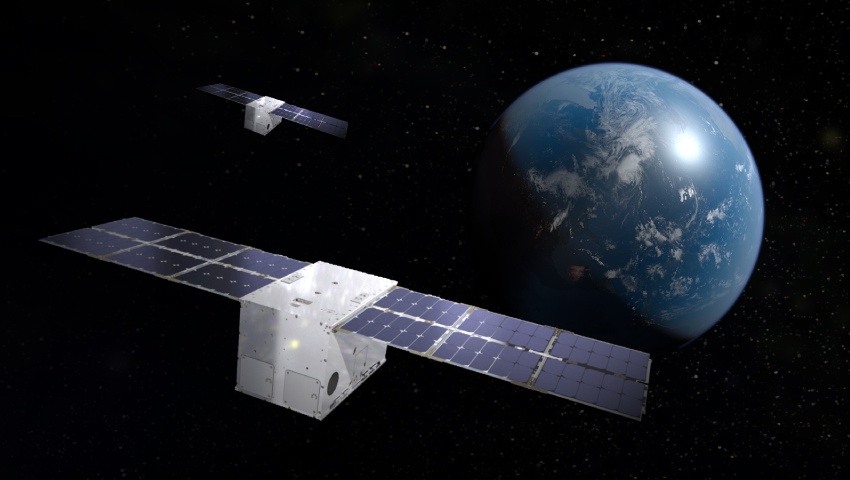
The CubeSats are ready for launch after passing an environmental testing process.
Lockheed Martin’s In-space Upgrade Satellite System (LINUSS) — a pair of LM 50 12U CubeSats designed to sustain critical architectures in geosynchronous Earth orbit (GEO) — has completed environmental testing ahead of a launch later this year.
Specifically, LINUSS will be used to validate essential manoeuvring capabilities for Lockheed Martin’s future space upgrade and servicing missions, while also demonstrating new technologies, including:
- onboard high-performance processing developed by Innoflight;
- low-toxicity propulsion developed by VACCO; and
- inertial measurement units, machine vision, 3-D printed components and SmartSat (transformational on-orbit software upgrade architecture) technologies developed by Lockheed Martin.
“Space is a dynamic domain and our customers are demanding the ability to rapidly upgrade spacecraft on orbit – to provide greater capabilities and more mission flexibility,” Chris Crawford, vice president of advanced program development for Lockheed Martin Military Space, said.
“LINUSS will be the first step flight-qualifying this technology. The ultimate near-term goal is supporting upgradeable LM 2100 satellite bus platforms, starting with GPS IIIF Space Vehicle 13.”
LINUSS is the collaborative integration of Lockheed Martin’s mission electro-optical payload deck with a 12U bus from Tyvak Nano-Satellite Systems, a Terran Orbital Company.
“Given we are well known for our systems integration work on large satellite systems, some people are surprised to learn Lockheed Martin has launched over 150 small satellites since 1997,” Dr David Barnhart, LINUSS program director, observed.
“LINUSS has higher bus density, payload accommodation, and on-orbit processing than any other CubeSat, enabling revolutionary mission capabilities in the future.”
In addition to the LINUSS project, Lockheed Martin’s smallsat projects include DARPA’s Mandrake, integration for DARPA’s Blackjack constellation, Pony Express, LunIR and La Jument.
The company has also supported the development of a 6U nanosat with GomSpace and Orbital Microsystems, as well as the UK’s endeavour to launch smallsats through the UK Spaceflight Programme.
[Related: Lockheed Martin launches new spacecraft manufacturing centre]

Want to see more stories from trusted news sources?
Make Defence Connect a preferred news source on Google.
Click here to add Defence Connect as a preferred news source.