

 iscover
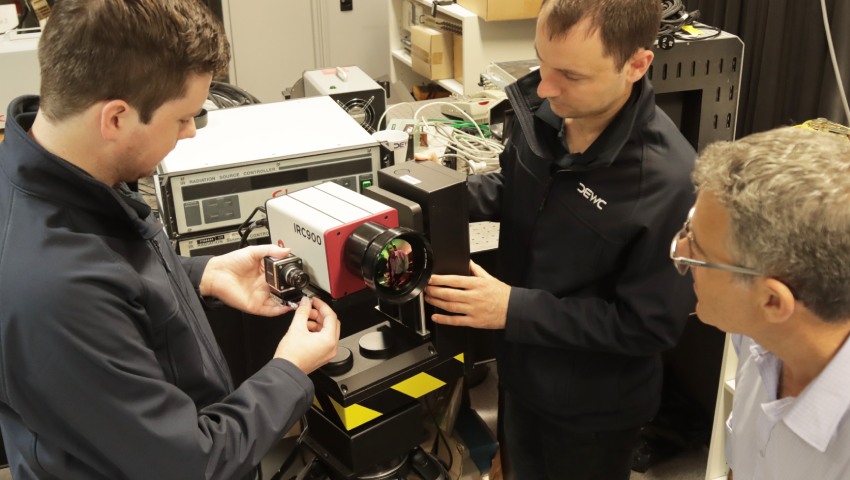
A strategic partnership has been established to support the development of advanced infrared camera capability for defence applications.
Defence Science and Technology Group (DSTG) and DEWC Services have teamed up to jointly develop a new infrared (IR) camera capability into field trials for electro-optic (EO) countermeasures.
As part of the collaboration, referred to as the ‘IIR Surrogate project’, representatives from the Electronic Warfare Operations (EWO) branch at DSTG will work alongside graduate engineers from DEWC Services, leveraging its experience providing EW and ISR operation and technical services to the ADF and defence industry.
“The ultimate aim is to build a sovereign EW capability within industry,” Dr Miro Dubovinsky from the DSTG said.
“The IIR surrogate project will contribute to this by developing a ground-based dual-band imager capability for detecting and tracking aircraft via their emissions in the infrared and visible spectrum.
“The effectiveness of electro-optic (EO) countermeasures designed to disrupt imager tracking can then be assessed during countermeasures field trials."
Specifically, the project will involve the assessment of pre-existing IR camera software, which could form the basis for integrating a next-generation camera into the system for future EO countermeasures trials.
The capability is also expected to incorporate a standard camera for visible tracking of platforms and dispensable countermeasures during trials.

The sensor is built with a 640 x 512-pixel focal plane array sensitive to the mid-wave IR spectrum.
Efisio Mancini, discipline leader for Electro-Optical Sensors and Systems at DSTG, has tasked the DEWC Services graduate engineers with building a custom software application to interface with the new camera to acquire image data.
“They conducted an initial assessment of the existing camera and its software to gain an understanding of how the code has been implemented,” Mancini said.
“The documented code highlighted areas for potential improvement. In fact, they have now begun applying that knowledge to develop interfacing and tracking software for the new camera.
“Tracking is done via a Simulink model that follows a four-step process: detection of objects, associating objects with a track index, tracking of an object, and track logic of a primary track for guidance. The model has a similar structure for both the visible and infrared tracking.”
DEWC Services CEO Allan Dundas said the IIR surrogate project would provide graduate engineers with an opportunity to contribute to the advancement of warfighter survivability.
“When our graduates get to go to DSTG and have hands-on experience in the countermeasures domain, they carry out work alongside highly experienced defence scientists and get further mentoring,” Dundas commented.
“We are turning these graduate engineers into passionate EW practitioners and ultimately helping the Australian Defence Force address the skills shortage.
“This is what our company is passionate about, using its EW expertise to support the ADF and ensure that those who put their lives at risk will have the best chance of success and returning home safely.”
[Related: DEWC, AIML partner on AI and machine learning to enhance RF signal detection]

Want to see more stories from trusted news sources?
Make Defence Connect a preferred news source on Google.
Click here to add Defence Connect as a preferred news source.