

 iscover
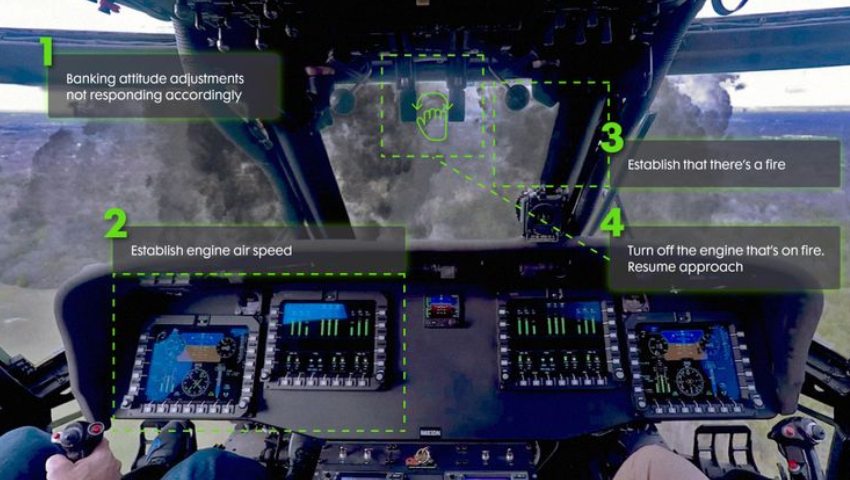
The defence R&D agency has tasked the prime with developing cutting-edge AI technology to assist with pilot training.
Northrop Grumman has been tapped to support the Defense Advanced Research Projects Agency’s (DARPA) Perceptually-enabled Task Guidance (PTG) program, winning a contract to develop a prototype artificial intelligence (AI) assistant.
Once delivered, the prototype will be embedded in an augmented reality (AR) headset designed to help rotary pilots perform “expected and unexpected tasks”.
Specifically, Northrop Grumman is expected to partner with the University of Central Florida (UCF) to develop an Operator and Context Adaptive Reasoning Intuitive Assistant (OCARINA), built to support UH-60 Blackhawk pilots flying with both visual and instrumented flight adjusted according to environmental conditions.
“The goal of this prototype is to broaden a pilot’s skillset,” Erin Cherry, senior autonomy program manager, Northrop Grumman, said.
“It will help teach new tasks, aide in the recognition and reduction of errors, improve task completion time, and most importantly, help to prevent catastrophic events.”
Overall, the project aims to overcome the limitations of warning systems, which can induce “unanticipated cognitive burdens” on pilots.
DARPA’s PTG program could instead produce AI technologies to provide users of PTG AI assistants with wearable sensors.

The AI assistant could then provide feedback and guidance through speech and aligned graphics to augment the aircrew.
[Related: Northrop Grumman deploys next-gen autonomous helicopter]

Want to see more stories from trusted news sources?
Make Defence Connect a preferred news source on Google.
Click here to add Defence Connect as a preferred news source.