

 iscover
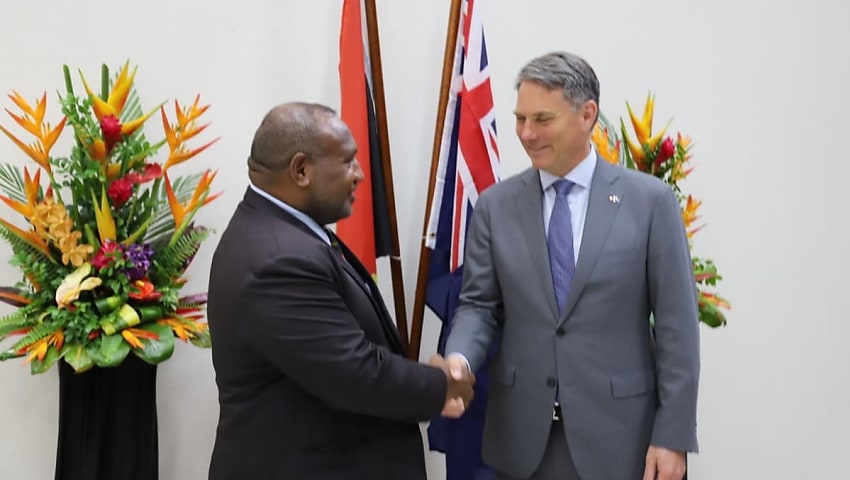
The nations are laying the groundwork for a new security partnership amid growing instability in the region.
Deputy Prime Minister and Minister for Defence Richard Marles has met with Papua New Guinea (PNG) Prime Minister James Marape in Port Moresby to discuss opportunities for greater bilateral cooperation.
This included exploring the potential for a new security treaty, aimed at ramping up defence collaboration.
“We’ve been talking a lot about how at a defence level we can do more together, have more coordination, have our servicemen and women working alongside each other more in the spirit of partnership,” Deputy Prime Minister Marles said.
“We’re looking at ways in which we can support that, at a policing level as well, looking at a bilateral security treaty so that we elevate the arrangements between our two countries to the status of a treaty document between our two nations.”
The agreement would reportedly include increasing investment in PNG’s military to fill “capability gaps”.
The deputy prime minister said the Albanese government would look to cement a commitment to enhance defence ties “as quickly as possible”.
He went on to stress the mutual benefits of a prospective agreement.

“One of the points that we seek to make here is that this is very much an equal relationship where there's as much for Australia to gain in this as there is in supporting PNG in building its capability [and] we think defence is a really critical way in which we can do that,” he said.
“So, we will work as quickly as we can to pursuing our agreements with PNG in relation to defence. It matters to get those documents, right, what really matters is to get the substance to those documents happening as well.”
This push comes amid growing instability in the region, with Beijing looking to establish its own foothold in the region.
China recently struck a security deal with the Solomon Islands, which reportedly includes Chinese commitments to deploy “police, armed police, military personnel and other law enforcement and armed forces” personnel to the Solomon Islands.
This would build on existing security ties between the nations, with China recently sending liaison officers and anti-riot equipment to train the Royal Solomon Islands Police Force in public order.
The security agreement also reportedly provides China with greater maritime access to the island nation by facilitating, with the consent of the government, ship visits, logistical support and stopovers.
China’s Foreign Minister, Wang Yi, had also proposed the “China-Pacific Island Countries Common Development Vision”, which offered intermediate and high-level police training for Samoa, Tonga, Fiji, Kiribati, Papua New Guinea, Solomon Islands, the Cook Islands, Niue, Vanuatu, and the Federated States of Micronesia (FSM).
This was accompanied by a five-year action plan, which calls for ministerial dialogue on law enforcement capacity and police cooperation.
This included the provision of forensic laboratories, cooperation on data networks, cyber security, and smart customs systems.
The plan also advocated for a “balanced approach” on technological progress, economic development and national security — backing a China-Pacific Islands free trade area and joint action on climate change and health.
However, Beijing reportedly withdrew its proposal after it was met with resistance from some Pacific Islands leaders.
[Related: ADF maritime task unit kicks off Indo-Pacific Endeavour 2022 from Darwin]

Want to see more stories from trusted news sources?
Make Defence Connect a preferred news source on Google.
Click here to add Defence Connect as a preferred news source.