

 iscover






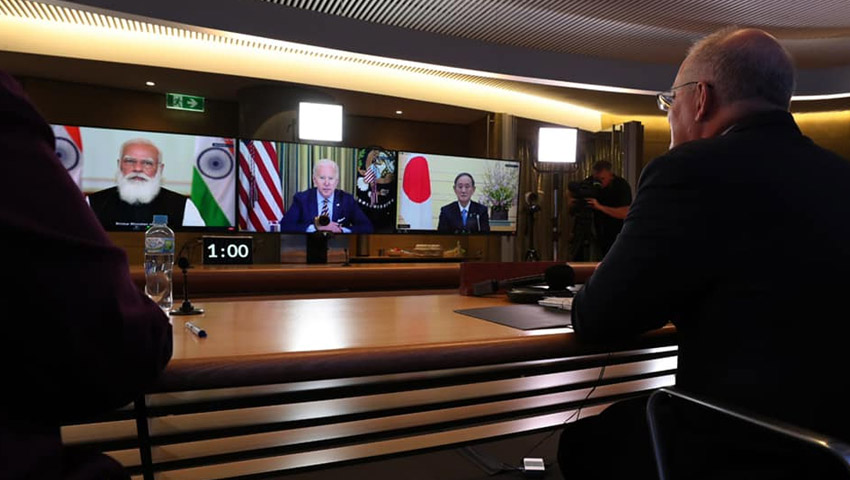
Creating a unified space policy among the Quad to dominate space-based ISR and SATCOM capabilities.
Australia and its allies must invest in a robust and forward-looking space program. Everyone seems to be acutely aware that satellites are a critical military tool for intelligence, surveillance and reconnaissance (ISR) – whether using typical electro-optical imagery or SARs – as well as providing communications services to rapidly transfer information and data to link ground, air and maritime units on the battlefield. So, why has Australia been so sluggish to grasp this necessary technology?
Sadly, ASPI’s Malcolm Davis noted this week in The Strategist that space didn’t warrant a mention at the inaugural Quad summit between Australia, the US, India and Japan.
This is a striking insight since NASA, JAXA (Japan Aerospace Exploration Agency) and the Indian Space Research Organisation (ISRO) are three of the world’s leading space agencies. One would assume that the Quad could identify economies of scale between the four space agencies and their robust space industries to overcome the tightened purse strings of government space investment. While there have been several agreements between these four nations over the recent months, it is an oversight to not have a unified approach to seek the domination of space ISR and communications opportunities.
Moreover, the ISRO’s low cost launch program could provide an avenue for cheap and impactful launch alternatives to bolster Australia's nascent sovereign launch capability. While a sovereign launch capability must be a paramount policy objective for Australia, the ISRO can provide a stop gap for the ADF to broaden the ISR and SATCOM capabilities while mitigating its overreliance on commercial providers.
Davis notes that the first step should be for the Quad to support the UK’s UN Resolution 75/36, which “seeks to establish new ‘norms, rules and principles of responsible behaviours’” in light of the growth of anti-satellite weapons systems among potentially hostile actors. To combat the growth of these weapons systems, a unified global framework would place pressure on nations developing anti-satellite capabilities to position them into a legal and ethical use of space. Davis notes that this should also be supported with greater levels of "space resilience", such as enhanced space domain awareness capabilities to monitor and track space movements.
Davis concludes by noting that “it’s time to expand these efforts by considering how Australia, Japan, India and the US can engage in closer co-operation on and around the moon. Establishing a regular dialogue on space cooperation would chart a path for the Quad to the moon, Mars and beyond in coming decades”.
Indeed, information and capability sharing across the Quad will provide untold ISR and SATCOM capabilities for the four nations and develop a deterrent for the use of ASAT weapons systems. Australia should hope that a unified space policy is discussed at the next Quad meeting, which will have overwhelming military and economic benefits to Australia.
Get involved with the discussion and let us know your thoughts on Australia's future role and position in the Indo-Pacific region and what you would like to see from Australia's political leaders in terms of partisan and bipartisan agenda setting in the comments section below, or get in touch with

Want to see more stories from trusted news sources?
Make Defence Connect a preferred news source on Google.
Click here to add Defence Connect as a preferred news source.