

 iscover
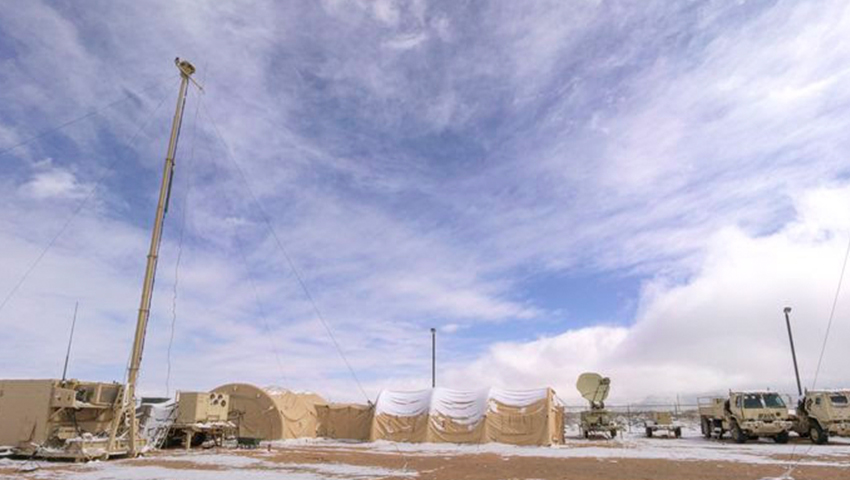
The scalability and resilience of the prime’s command system has been put to the test during US Army trials.
Northrop Grumman has confirmed its Integrated Battle Command System (IBCS) has completed two US Army flight tests, aimed at demonstrating the system’s scalability and resilience for all-domain command and control operations.
The testing activities were conducted at White Sands Missile Range, New Mexico, leveraging operationally realistic scenarios with soldiers of the US Army 3rd Battalion, 43rd Air Defense Artillery (ADA) Regiment.
As part of the first flight test, the US Army leveraged the IBCS to intercept a high-performance, high-speed tactical ballistic missile (TBM) target, supported by Northrop Grumman’s Joint Tactical Ground Station (JTAGS), which delivered space-based sensor data for early warning of an inbound TBM launch.
According to the prime, the IBCS established a track from the JTAGS data before ground-based sensors detected the target.
The second flight test tested the ability of the IBCS to defeat two cruise missile targets in a stressing electronic attack environment.
IBCS reportedly maintained continuous track custody of the targets by fusing data from multiple sensors degraded by electronic attack.
The tests formed part of the Initial Operational Test and Evaluation (IOT&E) of IBCS, which involves the evaluation of the system’s performance prior to deployment and full-rate production.

“We continue to demonstrate our architecture’s power to leverage information from every domain, delivering unprecedented situational awareness and increased time and options to warfighters,” Christine Harbison, vice president and general manager, combat systems and mission readiness at Northrop Grumman, said.
“IBCS’s maturity and ability to connect legacy systems significantly helps to expand their mission capability.”
IBCS is billed as an open, modular and scalable architecture, designed to integrate all available assets in the battlespace, regardless of source, service or domain.
[Related: Northrop Grumman ferries Japan’s first Global Hawk]

Want to see more stories from trusted news sources?
Make Defence Connect a preferred news source on Google.
Click here to add Defence Connect as a preferred news source.