

 iscover



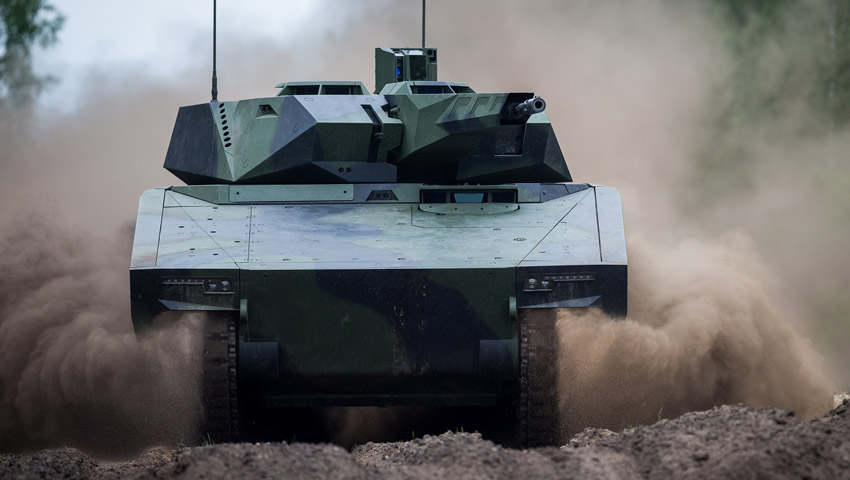
The prime has secured a $220 million contract to integrate its active protection system in a fleet of Lynx IFVs.
Hungary has awarded a €140 million ($220 million) contract to Rheinmetall for the delivery of its StrikeShield hard-kill active protection system (APS) to support 209 new Lynx infantry fighting vehicles (IFVs) ordered late last year.
The protection system, which will be provided by Rheinmetall Protection Systems, is built to withstand threats from anti-tank weapon systems.
The technology leverages sensors and countermeasures integrated into the contours of the entire vehicle, designed to protect the vehicle from shaped charge warhead threats such as rockets or missiles, “neutralising” incoming projectiles before they hit the platform.
StrikeShield features spaced passive armour tiles, which incorporate the components of the APS between an outer ply and inner tiles mounted on the vehicle’s hull.
“We see huge benefits from hybrid designs,” Dr Manfred Salk, CEO of Rheinmetall Protection Systems said.
“The effects that passive armour protects you from are standardised and well understood. Hybrid designs are different. They allow us to do a much better job of dealing with new effects and threats, such as residual energy from a disabled rocket hitting the vehicle and deflagrating.
“The combination of our passive and active technologies into hybrid systems therefore offer our customers unique benefits with regard to the protection capability, but also weight- and cost-efficiency.”
[Related: Rheinmetall, Thales tapped for C-130J program]

Want to see more stories from trusted news sources?
Make Defence Connect a preferred news source on Google.
Click here to add Defence Connect as a preferred news source.