

 iscover
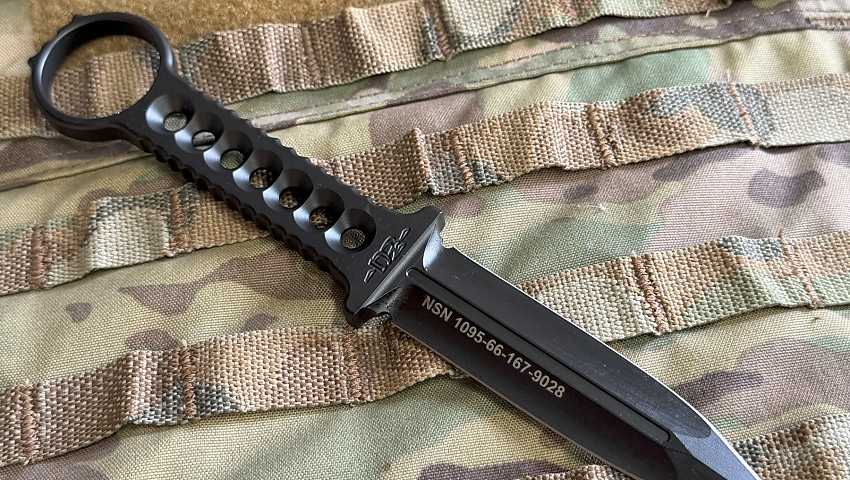
Zu Bladeworx Australia has confirmed the successful rolling out of the Hand-to-Hand Fighting Weapons System to the Australian Defence Force under the LAND 300 Lethality Project.
The defence contractor, manufacturing the H2HFW (Nomad Mk4) Knife for the Australian Army and the Commonwealth of Australia, is contracted by NIOA to complete the delivery under the Commonwealth Land 159 Lethality Program.
Zu Bladeworx has also completed a battalion level contract for 1RAR and the School of Infantry.
“After working on this product for the last three years, it is fantastic to see the knives making their way to the end user, Australian warfighters,” Bladeworx founder Matt Lucarnus said.
“It has been a long road for us, in addition to manufacturing the knives, we have also worked with NIOA and the Commonwealth to manage the quality assurance, codification, distribution and final acceptance of the pieces.
“It fills us with immense pride to see something that we have created with great care being issued to our soldiers. Our soldiers will now have access to a true Australian-made tertiary weapon system that they can depend on.”
Lucarnus confirmed the weapon system has a number of innovative features, such as a ring to allow the user to retain the knife if their hand is open.
“The product will perform exceptionally well and is 100 per cent fit for purpose. From what I understand, ADF personnel have begun adapting their training to focus on close quarter combat and light weight, high speed work,” he said.

“The H2HFW is a lightweight, high-performance knife designed around the needs of the modern soldier. It is also highly robust, as it is manufactured using technology seen in aerospace and high-performance car manufacturing. This process is known as billet machining where a block of material is machined to remove all the material that is not required, leaving a solid single piece of steel that includes the blade and handle, which is quite a unique way of making knives.
“An example of this manufacturing is seen in race car engines where the camshafts are billet machined to make a stronger camshaft. After machining, the H2HFW is hardened in a furnace to 970 degrees C and then double tempered. Following that it is coated in a ceramic coating normally reserved for firearms (Cerakote). The final process is individual sharpening on custom knife grinding machines. All these processes are completed in Queensland.”
The Capability Acquisition and Sustainment Group, Army, and NIOA have successfully collaborated to achieve rollout for the Hand-to-Hand Fighting Weapons System under the LAND 300 Lethality Project, according to NIOA, and these systems will now be deployed to user units.
“At present, our focus is on production for the ADF. We are three years into the LAND 300 contract, which is still ongoing, however, we are exploring export opportunities,” Lucarnus said.
“We are in early discussions with key stakeholders from a few Australian allied countries and have initial fact-finding meetings booked with them for later in the year in Dubai.”

Want to see more stories from trusted news sources?
Make Defence Connect a preferred news source on Google.
Click here to add Defence Connect as a preferred news source.