

 iscover
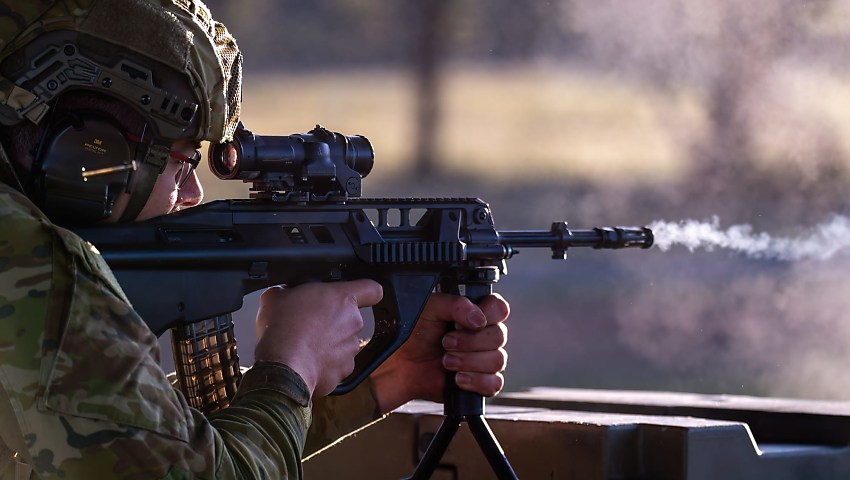
A race is brewing behind closed doors as the Australian Defence Force searches for its next service rifle before the tried-and-true Enhanced F-88 Austeyr rifle approaches its planned withdrawal mid next decade.
While contracts have not been formalised, Australian leadership has confirmed interest in moving close combatant personnel to an up-gunned 6.8mm weapon system and ammunition during an Australian Army Land Environment Working Group meeting in June this year.
It’s understood that support personnel would remain with the 5.56mm NATO ammunition they currently use, potentially utilising a new Armalite Rifle style standard configuration design.
The current EF88 rifle, chambered in 5.56mm NATO, is approaching a decade of service with the ADF since it was rolled out in mid-2016. The iconic bullpup-style rifle, with a 30-round magazine, is currently manufactured in Lithgow, NSW, by Thales Australia.
It’s speculated that Thales Australia could potentially contend for a future 6.8mm contract with a system of their own, possibly based on their standard configuration platform, the Australian Combat Assault Rifle (ACAR). The ACAR has allegedly already seen testing by members of the Australian Federal Police and the ADF’s 2nd Commando Regiment.
Thales neither confirmed nor denied the speculation.
There is already considerable momentum for Australian troops to move to a 6.8mm calibre rifle with the United States military currently transitioning the US Army to their new 6.8mm M7 rifle, produced by SIG Sauer. Such a rifle would almost certainly be considered a contender for any future rifle contract with the ADF, due to interoperability and joint force compatibility as well as historical preference for US-adopted military systems.
Victorian defence company Aquaterro, which supplies SIG Sauer products in Australia, confirmed its interest in entering the race to find the next ADF service rifle.

“Aquaterro, as an existing supplier of SIG Sauer platforms, optics and ammunition to the Australian Defence Force, is keen to offer the M7 rifle in 6.8x51mm as the close combatant rifle,” said Greg Knowles, Aquaterro director of defence and strategic programs.
“Manufacture of M7 rifles and the associated common cartridge case/hybrid cartridge case ammunition in Australia is absolutely feasible.
“The common cartridge case/hybrid cartridge case, regardless of calibre, is central to outperforming legacy brass cartridges. Hybrid ammunition, a brass cartridge with a steel case head, allows the safe function of ammunition at operating pressures over 30 per cent higher than legacy.
“These higher pressures deliver greater kinetic energy, with a flatter trajectories, from shorter barrels than what legacy ammunition and weapons can deliver, enabling the 6.8mm projectile to defeat body armour, protected mobility vehicles and the reduction of cover.”
In addition, it’s speculated that those changes may provide Australian soldiers an advantage with higher impact against near peer soldiers equipped with body armour and possibly effectiveness against lightly armoured vehicles.
There has been widespread uptake of conventional rifle designs, like the AR-15, with international military partners such as the United Kingdom, Ukraine and Sweden. Within Australia there are already several domestic manufacturers, such as NSW firearms manufacturer Oceania Precision and its 6.8mm OP25 rifle, moving to standard configuration AR style designs.
Oceania Precision managing director Jeffrey Bacon confirmed there is a tangible advantage to using 6.8mm rounds in a standard configuration rifle, such as the 6.8mm OP25 or in a 7.62mm OP25.
“This particular rifle runs our proprietary incline radial locking bolt, which allows us to chamber 6.8mm in an AR10 or an AR308 platform,” he said.
“We are looking at around about a 40 percent increase in pressure from 7.62mm, which give you an increase in velocity and thus, more energy on target.”
When questioned about replacing the ADF’s current service rifle, the Department of Defence confirmed it meets current requirements.
“The EF-88 is a highly effective weapon that meets the Australian Defence Force’s requirements,” a Defence spokesperson said.
“The weapon has demonstrated reliability in challenging operating environments, including littoral environments, through extensive training and exercises within Australia and the Indo-Pacific.
“Compared to the F88 Austeyr, the EF-88 improves close combat and general combat capability due to its accuracy and lethality, improved ergonomics, balance and increased mounting options for ancillary devices.
“The EF-88 is manufactured in Lithgow, New South Wales, by Thales Australia.”

Want to see more stories from trusted news sources?
Make Defence Connect a preferred news source on Google.
Click here to add Defence Connect as a preferred news source.